White grouper
Epinephelus aeneus · Serranidae
- Saltwater
- Coastal
- Medium
- Size
60–120 cm
- Weight
2.9–25 kg
- Depth
20–200 m
Where to fish
- Estuary
- Reef
- Rocky shore
Habitat icons: Flaticon
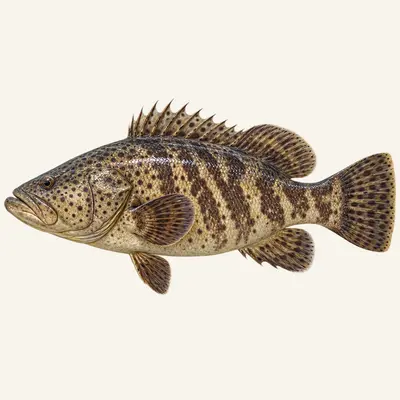
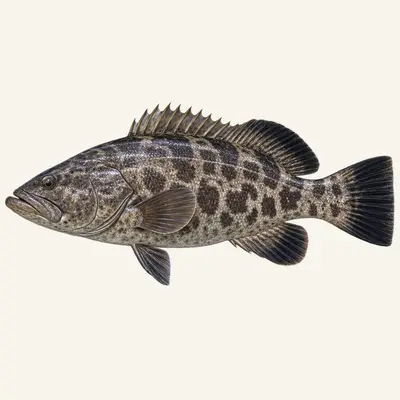
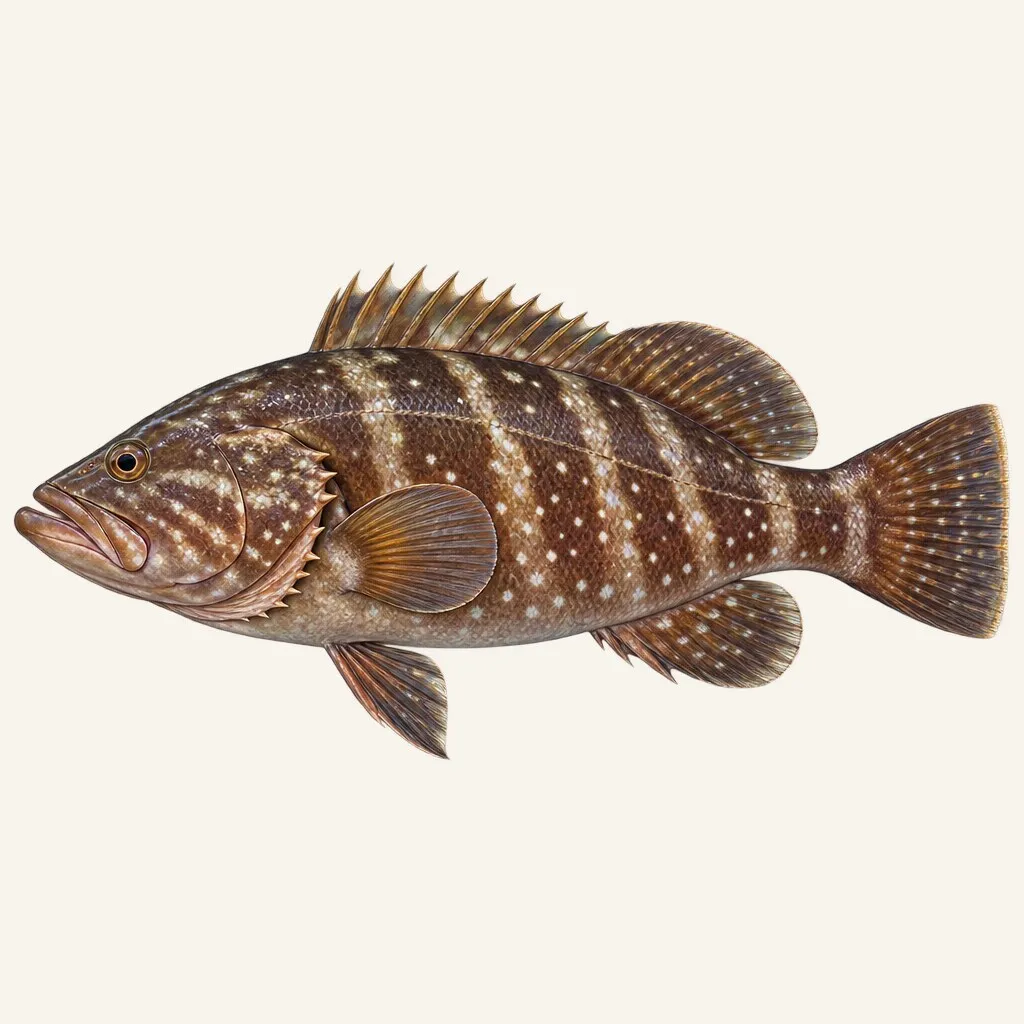
The white grouper is a robust serranid with a greyish-brown body bearing characteristic bronze reflections and diffuse pale spots on the flanks. Found in the Mediterranean and West Africa, it inhabits rocky and coral coastal bottoms down to 200 metres, hunting by ambush.
Calendar
Recorded in 20 countries
Albania · Benin · Cameroon · Congo - Brazzaville · Côte d’Ivoire · Equatorial Guinea · Gabon · Ghana · Greece · Guinea · Guinea-Bissau · Israel · Liberia · Malta · Mauritania · Nigeria · Senegal · Sierra Leone · Spain · Türkiye
GBIF occurrence records — native and introduced populations combined.
Its range
The species runs down the eastern Atlantic along the West African coast as far as southern Angola, and occupies the southern Mediterranean. The first Corsican record dates from 2012, which puts a marker on a northward movement rather than merely adding a dot to a map.
Reports from the Canaries and from Cape Verde have never been substantiated and should be treated as open.
Identifying it
This is a slimmer grouper than its relatives. Body depth is less than head length and goes 3.0 to 3.6 times into standard length; the head goes in 2.5 to 2.9 times.
The area between the eyes is convex, which separates it at a glance from the flat-headed goliath grouper when the two are laid side by side. The preopercle is angular and armed at its corner with three to six large spines, the lowest of them pointing downwards.
Two smaller details finish the job. The rear nostril is slightly larger than the front one. And the maxilla reaches almost to a vertical line at the back edge of the eye without extending well beyond it. The pelvic fins start below the base of the pectorals, the tail is rounded, the scales are ctenoid. Fin counts run to 10 or 11 dorsal spines, 14 to 16 soft rays, three anal spines and seven to nine anal rays.
Breeding
Like the dusky grouper, this species starts female and turns male later.
Here the threshold is recorded in weight, which makes it immediately usable on a boat: most females change at around 9 kg. Small males of 3 to 5 kg turn up occasionally, so the rule has exceptions. Off Tunisia the change occurs at 10 to 13 years, at 6 to 15 kg and 80 to 110 cm.
The fecundity figures deserve to be quoted in full, because the ratio between them is the argument. A female of 44 cm standard length weighing 2.2 kg carries an estimated 789,436 eggs. A female of 87 cm weighing 12.6 kg carries 12,589,242. Six times the mass, sixteen times the eggs.
That relationship holds independently of the sex change and it settles a question anglers and managers argue about elsewhere. A large female is not worth six small ones. She is worth sixteen, and the small ones do not add up to her.
First maturity arrives at about 55 cm, within a range of 50 to 60.
The water it needs
Adults are found on rock and on mud-sand bottoms between 20 and 200 m. Juveniles have been taken in coastal lagoons and in estuaries.
One trait separates this fish from most of its family: it is not tied to reef. Soft ground is part of its territory, not a place it crosses, and that widens enormously the area over which it can be encountered. A grouper that can be met over open mud is a different proposition from one that can only be met at a known hole.
Off Senegal its seasonal movements are governed by upwelling — the cold, nutrient-rich water that rises along the Senegalese and Mauritanian coasts at certain times of year. The fish is following an oceanographic feature, not a date on a calendar, and the feature moves.
Areas
- Coastal rocky bottoms
- Intermediate sandy-muddy zones
- Wrecks and artificial reefs
- Rocky estuaries
Techniques
- Bottom fishing from a boat
- Coastal jigging
- Slow bottom trolling
- Night fishing with live bait
Baits
- Fresh fish fillet
- Squid
- Whole shrimp
- Octopus piece
- Cuttlefish
What it eats
The diet has been measured in West African waters: 58 per cent fish, 21 per cent stomatopods, 10 per cent crabs and 10 per cent cephalopods.
The stomatopod share is the unusual entry. Mantis shrimps are burrowing animals of soft sediment, armed with a strike fast enough to be worth avoiding, and a fifth of the diet coming from them confirms where the fish spends its time. That prey belongs to the mud flat, not to the reef.
How to catch it
The upwelling is the most operational piece of information available on this species. Off Senegal, seasonal movement tracks the rise of cold water, so a fishery that follows the water finds fish and one that follows the calendar does not.
Its use of soft bottoms then changes the search itself. With most groupers, finding structure is finding the fish. Here, mud and sand are legitimate ground, and the plan cannot be built on relief alone.
The species is sought after in West African markets, eaten fresh and smoked, and that commercial value sustains a very substantial fishing effort along the whole coast.
A good-sized fish is almost certainly a female in full reproductive condition. That follows directly from a sex change at around 9 kg, and it is the only piece of information needed at the moment a decision has to be made about what to do with her.
Conservation · Near Threatened (IUCN) — This species is in decline. Release your catch quickly and handle it with care — wet hands, as little time out of the water as possible.
Conservation
The fecundity ratio is the central mechanism, and it works against the way fishing is normally conducted. A fishery that selects large fish does not remove a proportional share of the reproduction; it removes most of it. Twelve and a half million eggs in one 12.6 kg female against 789,000 in a 2.2 kg one means the small fish left behind cannot replace what was taken.
The sex change compounds it from the other direction. Taking everything above 9 kg means taking the males, with no fish below able to replace them for the best part of a decade.
Juvenile dependence on coastal lagoons and estuaries adds a third pressure that owes nothing to fishing at all. Coastal development and lagoon modification remove the nursery, and the effect only becomes visible in the adult stock years later.
Experimental aquaculture exists for this species, which changes the economics but not the biology of the wild stock.
Regulations
Check the local regulations in force (legal size limits, closed seasons, bag limits).
For guidance only. Legal sizes, quotas and open seasons vary by location and season: always check the local regulations in force before fishing.
Other names
White grouper in English, mérou blanc in French, and thiof in Wolof — the name under which it is one of the defining fish of Senegalese cooking. That standing in the kitchen explains both its market price and the pressure it is under, and it is not a detail that can be separated from the conservation section above.
White grouper is a market description as much as a species name, and pale-fleshed groupers of several species end up sold under it or under a local equivalent. The scientific name is the only wording that identifies this fish specifically, particularly in trade records and landings statistics where several West African groupers are reported together.
The species epithet means bronze or brazen, which describes the colour of the living fish better than white does.
Sources: fishbase.se · api.gbif.org