Barramundi
Lates calcarifer · Latidae
- Saltwater
- Predators
- Medium
- Size
150–200 cm
- Weight
33–60 kg
- Lifespan
35 years
- Water temp.
15–28 °C
- Depth
10–40 m
Where to fish
- Estuary
Habitat icons: Flaticon
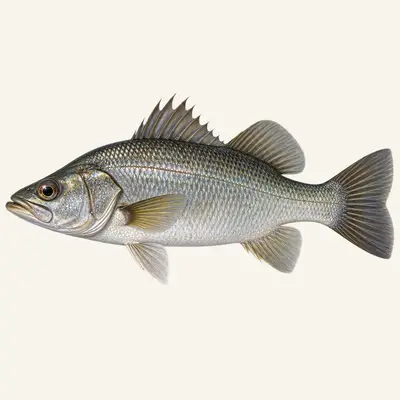
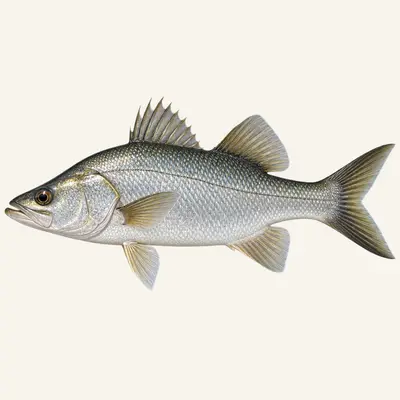
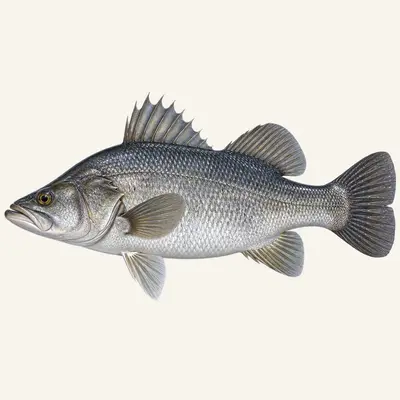
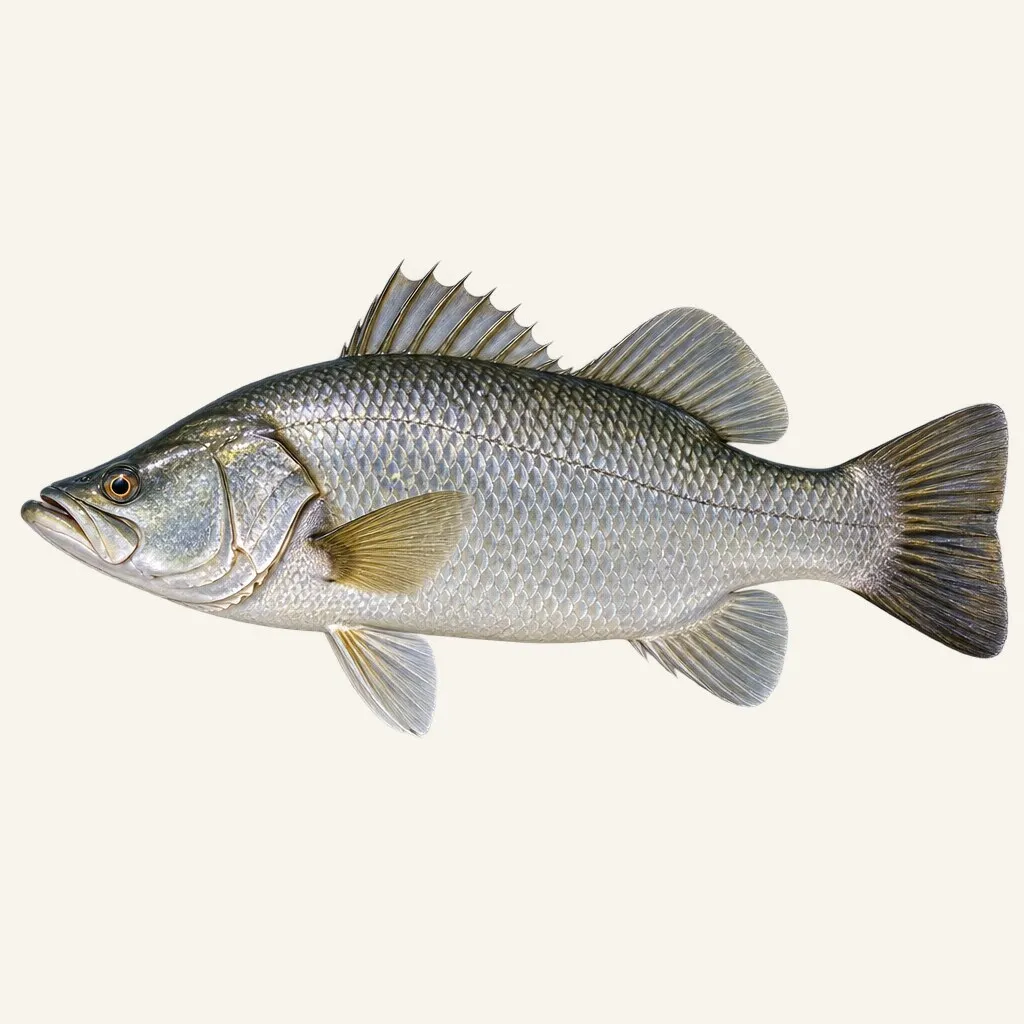
Large predator of the Latidae family, with a robust silver body, massive head and prominent jaw, capable of exceeding one meter in marine and brackish waters of the Asia-Pacific region.
Calendar
Recorded in 14 countries
Australia · Bangladesh · China · French Polynesia · India · Indonesia · Malaysia · New Caledonia · Singapore · Sri Lanka · Taiwan · Thailand · Vietnam · Wallis & Futuna
GBIF occurrence records — native and introduced populations combined.
Its range
The range is a coastal ribbon, and its shape comes from two requirements laid one over the other. The first is depth: this is a fish of the upper few tens of metres, and it does not cross an ocean. The second is the estuary, without which spawning leads nowhere. So the line follows monsoon coasts, wherever a river, a rainy season and a body of brackish water coincide, and it stops where any one of the three is missing.
Temperature sets the outer bound at 15 to 28 degrees, which rules out the temperate latitudes where the species is nonetheless farmed under cover.
Identifying it
The head is armed, and a hand discovers that before an eye does. The lower edge of the preopercle is serrated and carries a strong spine at its angle; the opercle has a smaller spine of its own, plus a serrated flap above the point where the lateral line begins. Three cutting surfaces on the same cheek, in the order a careless grip meets them.
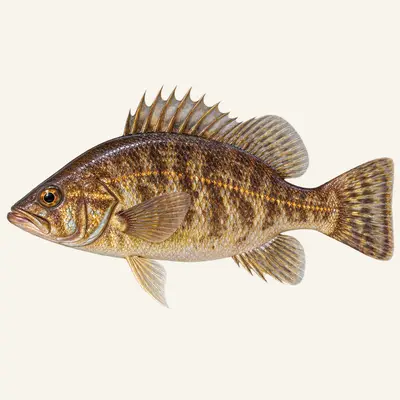
The body is elongate and compressed from side to side. The mouth is large and slightly oblique, and the upper jaw runs back behind the eye — the gape of a fish that engulfs prey whole rather than cutting it up. The tail fin is rounded.
The counts are simple: seven to nine dorsal spines, ten or eleven soft rays behind them, three anal spines and seven or eight soft rays.
Breeding
A barramundi starts life as a male and finishes as a female, and the changeover runs to no schedule. The general rule is that a fish matures male, functions as one for a season or several, and then inverts. Two departures complete the picture: a few individuals become female directly, with no male phase, and some males never switch at all. The result shows up in the length classes, where females are all but absent among small fish and dominant among large ones.
Fecundity is what turns that into a decision at the net. A female can carry up to 2.3 million eggs per kilogramme of body weight. A large fish is therefore not simply a female instead of a male; it is a per-kilogramme figure multiplied by a mass that keeps rising.
Timing follows the monsoon. At the onset of the wet season, maturing males drop downstream out of fresh water and join females already resident in the estuaries and on the tidal flats off the river mouths. Spawning happens on the full moon and the new moon, at the start of an incoming tide, so that the rising water carries the eggs up into the estuary. The fish gather in aggregations for it and release eggs and milt into open water.
One requirement governs the whole cycle. Adults and juveniles live perfectly well in fresh water, but the embryo needs brackish water to develop. A barramundi shut inside an impoundment grows, puts on weight, matures, and never reproduces.
The water it needs
Coastal water, estuaries and lagoons, in water either clear or heavily loaded with sediment. The fish moves between river and sea, and the river part is not incidental: older juveniles occupy the upper reaches, a long way inland.
The youngest fish live somewhere far less durable — temporary brackish swamps connected to the estuaries. That habitat exists for part of the year only, it is flat, and it lies along the coast, which makes it the first thing to be drained, embanked or built over.
Adults want cover. Undercut banks, fallen timber, submerged logs, overhanging vegetation: the fish sits against the obstacle and not out in open water.
Areas
- Estuaries and river mouths
- Mangroves and submerged roots
- Coastal lagoons
- Holes beneath structures
Techniques
- Popper cast and retrieve
- Vertical jigging
- Live bait fishing
- Subsurface hard lures
- Trolling
Baits
- Live baitfish
- Shrimps
- Metal lures
- Poppers
- Soft plastic lures
What it eats
Fish and crustaceans for the adult, insects as well for juveniles. Nothing on the menu is exotic; it is the rate at which the animal fills up that stands out.
In ponds under good conditions a barramundi puts on 1.5 to 3 kg in a year. Growth like that assumes near-continuous feeding, and a predator that has to eat constantly cannot afford to chase. It waits against a structure, within one short movement of whatever passes. The cover described above is not a refuge. It is a place of work.
How to catch it
Everything starts with structure. A cast that fails to reach the undercut bank, the stump or the low branch has not happened: the fish is against the obstacle, within a few tens of centimetres of it, and a metre out is far enough to produce nothing.
Choose the leader against the cheeks, not against the teeth. The dentition is built to hold, but the serrated preopercle and the opercular flap cut as cleanly as a blade the moment the fish shakes its head or rolls. Fine line that parts after ten seconds of a fight was not bitten through. It was sawn.
Calendar and tide are both written into the spawning behaviour. The onset of the rains gathers fish at the river mouths; the full and new moons concentrate activity; the beginning of the flood tide is the moment the species itself has chosen for everything that matters to it. Those three markers overlap, and when they coincide an estuary stops being water that needs searching.
Then the decision at the moment of capture. The big fish of the group is a female, and her fecundity is counted by the kilogramme. One that is going back is held by the lower jaw and never by the gill covers.
Conservation
The cycle breaks at a structure across a river. This species has to move from river to estuary and back; its eggs need brackish water; its larvae need temporary coastal swamps. Each of those three pieces can be in good order without the whole working, if the passage between them has gone. A dam, a poorly passable lock or a sea wall is enough to turn a breeding population into a maintained one.
Stocking impoundments demonstrates the same thing from the other side. The fish put in grow well and fish well and renew nothing: the resource there is entirely imported.
Farming has meanwhile reached considerable scale — Thailand, Indonesia, Australia — and the species is at once Australia's leading commercial fish and one of its most sought-after angling species. That double demand is what funds fish passes as much as it is what presses on the estuaries.
Regulations
Check the local regulations in force (legal size limits, closed seasons, bag limits).
For guidance only. Legal sizes, quotas and open seasons vary by location and season: always check the local regulations in force before fishing.
Other names
Barramundi comes from an Aboriginal language of Queensland, where it meant something close to "large-scaled river fish". The word passed into Australian English, then into the world trade, and it has ended up as the name in all six languages of this catalogue — unusual for a fish Europe does not catch.
It also did not start on this animal. In Australia the same word was applied, and locally still is, to unrelated freshwater fish, among them a saratoga of the genus Scleropages — an osteoglossid, about as distant a relative as a large freshwater predator can be. The market settled the word on Lates calcarifer and left the older uses stranded, so a local barramundi may still be something else entirely.
Asian fisheries use other names: Asian sea bass or giant sea perch for export, bhetki in Bengal, kakap putih in Malaysia and Indonesia.
Sources: fishbase.se · api.gbif.org