Weakfish
Cynoscion regalis · Sciaenidae
- Saltwater
- Coastal
- Medium
- Size
50–98 cm
- Weight
1.2–8.9 kg
- Water temp.
17–27 °C
- Depth
10–26 m
Where to fish
- Estuary
- Beach
Habitat icons: Flaticon
Weakfish - coastal marine species, Western Atlantic
Calendar
Recorded in 2 countries
GBIF occurrence records — native and introduced populations combined.
Identifying it
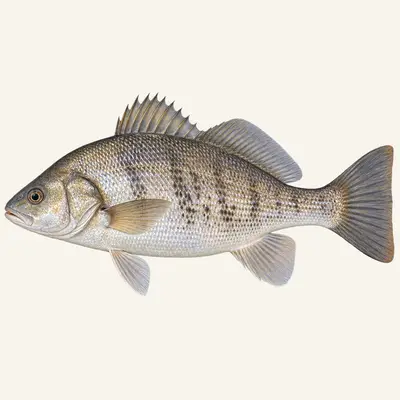
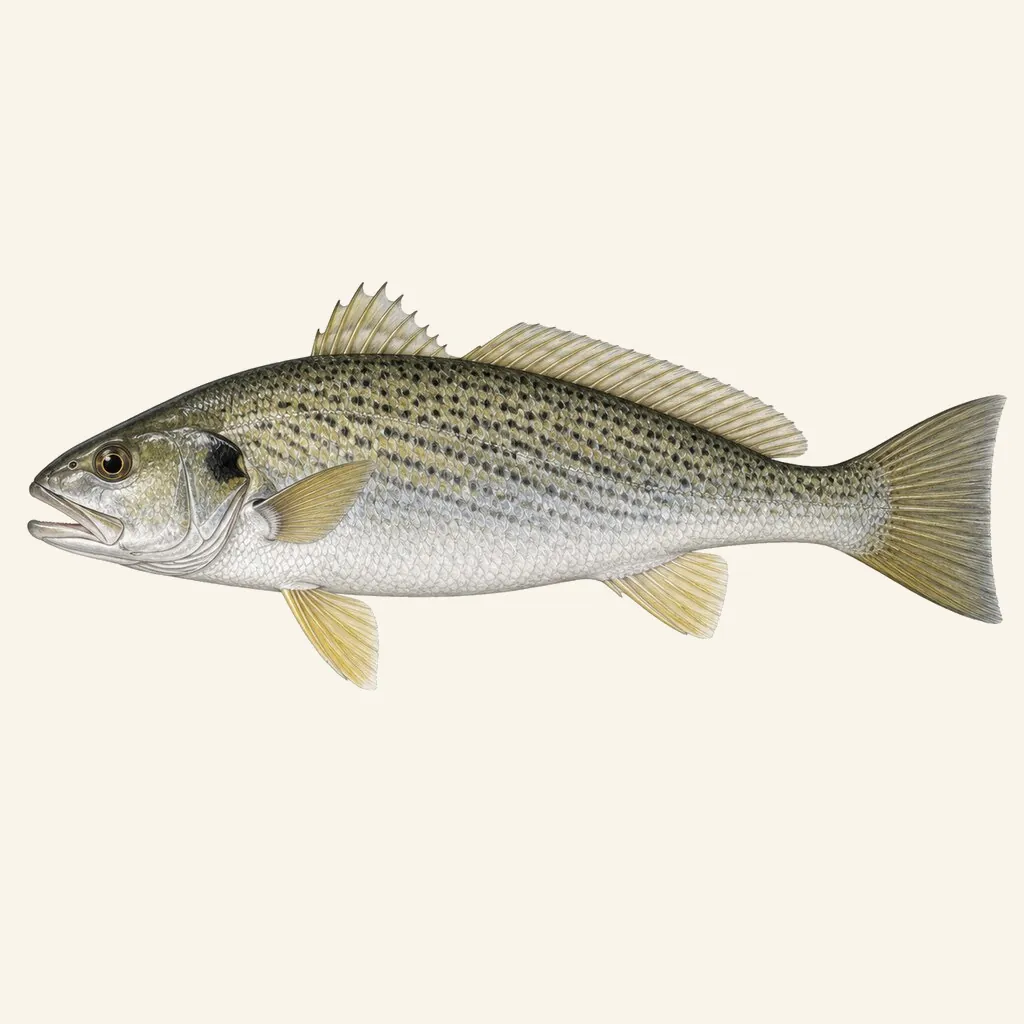
The spots line up. Small dark marks over the back arrange themselves into undulating dotted lines running across the upper flank, and they stop at the body: no spot carries on out onto a fin. That is the first thing to check whenever the other spotted member of the genus is a possibility, because it is the one difference that does not require a ruler.
The second character is internal and still visible from outside: the inside of the gill cover is dark, and the colour shows through the membrane.
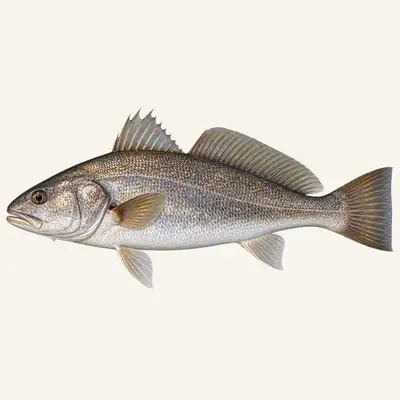
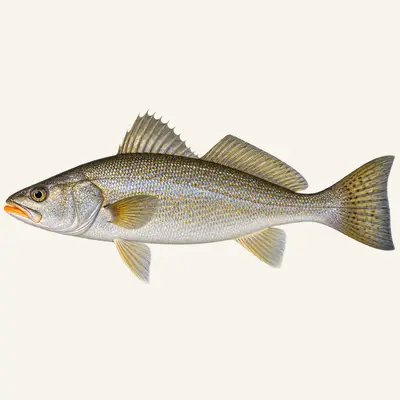
The body is greenish grey above and silvery below, the pelvic and anal fins yellowish, the rest pale and sometimes tinged with yellow. The mouth is large and oblique with the lower jaw projecting, and a pair of large canine-like teeth stands at the tip of the upper jaw. There are no barbels and no pores on the chin, and the snout carries a single marginal pore.
Two details finish a specimen in the hand. The soft part of the dorsal fin is covered in small scales over the lower half of its height, and the gas bladder holds a pair of nearly straight horn-like appendages.
The first dorsal carries 11 spines with no variation on record, followed by 25 to 29 soft rays; the anal has two spines and 11 to 13 rays.
Breeding
Oviparous, with high fecundity.
Maturity arrives remarkably early: about 18 cm, within a span of 14 to 22.5, in an animal whose common length is 50 cm. A fish that begins spawning at roughly a third of its ordinary adult length, and does so prolifically, produces a stock that renews itself quickly. Few large coastal fish are built that way, and on paper it should make the species resilient to heavy removal.
The water it needs
Shallow coastal water over sand and sandy mud is the usual ground, between about 10 and 26 m, in water from 17 to 27 degrees.
The seasonal cycle is what organises everything else. Through the summer the fish move into river estuaries, which serve as both nursery and feeding ground; they leave in autumn as the temperature falls. But some are known to overwinter in those same estuaries, and that exception is worth carrying, because it means an estuarine mark can produce in the cold season against all expectation.
Juveniles are euryhaline, so the nursery extends right up the salinity gradient rather than stopping at a particular line in it.
Areas
- Atlantic coast estuaries
- Sandy bays and coves
- Coastal sandy bottoms
- Channel edges
Techniques
- Soft lure fishing near the bottom
- Live shrimp fishing
- Light jigging in estuaries
- Surface cast-and-retrieve
Baits
- Live shrimp
- Soft lures
- Sandworms
- Small live baitfish
What it eats
Crustaceans first, fish second.
The large oblique mouth and the projecting lower jaw belong to a predator that takes upward and forward — into the water column, not down onto the bottom it happens to be swimming over. That orientation is the useful part of the description, and it survives the fact that the species is classed as demersal.
How to catch it
The estuary in summer is the principal context, and along the eastern seaboard of the United States this is one of the most consistently targeted fish there is.
The diet and the shape of the mouth point at lures worked through the water column, at live baits and at crustacean baits.
Then there is the fact that reorganises a late-season plan. This species stops feeding when the water reaches 7.9 degrees and dies at 3.3. Those are unusually precise figures and they are narrow ones for a coastal fish. Fishing an estuary as the temperature slides towards the first of them is fishing for an animal that has already switched off, and a hard cold snap over shallow estuarine water holding wintering fish does not slow them down, it kills them.
The mouth sets the last constraint. Its hold tears out under pressure, which is exactly what the English name records: a yielding rod tip puts more of these fish in the net than a stiff one, and a tight drag loses them alongside.
Conservation · Endangered (IUCN) — This species is threatened with extinction. Always release it (no-kill), handle it with the utmost care and check local rules — fishing for it may be prohibited.
Conservation
Estuarine dependence here is doubled, and that is the point to start from. The estuary is the nursery and it is also the summer feeding ground, so anything that degrades one water removes two functions at once — where a species using an estuary for a single stage of its life would lose only one.
The thermal figures add a second exposure that has nothing to do with fishing. Feeding stops at 7.9 degrees and death follows at 3.3, so a population wintering inshore can be cut down by weather.
Early maturity and high fecundity are what the stock has working for it, and they are also what makes a decline hard to read. A fish that starts spawning at 18 cm goes on reproducing while its size structure collapses around it, so the catch can stay numerous long after the large fish have gone out of it. Watching the average size rather than the count is the only way to see that happening.
Regulations
Check the local regulations in force (legal size limits, closed seasons, bag limits).
For guidance only. Legal sizes, quotas and open seasons vary by location and season: always check the local regulations in force before fishing.
Other names
Weakfish is the English name, and it refers to the mouth rather than to the fight: the tissue tears at the strike. Squeteague, from an Algonquian word, survives in the north-east, and grey trout is used further south.
That last one is worth being careful with. This is a drum, in the family of the croakers and the redfish, and it is not related to any salmonid; a report of trout from an American estuary and a report of trout from a British river have nothing in common but the word.
The genus name is built from the Greek for dog and the classical name of the family, after those canine teeth at the front of the jaw. Regalis means royal, and the fish carried a considerable commercial fishery long before it carried a sporting reputation.
Its congener has been reported from a European estuary in recent years. This one arrived in Europe by deliberate introduction, so on the eastern side of the Atlantic there are now two reasons to look twice at an unexpected drum.
Sources: fishbase.se · api.gbif.org