Nile perch
Lates niloticus · Latidae
- Freshwater
- Predators
- Medium
- Size
100–200 cm
- Weight
9.8–200 kg
- Depth
10–60 m
Where to fish
- Lake
- River
Habitat icons: Flaticon
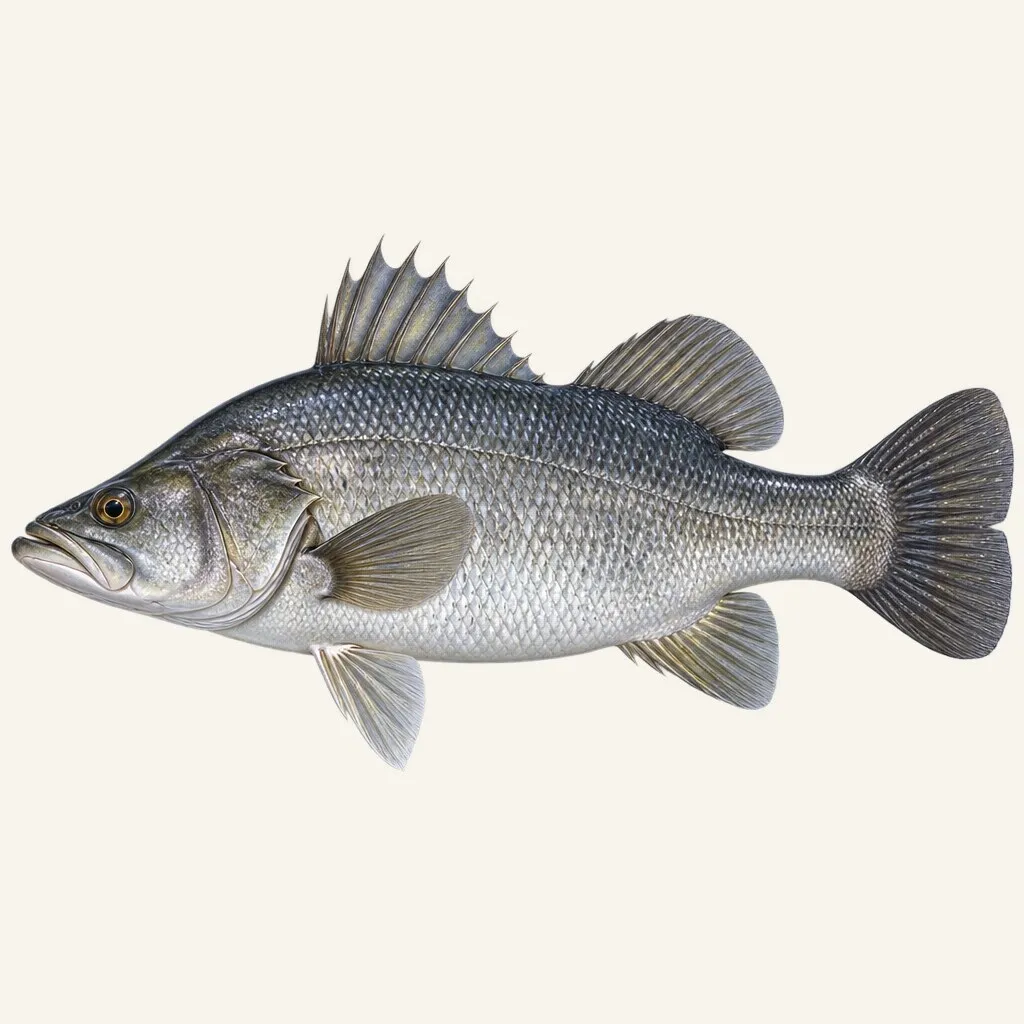
Imposing freshwater predator of the Latidae family, with a massive silver body and two-part dorsal fin, introduced into many African lakes.
Calendar
Recorded in 19 countries
Benin · Cameroon · Central African Republic · Chad · Congo - Kinshasa · Côte d’Ivoire · Egypt · Ghana · Guinea · Italy · Kenya · Mali · Niger · Nigeria · Senegal · Sudan · Tanzania · Uganda · United States
GBIF occurrence records — native and introduced populations combined.
Its range
The native range is a band drawn across the continent, from the Senegal to the Nile, taking in the Niger, the Volta, Chad, the Congo basin and lakes Albert, Turkana and Tana. Rivers with no present connection to one another share this fish because they once had one: the Sahara has passed through wet phases, those basins communicated during them, and the fauna they hold in common outlived the separation without changing. Across West Africa the species is close to ubiquitous, with Gambia as the notable exception.
The rest of the map is introduction, and one of those introductions became the standard case of the discipline.
It was put into Lake Victoria in the middle of the twentieth century to create a fishery for a large fish. What it found there was an endemic cichlid fauna of a richness matched in no other lake, every member of it narrowly specialised, none with any evolutionary experience of a predator of this size. Within three decades the perch dominated the lake's catches and much of that cichlid fauna had gone out of the nets.
The predator was not working alone, and saying so is not a defence of it. The same decades brought heavy fishing pressure and the nutrient enrichment of the lake, which stripped the oxygen out of deep water and cost the cichlids the visual clarity a number of them needed to tell each other apart at spawning. Three processes ran together. The perch is the one that moved fastest, and it is the one still there.
What followed was economic as much as ecological. A hundred-kilogramme fish is not handled like a ten-centimetre cichlid and does not sell into the same market, so the lake's fishery shifted from subsistence to a filleting industry supplying export, with the plants and the freight that implies. The introduction changed the fish community and it changed who on the shore eats what. Several countries record adverse ecological effects where the species has been established.
Identifying it
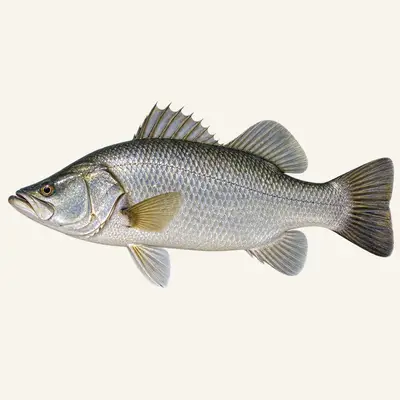
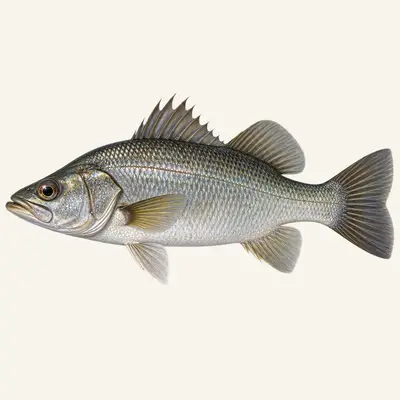
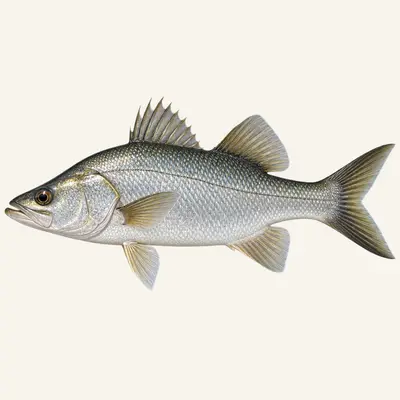
The eye gives the species away before anything else does. Its interior is a clear yellow, plainly visible, on a head that is otherwise uniformly silver. On an animal whose flanks carry no band, no spot and no marbling, that yellow is the only colour anywhere on it.
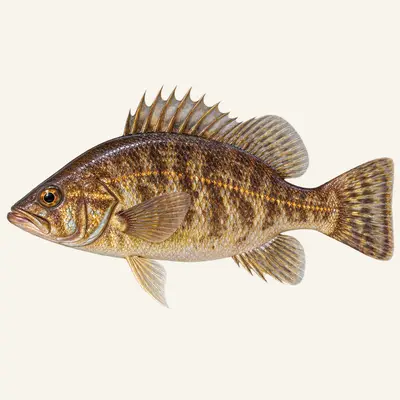
The back is dark grey-blue, the flank and belly silver-grey, the fins grey. Juveniles are brown with lighter marbling over head and sides — two liveries with nothing in common on one species, the second fading out with growth.
The mouth is large and protrusible, with the lower jaw a little the more prominent. It is filled with villiform teeth, brushes rather than blades, set on the jaws, the palate and the vomer. They cut nothing and hold everything, which is all a fish that swallows its prey whole requires.
The weaponry is elsewhere. The preopercle and the lachrymal bone are denticulate, and the free edge of the gill cover carries a strong spine with a smaller one above it. The dorsal fin is split by a deep notch into a spiny front and a soft-rayed rear; the tail is rounded. There are 54 to 74 ctenoid scales along the lateral line, six to eight pored scales beyond them on the tail base, and 12 to 14 rakers on the lower limb of the first gill arch.
The water it needs
Channels, lakes and irrigation canals: this fish takes a man-made body of water as readily as a river. What fixes it in place is depth — adults keep between 10 and 60 metres and hold against the bottom.
The young take the opposite, the shallows and the margins. That vertical separation by age is sharp and worth knowing: hunting for a large one in the shoal water where two-kilogramme fish swarm leads nowhere.
Areas
- Rocky drop-offs in large lakes
- Deep pelagic zones
- River mouths
- Shallow areas near deep water
Techniques
- Deep vertical jigging
- Cast and retrieve with large lures
- Trolling
- Drifting with live bait
- Hard lures
Baits
- Whole baitfish
- Large metal lures
- Deep-diving hard lures
- Large live bait
- Heavy jigs
What it eats
The menu changes three times over a life. Fry take plankton, small fish take sizeable crustaceans and insects, adults take fish — clupeids and Alestes for the most part, which is to say open-water shoals.
There is an apparent contradiction in that, and it points to where the animal holds station. Something that lives on the bottom and eats pelagic shoals cannot hunt in its own layer: it waits at the foot of drop-offs, on breaks of slope and along channels, where open water passes over the substrate. The lie is benthic. The prey is not.
How to catch it
Two facts drive the rest: the depth the fish holds, and the nature of its armament.
Depth first. Adults sit between 10 and 60 metres against the bottom while their food circulates above them. The methods that produce are the ones that reach that layer and stay in it — vertical jigging on drop-offs, deep trolling along slope breaks, a live bait drifted over channels. Working the surface of a lake full of these fish can give nothing for hours on end.
Armament second, and it is not where it looks. The teeth do not cut; they are brushes made to grip, and a fine leader survives them without trouble. What severs line is the cheek: a denticulate preopercle, a denticulate lachrymal, two spines on the gill cover. Line wears through when the fish shakes its head, not when it takes, and a hand gets opened at the grab rather than at the unhooking.
Then the mass. The heaviest verified fish weighed 164 kg at 180 cm, in Lake Albert, and the published records run higher still without agreeing with one another. An animal on that order is not handled alone and will not tolerate a long spell out of the water.
Conservation
The irony is complete: the fish that erased a fauna elsewhere is in retreat at home. Over-harvesting is the identified cause, and the mechanism sits in one figure. Maturity arrives at around 75 cm, within a span of 53 to 85. A fish has to pass three-quarters of a metre to spawn for the first time, in a fishery whose catches lie largely below that.
Market value finishes the account. The flesh sells high and travels far, farming has developed alongside, and demand does not fall as the fish gets scarcer — it moves onto smaller individuals, which is to say precisely onto the ones that have not yet bred.
To that must be added what the species does where it is carried. It is listed among the potential pests, and moving a live one into water that holds none is the only gesture here whose outcome is known in advance.
Regulations
Check the local regulations in force (legal size limits, closed seasons, bag limits).
For guidance only. Legal sizes, quotas and open seasons vary by location and season: always check the local regulations in force before fishing.
Other names
Nile perch is the name in all six languages of this catalogue, and it is wrong twice over. The fish is not a percid but a latid, and the resemblance to the perches of Europe and North America is a matter of outline and nothing more. The Nile, meanwhile, is one basin among the ten or so it occupies naturally; the Senegal, the Niger, the Volta and Chad have as much claim on it.
"Perch" is the English word that has been stretched furthest across unrelated fish, and this is one of the larger stretches: an animal of this size named after something that fits in a hand.
In francophone West Africa nobody says Nile perch. The fish is capitaine, and that is the word on the slab in Bamako as in Dakar — the working name of a species Europe mostly meets as a frozen fillet sold under the name of a river.
Sources: fishbase.se · api.gbif.org