Black carp
Mylopharyngodon piceus · Cyprinidae
- Freshwater
- Carp & coarse
- Medium
- Size
12–180 cm
- Weight
0.0–74 kg
- Lifespan
13 years
- Water temp.
0–40 °C
- Depth
5–30 m
Where to fish
- Canal
- Lake
- River
Habitat icons: Flaticon
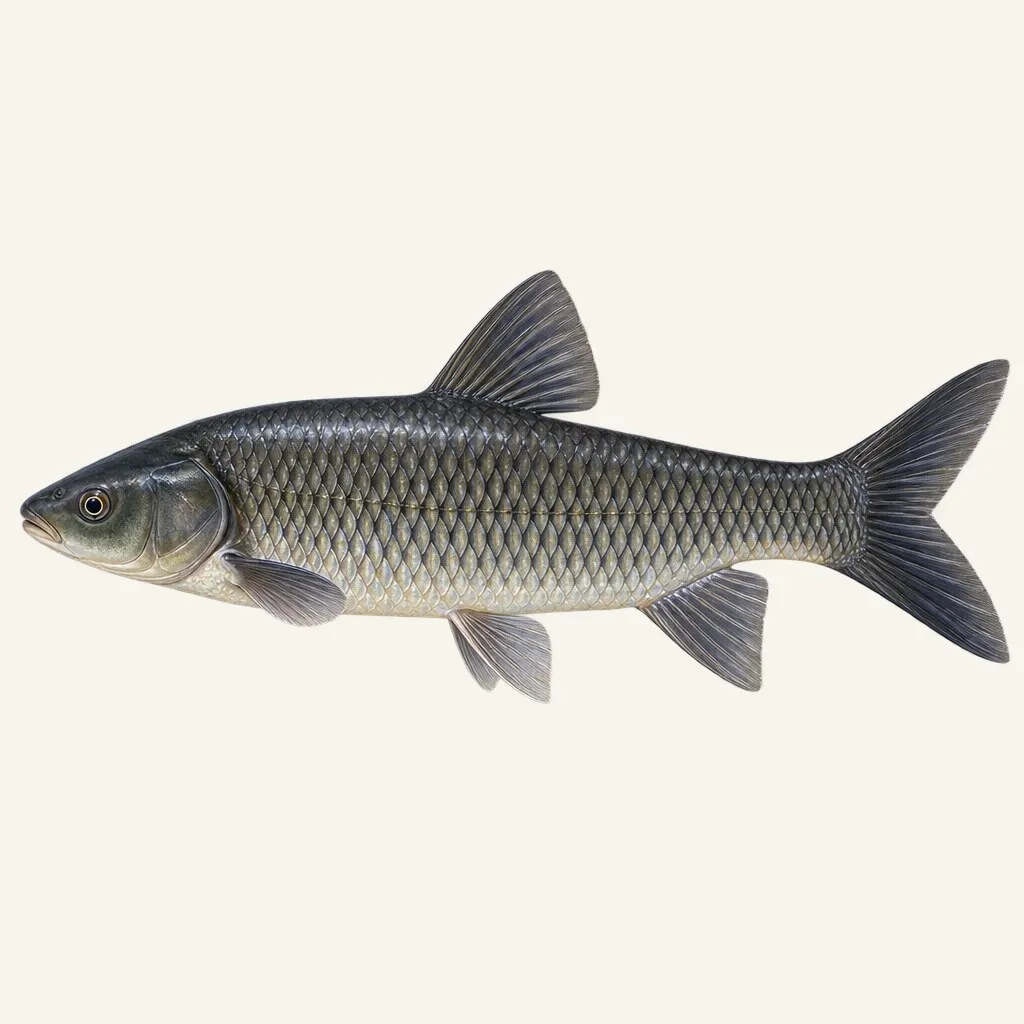
Large cyprinid with an elongated and stocky body entirely covered in dark, near-black scales; specialised in crushing molluscs with its powerful pharyngeal teeth.
Calendar
Recorded in 5 countries
China · French Guiana · Japan · Taiwan · United States
GBIF occurrence records — native and introduced populations combined.
Its range
The native range runs from the Amur basin down to southern China, with records from Vietnam. Two things are recorded about it that point in opposite directions.
The first is that the Russian stocks have declined sharply at home. The second is that in Europe the species persists only through stocking and accidental escape, and that more than one country which received it has logged ecological consequences. The literature reflects that unease directly: the standard reference on this fish is not a monograph on its biology but a 337-page biological synopsis and risk assessment of an introduced species, published by a fisheries society. Very few fish have had that much attention paid to the question of what they might do somewhere they do not belong.
Identifying it
What identifies this species cannot be seen from the bank, from a boat, or in a photograph. It is a set of teeth in the throat: a single row of four or five large molariform teeth on each of the two pharyngeal arches, written as 1,4-4,1. Flat-crowned, heavy, arranged like paving. No other fish of this build carries anything like them, and the whole biology of the animal is downstream of them.
Outside, the fish is plain and dark, close enough to black to have taken its name from it. The body is fusiform with a circular cross-section, the dorsal has seven to nine soft rays and the anal eight to ten, none of them spined. Alongside the grass carp — same family, same shape, same size, frequently the same pond — the only external difference is that darkness, and darkness in a fish varies with the water it came out of. Anyone who needs to be certain looks inside the mouth.
Breeding
Maturity arrives extraordinarily late. Records put first spawning at around 91 centimetres, with figures reaching a metre, in an animal that has been aged at 13 years and probably passes 15. A fish that must approach a metre before it can breed has spent most of its life not breeding, and its whole reproductive output is packed into the last years of it.
Getting there takes three separate places, connected. Adults ready to spawn run upstream in spring or early summer and release in turbulent open water. The eggs are pelagic or semipelagic and hatch while they drift down. The larvae then have to arrive somewhere with little or no current — a floodplain lake, a side channel — and settle there. Subadults and adults use the main channel afterwards for feeding and for wintering.
With any one of the three missing, the cycle produces nothing. That is not a redundant system, and it is the reason the species does not colonise quietly.
The water it needs
Adults want large lowland rivers and lakes, and they want them clear and well oxygenated. The pH range recorded is narrow — 7.5 to 8.5 — and the fish is demersal, working between about 5 and 30 metres.
Temperature is not what limits it. The recorded span runs from zero to 40 degrees, which is as wide as fresh water gets. What limits it is water quality: a turbid, warm, deoxygenated pond of the kind that suits several of its relatives does not suit this one. That single requirement is the main reason its establishment outside Asia has been patchier than the alarm around it would suggest, and it is also the reason a river cleaned up for other purposes can become suitable for it.
Areas
- Mussel and unionid beds
- Hard-bottom river stretches
- Rocky shores of large lakes
- Muddy-bottom canals
Techniques
- Bottom fishing with molluscs
- Hair rig with hard seeds
- Heavy bottom feeder
- Dense boilie fishing
Baits
- Shelled freshwater mussels
- Freshwater snails
- Hardened corn
- Seafood boilies
- Tiger nuts
What it eats
The diet changes three times and then stops changing for good. Larvae take zooplankton. They move on to ostracods and aquatic insects. At about 120 millimetres the juveniles begin taking small snails and clams, and from there on the larger juveniles and the adults feed almost entirely on molluscs.
This is the point at which the pharyngeal mill starts earning its keep. A row of pavement teeth on each arch crushes shell, and it lets the fish exploit a standing crop that most fresh water carries in quantity and that very few large fishes can open — snails and bivalves sitting on and in the bed, not going anywhere, needing neither pursuit nor ambush. The reward is a food supply with almost no competition in it and no chase attached.
The cost is total specialisation. An adult that lives on shellfish has no alternative diet to fall back on. Where the molluscs go, the fish goes, and where the fish stays, the molluscs do not.
How to catch it
A fish that eats nothing but molluscs cannot be fished for in any way that involves imitating something alive. There is no prey to represent, no movement to suggest, no flash. Shelled mussels and snails presented on the bottom, and the hardened seeds and dense baits that ask the same crushing action of the throat, are what there is.
The water to look for is a further departure from carp habit. Clear, oxygenated, deep and large: a hard-bottomed reach with mussel beds in it, or the deeper margins of a lake with a living benthic fauna, rather than the silty slack water where the rest of the family is sought. Where the molluscs are is where the fish is, and that is a question about the bed rather than about the surface.
It is a heavy animal, slow to mature and long-lived, and a large one has been a mollusc grinder for a decade. Terminal tackle takes that literally: a bait it can crush, and a hook and line that survive being crushed against.
Conservation
This species carries its two problems at opposite ends of its range, and each is the other's mirror.
At home, the Russian stocks have fallen steeply, and the reason is legible in the life cycle. Reproduction needs a turbulent reach to spawn in, a long free drift to hatch in, and floodplain water to settle in — and those three things are precisely what the damming, embanking and channelling of a large river removes, usually in that order. Late maturity makes it worse: a population that only breeds at around a metre cannot absorb pressure on its largest fish, because they are the only ones contributing anything.
Away from home, the same specialisation becomes the hazard. A large, long-lived molluscivore at density strips the snails and bivalves out of a water body, and that fauna is among the slowest to re-establish: sedentary, slow-growing, and in many systems already the most depleted group present. The effect is not visible in a catch return, since it falls on animals nobody counts.
Regulations
Check the local regulations in force (legal size limits, closed seasons, bag limits).
For guidance only. Legal sizes, quotas and open seasons vary by location and season: always check the local regulations in force before fishing.
Other names
Black carp is the colour, and snail carp — the other name in use — is the diet and the reason the fish was ever moved. Between them they cover the whole species, which is more than most common names manage.
The scientific name is built from the same observation as the second of them. Mylopharyngodon joins the Greek for millstone, throat and tooth: the mill in the throat, named as the defining organ. Piceus means pitch-black.
The name to distrust is the one the fish shares with its relatives in ordinary speech. Big plain Asian cyprinids get called carp indiscriminately, and this one is confused with the grass carp constantly, in technical literature included. The two are separated by what a fish crushes and what a fish shears, and nothing on the outside of either animal settles which one is in the hand.
Sources: fishbase.se · api.gbif.org