Northern snakehead
Channa argus · Channidae
- Freshwater
- Predators
- Medium
- Regulated
- Size
100 cm
- Weight
8.0 kg
- Water temp.
4–22 °C
Where to fish
- Canal
- Pond
- River
Habitat icons: Flaticon
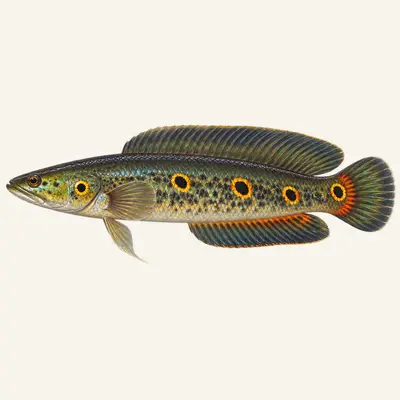
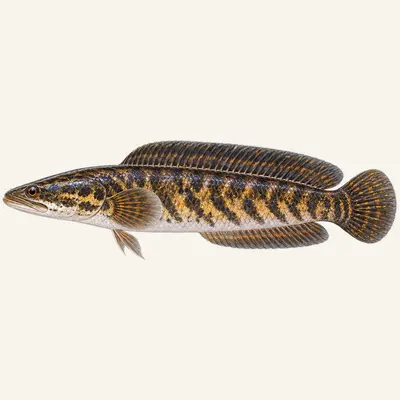
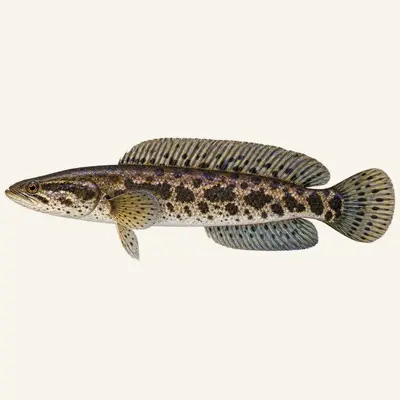
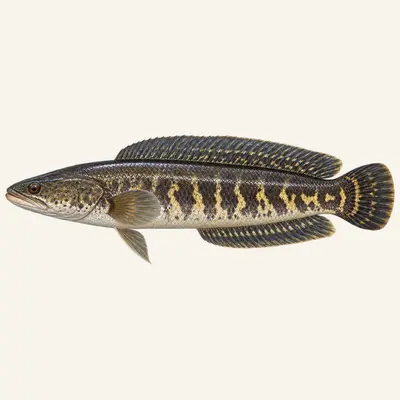
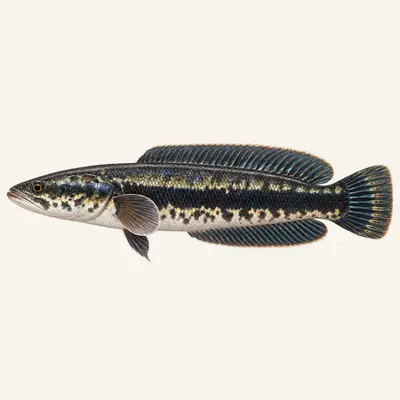
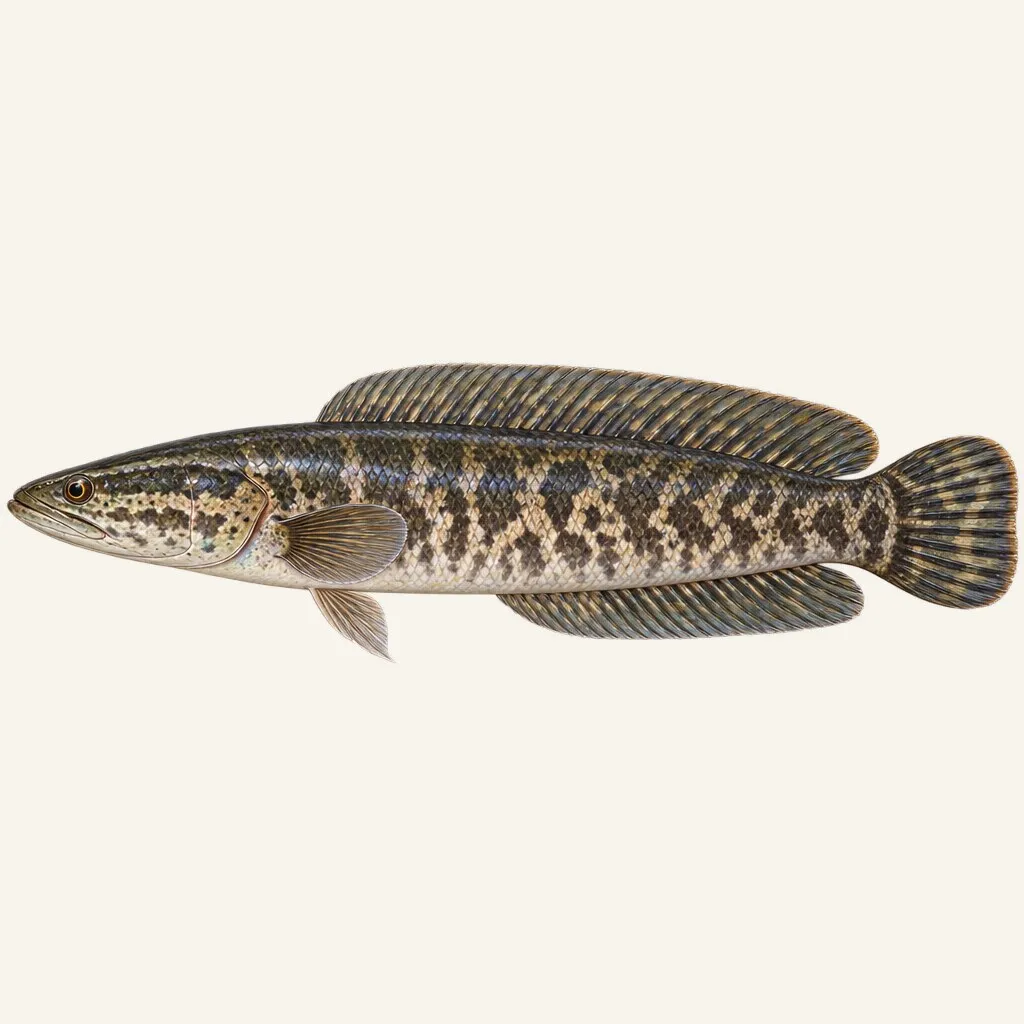
The northern snakehead features a robust, elongated body, a broad flat head with a large toothed mouth, and a pattern of irregular brown-green blotches providing excellent camouflage.
Calendar
Recorded in 5 countries
China · Japan · South Korea · United States · Uzbekistan
GBIF occurrence records — native and introduced populations combined.
Its range
The native range runs from the Amur south to the Xi Jiang and Hainan Island in China, between 25 and 54 degrees north. It has been introduced elsewhere, and both Japan and the United States record ecological damage as a result.
The temperature tolerance explains why this species and not one of its relatives. It works between 4 and 22 degrees, where the tropical snakeheads need 23 to 28. That difference is the whole reason a snakehead was able to establish itself in the rivers of the eastern United States: it is the only member of the group that can pass a temperate winter, so it is the only one for which most of North America is habitable at all.
The fish is also non-migratory. It does not need connected water to complete its life cycle, which means an isolated pond is a viable permanent home rather than a staging post.
Identifying it
Count the rays and the species is settled. The dorsal carries 49 to 54 soft rays and the anal 32 to 38, with no spines in either — the longest unpaired fins of any snakehead in this catalogue, and comfortably above the 38 to 43 dorsal rays of the striped snakehead. Nothing about colour or head shape does the job as cleanly.
The body is elongate on the standard plan of the genus, and the maximum is a metre for 9.5 kg.
In North American water, where this fish is not native, the animal it gets confused with is the bowfin, and the confusion runs in both directions. The fins resolve it: a bowfin has a very long dorsal and a short anal, while this fish carries both fins long. Anything reported as a snakehead on the strength of a snake-like head alone is worth a second look.
Breeding
Two years old and 30 cm long: that is when this fish starts breeding, and both figures are low for an animal reaching a metre. Spawning takes place in June and July.
The eggs are pelagic. They float rather than attaching to a substrate, which removes any dependence on the right kind of bottom or vegetation being present, and is one reason the species establishes so readily in water it did not evolve in.
Two months is a narrow window by the standards of the genus, whose tropical members spawn over a long season. It is a consequence of climate: the Amur basin has real winters, and the favourable period there is short.
The water it needs
Fresh water, still or slow, with no seasonal movement to speak of.
The capacity that gets discussed most is aerial. An individual can remain out of the water for three to four days at temperatures between 10 and 15 degrees. That is not the passive dormancy of a fish sealed in mud; it is a spell in open air, and it is the observation behind every account of snakeheads crossing ground between one water body and another.
It also explains why conventional eradication fails. Draining a pond leaves the target alive on the bed of it, and the standard tool for removing an unwanted fish population is the one measure this species is equipped to sit out.
Areas
- Ponds and swamps with dense weed beds
- Edges of slow rivers
- Canals and ditches with floating vegetation
- Shaded undercut banks
Techniques
- Surface lure fishing (frog, popper)
- Spinnerbait along vegetation edges
- Cast and retrieve with soft lures
- Live bait fishing
Baits
- Artificial frogs
- Small live fish
- Shad-type soft lures
- Spinnerbaits
- Live shrimps
What it eats
A textbook ambush predator: it lies still on the bottom and waits for prey to come within range, taking mainly fish.
Hunting is concentrated in the morning and the evening. That double window is regular enough to plan around, and it is the most directly usable behavioural fact the species offers.
How to catch it
Two hours at each end of the day. Activity clusters there, and working the middle of the day means casting at a fish lying motionless on the bottom with no intention of moving.
Ambush hunting decides the presentation. A lure passing over a fish that is already in position draws the strike; a lure covering open water meets nothing at all. Cover, weed beds and cluttered margins are the places to put it, and accuracy beats distance every time.
A metre and 9.5 kg, with the dentition of a fish-eater, sets the floor on tackle. Landing one out of heavy cover is a matter of stopping it rather than playing it.
Where the species has been introduced and is treated as a pest, its transport, possession and release are commonly restricted, and the restrictions differ between jurisdictions and change. They come from the agency responsible for the water in question.
Regulated — Often governed by quotas, size limits, seasons, or reporting rules.
Conservation
The question is inverted for this fish. It is not under pressure; it applies it.
The mechanism is easy to state and hard to counter. A predator that breathes air occupies deoxygenated water where nothing competes with it, survives days out of the water altogether, tolerates a temperate winter, needs no substrate for its eggs and guards what it produces. Each of those traits exists separately in other fish. Assembled in one animal, they describe a species that drought, cold and predation do not remove.
In its native basins the situation is unremarkable: it is an ordinary food fish, farmed and caught, and nothing in particular threatens it there.
Regulations
Check the local regulations in force (legal size limits, closed seasons, bag limits).
For guidance only. Legal sizes, quotas and open seasons vary by location and season: always check the local regulations in force before fishing.
Other names
Northern snakehead in English, kamuruchi in Japanese.
This is the fish the American press named the Frankenfish, after specimens were found in a pond in Crofton, Maryland, in 2002, and the label attached itself to the whole genus. The coverage was not proportionate — the animal is a large ambush predator, not a novel one, and the traits that made it newsworthy are ordinary within its family. What was genuinely unusual was the combination of those traits with a tolerance for cold, which is what made establishment possible at that latitude and which no amount of the framing conveyed.
The scientific epithet argus refers to the eye-like markings on the flanks, after the hundred-eyed watchman of Greek myth.
Sources: fishbase.se · api.gbif.org