Bordallo
Squalius carolitertii · Cyprinidae
- Freshwater
- Carp & coarse
- Medium
- Size
14–25 cm
- Weight
0.0 kg
Where to fish
- River
Habitat icons: Flaticon
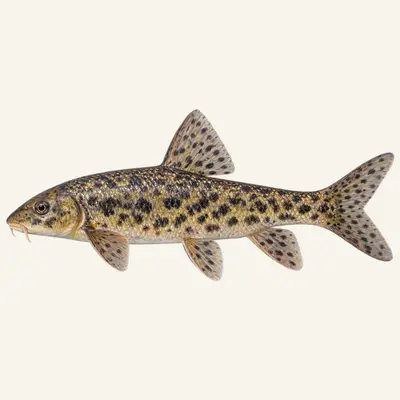
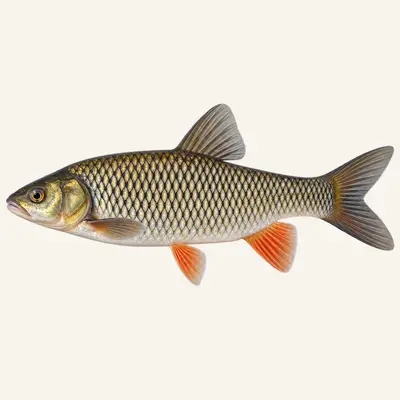
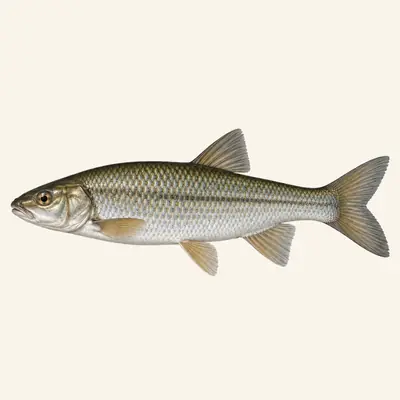
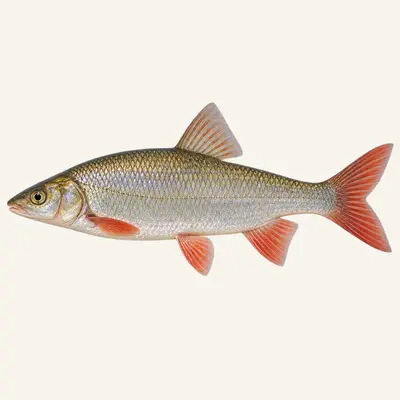
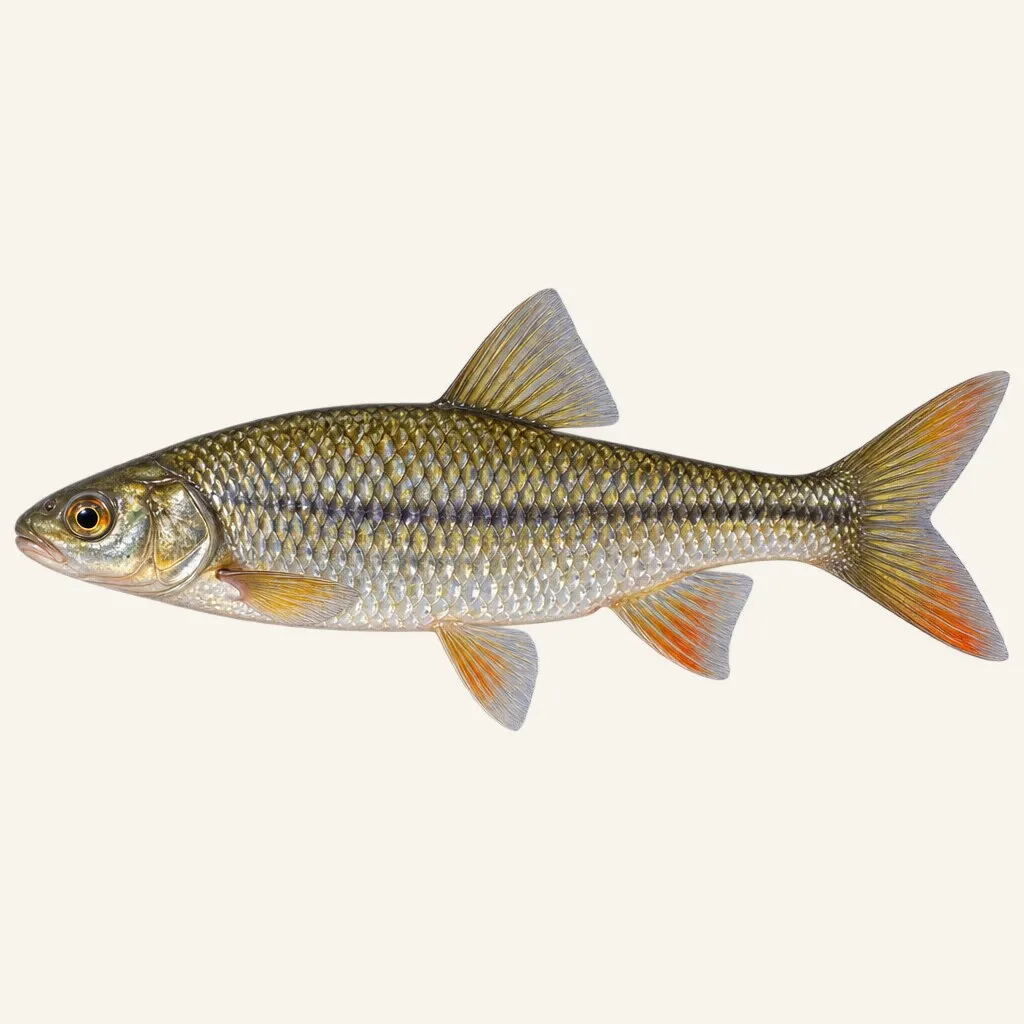
A freshwater cyprinid endemic to northwestern Iberia with an elongated, slightly compressed body and a greenish-grey back fading to silvery flanks, closely related to the European chub.
Calendar
Its range
The fish holds the north-west quarter of the peninsula: the Douro, Mondego, Umia, Limia, Tagus, Mino and Lerez.
Those are Atlantic drainages, and the shape of that list is the shape of a watershed rather than a climate limit. The interesting entry is the Tagus, because the southern Iberian chub occupies it too — the two ranges meet in that one basin, which makes the Tagus the only water where the osteological characters have to be used rather than merely cited.
The species is listed in the Spanish Red Data Book.
Identifying it
Snout rounded, mouth set below the tip of it. On a live fish in the hand that is the whole of the field identification, and it is worth learning because the southern Iberian chub does the reverse: pointed snout, mouth right at the front. Head length runs about equal to the greatest depth of the body.
Everything else that separates this species from its Iberian relatives is bone. The infraorbital series is narrow — bones 2 and 5 measure roughly twice the width of the sensory canal running through them, where the southern species carries four to five times that width. Infraorbitals 4 and 5 are expanded, the preopercular-mandibular and infraorbital canals connect, and the supraethmoid is short and narrow. None of that can be read at the water's edge, and it is what published keys actually turn on.
The counts sit close to the neighbours and settle nothing on their own: 39 to 44 scales along the lateral line plus two or three, three to four and a half rows between that line and the origin of the pelvic fin, seven to nine soft rays in the dorsal, six to nine in the anal, 39 to 41 vertebrae.
Breeding
The species supplies males to something that is not itself. It takes part in the Iberocypris alburnoides complex, a tangle of Iberian cyprinid lineages in which hybridisation is not an accident but the working mode: males of this chub fertilise females of the complex, which is documented as the direction the cross runs in.
The consequence is administrative as much as biological. Protecting this fish also means keeping a genetic system running that produces animals answering to another name, and a river emptied of it loses more than one species.
The water it needs
Hill streams down to the middle reaches of rivers, on the low plains and at altitude alike. Read as a preference list that says almost nothing; read as a tolerance, it says everything.
The decisive trait is physiological: the fish withstands low oxygen through the summer. Iberian rivers in August are warm, shrunken and short of oxygen, and a species that keeps working under those conditions inherits the reaches that more demanding fish have vacated. The distribution therefore has less to do with what the water offers in spring than with what it becomes in high summer.
Areas
- Shallow riffles
- Vegetated banks
- Moderate current zones
- Small tributaries
Techniques
- Float fishing
- Light bolognese
- Surface fishing
- Light feeder
Baits
- Maggots
- Bloodworms
- Earthworm fragments
- Bread flake
What it eats
Juveniles are omnivorous. Adults switch to arthropods and other animal prey, and they are reported to take the fry of other fish species.
That last item changes the standing of the animal. A cyprinid of this size is usually a consumer of invertebrates and nothing more; one that eats fry has a hand in the recruitment of its neighbours, which puts it in the middle of the food web of a small Iberian river rather than at the bottom of it.
How to catch it
A fish that runs from hill brooks to middle reaches, at any altitude, has to be looked for everywhere — but its tolerance of deoxygenated water gives a season and a place. In the warm, reduced stretches of late summer, where the rest of the assemblage has withdrawn, this is often what remains.
Fry in the diet opens presentations that most cyprinids of the same length would ignore: small fish imitations, tiny spinners, a strip of flesh. Common length is around 13 cm, so the tackle stays at the fine end whatever the method.
It is of no commercial interest and no target for sport fishing, which is worth saying plainly. Most captures are incidental, taken while fishing for something else, and the reasonable thing to do with one is to identify it and put it back.
Conservation · Near Threatened (IUCN) — This species is in decline. Release your catch quickly and handle it with care — wet hands, as little time out of the water as possible.
Conservation
Habitat destruction and pollution are the recorded pressures, and there is a third: the arrival of introduced fish species. All three act on a range of seven river basins, none of them large, in a peninsula where summer flow is the scarce resource.
The hypoxia tolerance is worth reading correctly, because it is easy to mistake for safety. It protects the fish from the low water itself, not from what happens in what remains. A pollutant load that a winter river dilutes to nothing arrives at full strength in an August pool, and abstraction for irrigation compounds the effect by removing the diluting volume outright.
Its place in the hybrid complex makes recovery harder to judge. Counting fish that look like this species does not, by itself, establish that the lineage is intact, and the peninsula has no other stock to restock from.
Regulations
Check the local regulations in force (legal size limits, closed seasons, bag limits).
For guidance only. Legal sizes, quotas and open seasons vary by location and season: always check the local regulations in force before fishing.
Other names
Iberian chub, or northern Iberian chub where both Iberian species are under discussion at once; escalo and bordalo in Portuguese and Spanish regional use, names that get applied to whichever chub is local. The epithet honours Charles III of Spain.
The species was described in 1988 and spent its early literature as Leuciscus carolitertii, which is the combination under which the older Iberian faunal work files it. Anything predating the move to Squalius uses the other genus for the same fish.
Sources: fishbase.se · api.gbif.org · fishbase.se