Catla
Labeo catla · Cyprinidae
- Freshwater
- Carp & coarse
- Medium
- Size
182 cm
- Weight
39 kg
- Water temp.
18–28 °C
Where to fish
- Estuary
- Lake
- River
Habitat icons: Flaticon
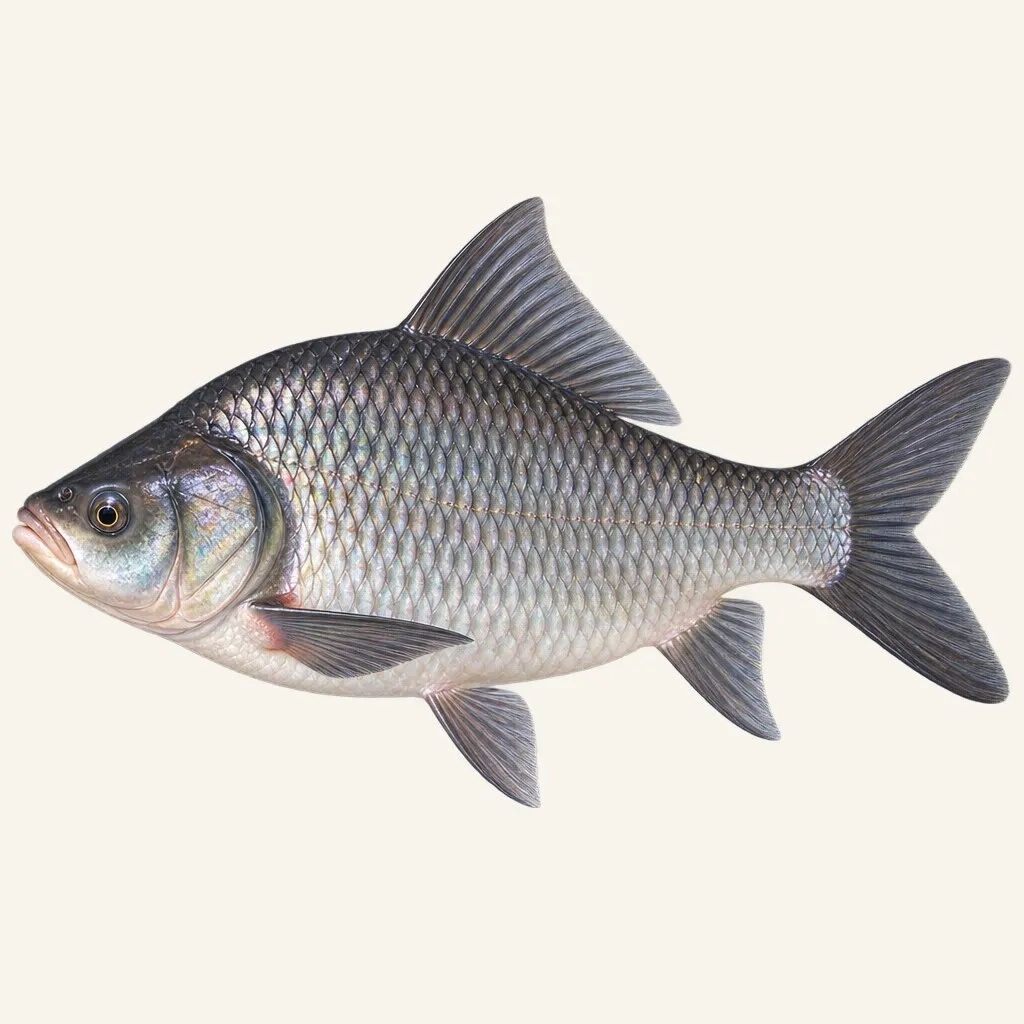
The catla is a large cyprinid with a massive body, broad head and prominent upturned mouth, with large silvery scales on the flanks.
Calendar
Recorded in 1 country
India
GBIF occurrence records — native and introduced populations combined.
Its range
The species belongs to Pakistan, India, Bangladesh, Nepal and Myanmar, and has been introduced beyond them. The recorded latitude band is the detail worth reading: it runs from well north of the native rivers to 19 degrees south, which means the introductions crossed the equator. A fish taken from the northern tropics has been established in the southern ones.
Two tolerances made that portability possible. The species holds from 18 to 28 degrees, a warm but not narrow window, and it accepts brackish water, so a delta or a coastal lagoon does not stop it. Neither trait is exceptional on its own; together they open a very large part of the tropics.
Identifying it
The mouth is turned upwards and the lower jaw juts out in front of the upper one. On a cyprinid, that is close to an inversion: most of the family carries a mouth slung under the snout for working the bed, and this one is built to take material off the underside of the surface film. Everything else about the head follows the same design — it is broad, and it is large in proportion to the fish.
The body is deep, its depth going two and a half to three times into standard length, which gives a short high silhouette rather than a torpedo. The scales are conspicuously large, the flanks silvery under them. The pectoral fins are long enough to reach back to the pelvics, a proportion easy to check on a fish in the hand and unusual enough to be worth checking.
The fin counts are simple: 17 soft rays in the dorsal, seven or eight in the anal, and no spines anywhere.
Breeding
Adults live in rivers, in lakes and in culture ponds. Mature fish breed in rivers.
Those two sentences sit next to each other in the record and the gap between them is the important part. A pond can hold catla for its entire growth, to a very large size, and get nothing out of them: the fish is potamodromous, the spawning act belongs to running water, and a still pond is reproductively a dead end. Every catla in a pond therefore comes from somewhere else — from a river fishery for eggs and fry, or from a hatchery that induces spawning artificially.
That dependence is why the species is bound to two kinds of water at once, and why a change to the rivers is felt in ponds hundreds of kilometres away that look entirely self-contained.
Areas
- Large slow-flowing rivers
- Lowland reservoirs and lakes
- Calm mid-water zones
- Tributary mouths
Techniques
- Bolognese fishing
- Surface feeder
- Match fishing
- Pole fishing
Baits
- Flour dough balls
- White bread
- Mustard seeds
- Groundnut cake
- Cooked rice
What it eats
Catla feeds at the surface and in mid-water, which no other large carp in its ponds does. The diet is broadly omnivorous; juveniles have been recorded on aquatic and terrestrial insects, on detritus and on phytoplankton, so the fish is not a specialist filter feeder so much as a generalist that happens to work the upper layers.
The consequence is straightforward. Terrestrial insects on the surface, drifting plant material and the plankton concentrated in the warm top half of a pond are all resources that a bottom-oriented fish never touches, and catla has them to itself. It is the top tier of the three-carp pond that South Asian fish culture is built around, with the mrigal on the floor beneath it, and its mouth is the whole reason it is stocked there.
How to catch it
This is a carp that is not fished on the bottom, and the whole approach turns on that. A bait lying on the bed sits below the fish rather than in front of it; the water it works is the top half, and floury or plant-based preparations suspended or drifting there are what reach it.
The deep body and the large surface area do the rest. A fish shaped like that, hooked in the upper layers of open water, has nothing to bolt into and uses its flank against the line instead, so the fight is a long series of arcs at middling depth rather than a dive for cover.
Timing follows the rivers. The species is a genuine sport fish in its own range, taken at the mouths of tributaries and in the calm mid-water of large slow rivers and lowland reservoirs, and the fish that concentrate there in the run-up to spawning are fish on their way to spawn.
Regulations
Check the local regulations in force (legal size limits, closed seasons, bag limits).
For guidance only. Legal sizes, quotas and open seasons vary by location and season: always check the local regulations in force before fishing.
Other names
Catla is the English name, borrowed from the vernacular without translation, and for most of the time the fish has been known to science it was also the genus: Catla catla, a tautonym, which is how most of the fisheries and aquaculture literature still writes it. That name no longer stands. The species has been returned to Labeo, the large Asian genus it came out of, and the catalogue follows that placement.
The practical consequence is bibliographic. A search under the old tautonym and a search under the current binomial return different sets of papers, and the aquaculture literature, which is enormous for this fish, sits almost entirely under the discarded name.
Labeo comes from the Latin for a fish with thick lips, which suits the genus better than it suits this member of it — a lipped bottom-feeder is precisely what catla is not. The name records where the species sits on a family tree, and says nothing at all about where it sits in the water.
Sources: fishbase.se · api.gbif.org