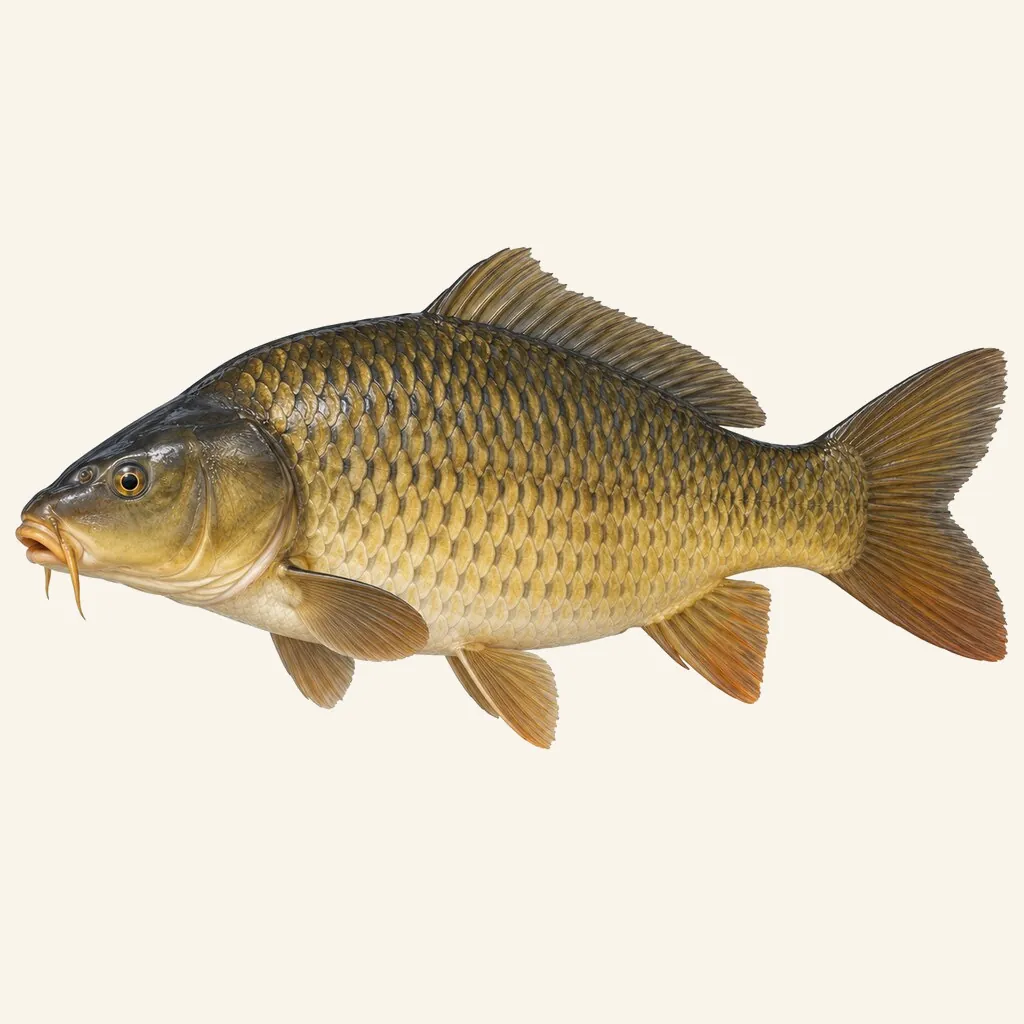
Common carp
Cyprinus carpio · Cyprinidae
- Freshwater
- Carp & coarse
- Hard
- Size
50–129 cm
- Weight
1.8–40 kg
- Lifespan
38 years
- Water temp.
3–35 °C
- Depth
0–29 m
Where to fish
- Canal
- Lake
- Pond
Habitat icons: Flaticon
An iconic recreational angling fish, able to learn and remember dangers
Calendar
Spawning: fish are vulnerable. Check local rules — closed seasons vary by country.
Recorded in 46 countries
Algeria · Argentina · Australia · Austria · Belarus · Belgium · Brazil · Canada · Chile · China · Colombia · Croatia · Czechia · Denmark · Finland · France · Germany · Greece · Hong Kong SAR China · Hungary · India · Indonesia · Israel · Italy · Japan · Luxembourg · Mexico · Netherlands · New Zealand · Norway · Poland · Portugal · Romania · Russia · Slovakia · Slovenia · South Africa · South Korea · Spain · Sweden · Switzerland · Taiwan · Türkiye · Ukraine · United Kingdom · United States
GBIF occurrence records — native and introduced populations combined.
Its range
The native range of the carp is narrow, which is the opposite of what its worldwide presence suggests. Genuinely wild populations occur only in rivers draining to the Black, Caspian and Aral Seas. Everything else — western Europe, North America, East Asia, Australia, Africa — comes from introductions, some dating to Roman times and many to the Middle Ages, when monastic estates turned this fish into a pond crop.
That history has a paradoxical result. Carp are everywhere, and wild carp are disappearing. The riverine population of the Danube, taken to be the origin of the European strains, is now under threat. Two forces work together: river regulation, which removes the floods spawning depends on, and hybridisation with domesticated stocks and East Asian relatives released into the same water.
The map above therefore blends the native range with six centuries of human transport, without telling them apart.
Identifying it
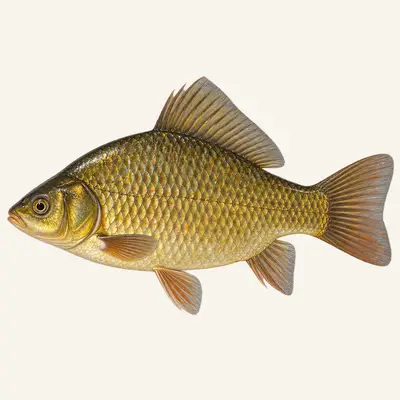
Four barbels: two short ones on the upper lip, two longer at the corners of the mouth. That is the character separating carp from every other European cyprinid, and it settles the question when colour muddies it.
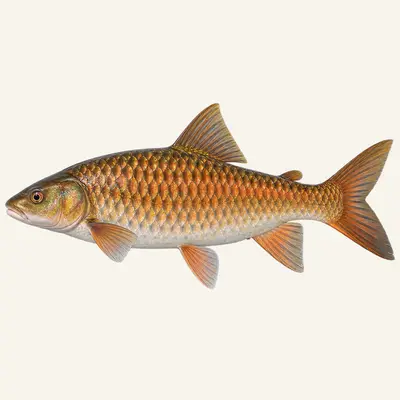
The rest is bewilderingly variable. Carp shift in shape, proportion, scaling, fin development and colour according to strain and to the water they grew up in. A wild river carp is streamlined, roughly three and a half times longer than deep; a pond fish fattened over generations can be twice as stocky. The body runs from grey through bronze to outright gold.
Two details never move and are worth knowing. The last ray of the anal fin is bony and serrated along its rear edge — that is what catches in landing nets and opens the fingers of a hurried angler. And the pharyngeal teeth, deep in the throat, are flattened molars: a fish with no teeth in its mouth that can still crush a mussel or a hard seed.
The tail fin is clearly forked, the dorsal long, carried on fifteen to twenty branched rays. Those figures, invisible at any distance, are what serious identification rests on.
Breeding
Carp spawn in very little water, over vegetation, and their success hangs on a precise run of weather. Adults move into backwaters and flooded meadows, sometimes well away from where they normally live. One female is followed by several males — the species is polygamous — and releases sticky eggs that fasten to submerged plants.
The numbers are startling: a single female may lay more than a million eggs in a season. The trade-off is a narrow set of conditions. Spawning needs water between fifteen and twenty degrees, hatching follows in four days, and larvae survive only in very warm water among shallow submerged vegetation.
Hence an observation that explains the missing year classes: reproduction only really succeeds when levels rise in May and the flooding of terrestrial vegetation lasts, with high temperatures, into June. A cold spring or a regulated level, and an entire cohort fails to appear. In the tropics, where those conditions hold all year, carp breed continuously.
The water it needs
Carp want warm water, slow or still, over a soft bed. Lowland rivers, large well-vegetated lakes, ponds, canals: wherever current fades and sediment gathers, they thrive. They tolerate conditions that see other species off, including heavy turbidity and low oxygen, and do particularly well in large coloured rivers.
That hardiness explains their presence in water you would write off — an urban canal, a reservoir margin, a shallow gravel pit. It also explains their status as a problem species in several countries: by grubbing through the bed, a dense population keeps sediment permanently in suspension, which clouds the water, cuts the light and pushes back the aquatic plants other species depend on.
Activity concentrates at dusk and dawn. The rest of the time carp alternate spells of feeding with periods of stillness, often at the surface in warm weather — where they can be watched taking floating insects, unexpected behaviour in a fish assumed to be welded to the bottom.
Areas
- Muddy bottoms
- weed beds
- calm areas
- ponds
- lakes
- canals
Techniques
- Hair rig
- Method feeder
- Zig rig
Baits
- Boilie
- Pellets
- Seeds
- Natural baits
What it eats
Carp are omnivorous bottom-feeders, as adults and as juveniles. They take what the bed holds — insect larvae, worms, molluscs, crustaceans — and supplement it heavily with plant material. Those flattened pharyngeal molars let them crush shells few freshwater fish can open.
That lack of specialism is their strength. Where a strict predator depends on one prey being present, carp make do with what they find, which is why they establish themselves so durably in almost any water they are put into.
They do not ignore the surface either. They are regularly seen sipping floating insects, behaviour that contradicts the image of a purely bottom-grubbing fish and opens an entirely different approach for the angler.
How to catch it
Everything in carp fishing follows from how they feed. They do not hunt, they sift: they suck in, taste, and blow out. A bait can enter and leave the mouth without anything moving at the other end of the line. That is why the delicacy and discretion of the rig count for more here than the power of the rod, and why self-hooking arrangements came to dominate this branch of the sport.
Baiting does the rest, and it is not about feeding. A full carp takes nothing; the point is to hold fish on a spot and settle them. Substantial, spaced deposits beat a continuous trickle, and a swim prepared the evening before regularly outperforms a whole day spent changing baits.
Temperature sets the rhythm of the season. In cold water the metabolism slows to the point that a fish may go weeks without feeding seriously; the first spring warmth and the long days of autumn open the best windows. Through the heat of summer carp come to the surface, and looking for them on the bottom means fishing where they are not.
Then there is the sheer force. A fish of that mass, in cluttered water, reaches an obstacle in seconds. The fight is won less by tackle strength than by angle: the task is to keep it out of the weed and the snags, not to winch it in.
Conservation · Vulnerable (IUCN) — This species is threatened with extinction. Always release it (no-kill), handle it with the utmost care and check local rules — fishing for it may be prohibited.
Conservation
Counting the world's carp says nothing about the state of the species. The total mixes the native populations with everything four centuries of stocking put on five continents, and at that scale carp really are innumerable.
The genuinely wild populations are another matter. River regulation removes the spring floods without which spawning fails, and hybridisation with farmed strains and Asian relatives dilutes what remains. An ever-present fish can watch its original form disappear, and that is what is happening in the Danube.
Conversely, several countries treat it as a problem species where it was introduced, because of its effect on turbidity and aquatic plants. Depending on which bank you stand on, the same fish is to be protected or to be contained — an unusual ambivalence, and worth knowing before deciding what to do with a catch.
Regulations
Generally no minimum size / Variable closed season
For guidance only. Legal sizes, quotas and open seasons vary by location and season: always check the local regulations in force before fishing.
Other names
Common carp covers the wild form and the farmed varieties alike, which keeps a persistent confusion alive. Mirror and leather carp are not species but selected lineages, told apart by their scaling: full cover, a few scattered large scales, or bare skin. French speakers say carpe commune, Germans Karpfen.
Sources: fishbase.se · api.gbif.org