Brook barbel
Barbus caninus · Cyprinidae
- Freshwater
- Carp & coarse
- Medium
- Size
15–25 cm
- Weight
0.0–0.2 kg
- Lifespan
5 years
- Water temp.
18–28 °C
Where to fish
- River
Habitat icons: Flaticon
Small alpine barbel - 4 barbels - inferior mouth
Calendar
Recorded in 2 countries
GBIF occurrence records — native and introduced populations combined.
Its range
The native range is a ribbon of piedmont on the Adriatic slope, between the Marecchia and the Brenta, in Italy and Switzerland. It is narrow, and it is entirely upland: what the range follows is not a basin but a band of altitude, repeated across a series of separate rivers.
The fish has also been introduced on the Tyrrhenian side, in the Arno and the Ombrone.
Its identity took a long time to settle. It was first confused with Barbus meridionalis and carried that name; the records from the Soča once attributed to it in fact belong to Barbus balcanicus. Three names have thus passed over fish of which two were not this species, and the older literature has to be read with that in mind — including anything it says about range.
Identifying it
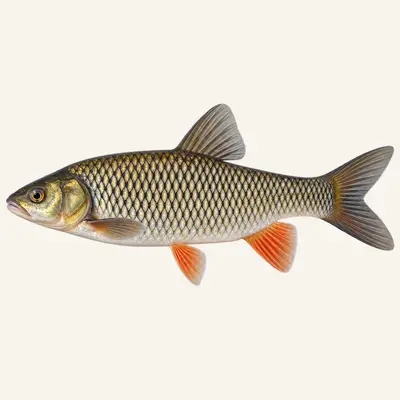
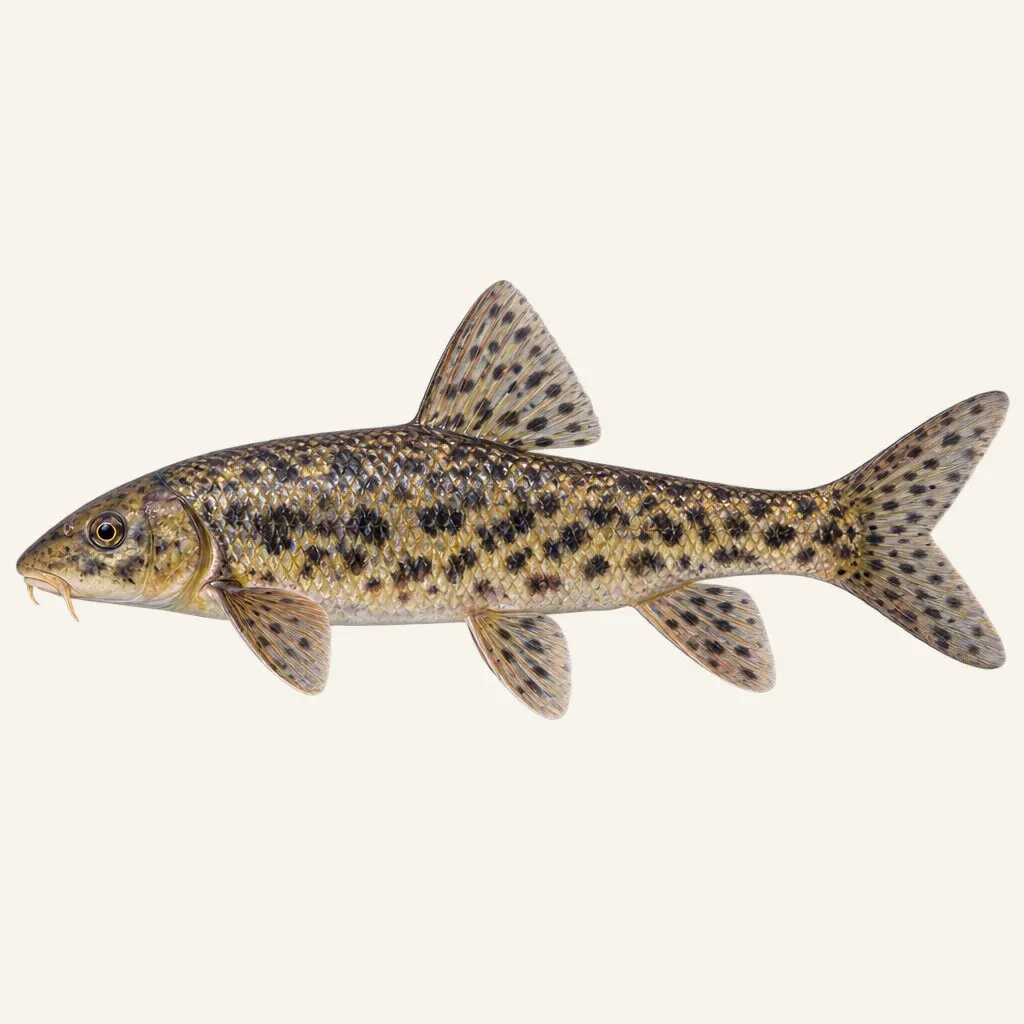
Its fins are thick and fleshy, and the lobes of the tail are rounded rather than drawn out. That is the profile of a fish that wedges itself under a stone in a torrent, not of a swimmer working an open current, and it is visible the moment the fish leaves the water.
The livery is the boldest in the genus in Italy: large irregular black patches and frank blotching, spread across the back, the flanks and onto the fins themselves. Nothing fine, nothing stippled — marks that can be made out a metre away in clear water.
The counts confirm it, and they run low: 36 to 47 scales along the flank, two or three more on the tail base, 22 to 24 rows around the caudal peduncle. No other barbel on the peninsula goes that low. The lining of the body cavity is black, against grey and white in the two other Italian species, which makes it a decisive character available only on a fish that has been killed.
The ray at the front of the dorsal stays flexible and is not toothed. The lower lip extends backwards into a median lobe. It stays small, and the greatest reported age is five years.
The water it needs
It holds strong current, around stones and under them, in the quick brooks of hill and sub-alpine country. The station is the boulder rather than the pool or the open riffle: the immediate hydraulic shelter behind or beneath a rock, where the velocity drops away over a few centimetres.
It spawns in the same fast water, over gravel. No winter descent is documented for the species, and no seasonal change of habitat — the torrent is the only address it has, in every month of the year.
Areas
- Rocky alpine torrents
- Fast shallows
- Rapid-current zones
Techniques
- Feeder
- Bolognese float
Baits
- Worms
- Pellets
- Maggots
What it eats
It hunts invertebrates on the bed. Nothing else is documented, and the brevity of the diet goes with the brevity of the life: a fish of five years in a cold torrent has neither the time nor the occasion to broaden its menu the way a long-lived lowland cyprinid does.
How to catch it
A short fish in heavy current, pressed in under the stones: the rig has to reach the bottom fast and stay short. A light feeder and a Bolognese float run down the seam are the two approaches on record, with worms and larvae for bait, worked into the pockets rather than swum through open water.
Its dorsal presents no danger to the hand, unlike that of the large barbels. The precaution is of another sort. Five years is the known ceiling on age, and the number of active spawning grounds has fallen sharply, so each adult taken represents a far larger share of the population than it would in a fish that lives for twenty.
Conservation · Near Threatened (IUCN) — This species is in decline. Release your catch quickly and handle it with care — wet hands, as little time out of the water as possible.
Conservation
The species is still commonly encountered in habitat that suits it, and the number of spawning sites has dropped markedly all the same. The two statements do not contradict each other; they follow one another. Adults remain visible for as long as a generation after recruitment has stopped.
Here that generation is five years, and that is the decisive figure on this page. An Iberian barbel reaching eighteen years absorbs a decade of failed spawnings on the backs of its old fish; this one has nothing of the sort to fall back on. Counting the fish present therefore says nothing about the state of the stock. The count that matters is the count of spawning grounds, and that is the one going down.
Regulations
Check the local regulations in force (legal size limits, closed seasons, bag limits).
For guidance only. Legal sizes, quotas and open seasons vary by location and season: always check the local regulations in force before fishing.
Other names
Italian says barbo canino and German Semling, and both of them use the same words for Barbus meridionalis. The duplication is the direct residue of the taxonomic confusion: the two fish shared a scientific name long enough for everyday language to make only one out of them, and no one has since had a reason to prise them apart.
English took the habitat instead and calls it the brook barbel, sometimes the Italian brook barbel. That is the best of the names available, because it says where to look; the Latin caninus, dog-like, describes nothing about the animal that anyone has been able to point at since.
Sources: fishbase.se · api.gbif.org