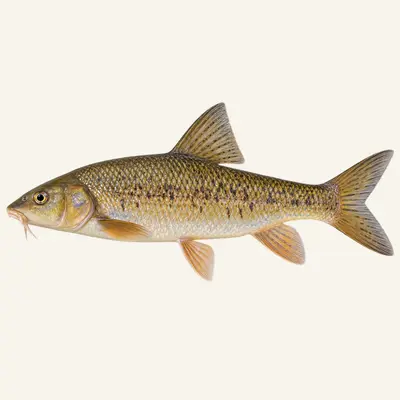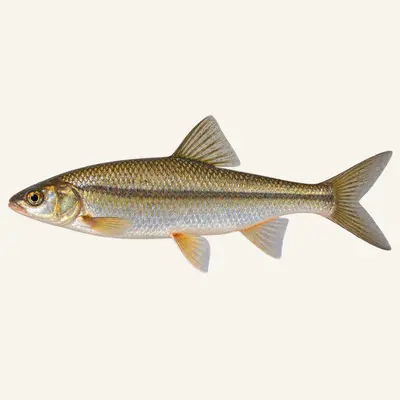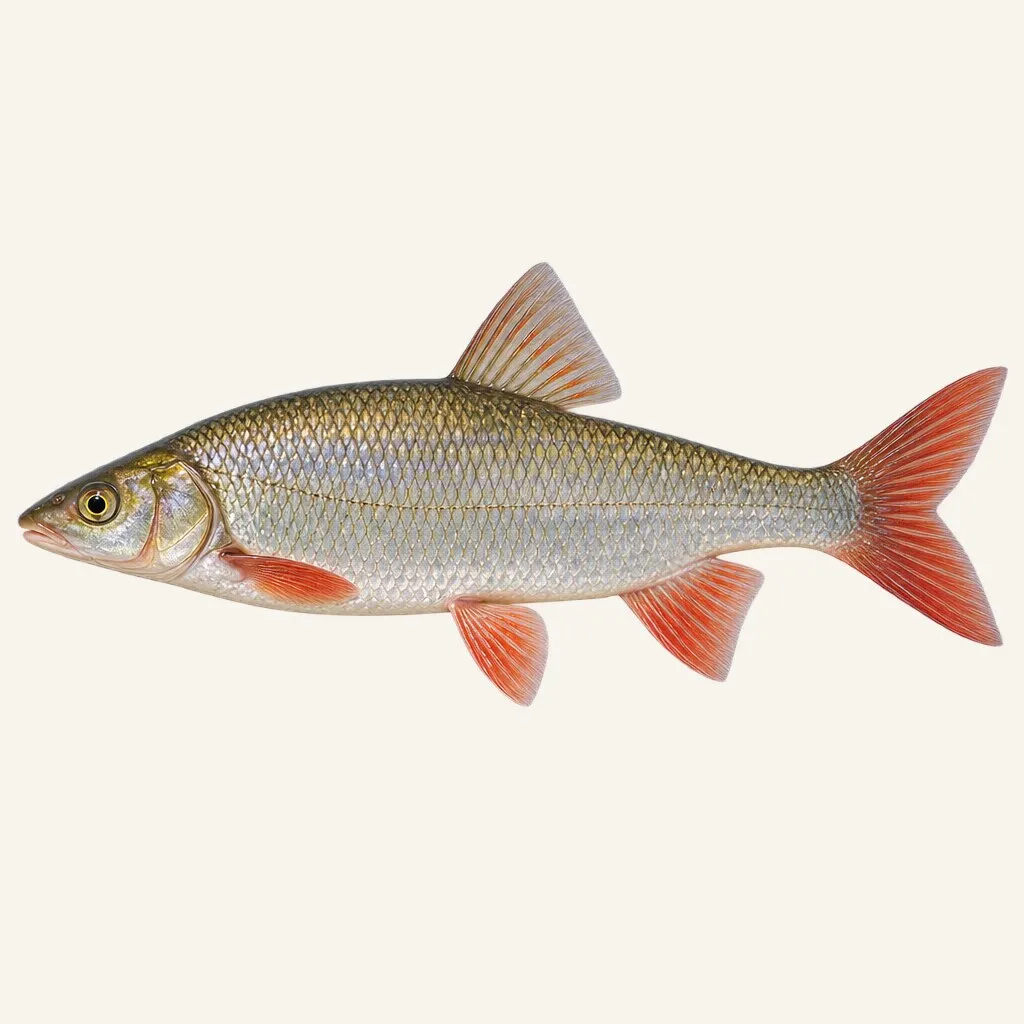
Common nase
Chondrostoma nasus · Cyprinidae
- Freshwater
- Carp & coarse
- Easy
- Size
25–50 cm
- Weight
0.2–1.5 kg
- Lifespan
15 years
Where to fish
- River
Habitat icons: Flaticon
See nase (synonym or closely related species depending on classification)
Calendar
Recorded in 18 countries
Austria · Belgium · Bosnia & Herzegovina · Bulgaria · Croatia · Czechia · France · Germany · Luxembourg · Montenegro · Netherlands · Poland · Romania · Serbia · Slovenia · Switzerland · Türkiye · Ukraine
GBIF occurrence records — native and introduced populations combined.
Its range
The native range covers the Black Sea drainages — the Danube, the Dniester, the Southern Bug and the Dnieper — the southern Baltic by way of the Neman, the Oder and the Vistula, and the southern North Sea basin as far west as the Meuse, with Turkey completing it on the Asian side.
Everything west and south of that line was put there. In France the fish is introduced in the Rhône, the Loire, the Seine and the Hérault; in Italy and Slovenia, in the Soča. The consequence is a map no observer can read off the fish: the same species is native in one French basin and an introduction in the next, and there is nothing about an individual to say which.
One reading note. Records from the Drin drainage, including Lakes Ohrid and Skadar, belong to a distinct species and should not be attached to this one.
Identifying it
The mouth is not finished until the fish is grown. Past 20 cm standard length it forms a straight transverse slit under the snout, with a thick horny sheath along the lower lip; below that size it has not yet taken the shape. A small specimen and a large one therefore do not key out the same way, and the character that identifies the species is one the animal acquires rather than one it is born with.
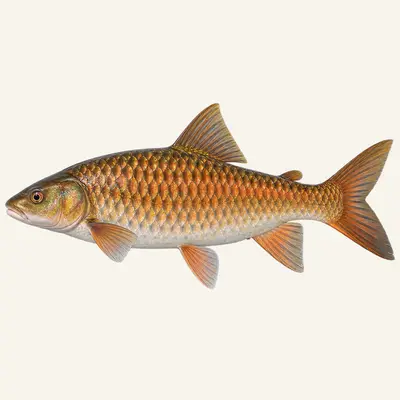
Colour helps at a distance, in clear water and from a bridge. The pectoral, pelvic, anal and caudal fins are red. The published diagnosis uses that redness explicitly to separate this fish from the related grazers of the Atlantic, Adriatic and Mediterranean basins of France, Italy and Slovenia, alongside the straight mouth, the horny lip and a gill raker count of 27 to 36. The comparison is in the source, and it is the one to lean on where those species share a river.
The flank is silver and carries no broad dark band along its middle. The eye is large, its diameter between half and two thirds of the space between the orbits. The lateral line holds 52 to 66 scales and usually 60 to 63; the dorsal fin carries nine and a half branched rays and the anal 10 to 11 and a half; the tail has 19 to 21 rays. There are 47 or 48 vertebrae, a high count that goes with the long, cylindrical build of a fish that holds station in current.
Breeding
A female spawns once a year, and in some populations the whole of it is over in three to five days.
Before that there is a journey. Adults run some tens of kilometres upstream to reach the spawning grounds, which are frequently in tributaries rather than in the main river. On arrival the males gather in large numbers, each holding a small territory — a mosaic of adjacent posts rather than a hierarchy — and the females lay adhesive eggs into hollows excavated in shallow gravel under fast water.
Three conditions therefore have to coincide within a few days: a passable route to the tributary, a flow that is neither a flood nor a drought at that exact moment, and gravel still loose enough to be dug and permeable enough to keep the eggs supplied with oxygen. There is no second attempt in the same year.
The water it needs
The lie is unusually specific and it can be picked out from the bank. Adults hold fairly shallow, quick water, often right beside the eddies thrown off bridge piles and boulders — where the flow accelerates, the bed stays clean, and a fish can sit at the edge of the fast thread without swimming in it. The river type is medium to large with moderate to fast current over rock or gravel.
Position sorts by age across the width of the channel. Larvae hold just under the surface and then along the margins; early juveniles lie on the bottom in very shallow water at the edge; each stage moves into faster water as it grows. A river holding this species is stratified from bank to midstream by size.
Winter rearranges all of it. Juveniles shelter in backwaters and in cavities under the banks. Adults drop downstream and mass into dense swarms in the lower reaches. A reach that appears abandoned in December has not lost its population — the fish are packed together a few kilometres below.
The species is gregarious in every season.
Areas
- Moderate to fast currents
- gravelly bottoms
Techniques
- Pole/coarse fishing
- Light feeder
Baits
- Maggots
- Worms
- Bread
What it eats
This animal changes trade halfway through its life, and its head is rebuilt to match.
Larvae and early juveniles eat small invertebrates, like every other young cyprinid in the river. Large juveniles and adults eat benthic diatoms and detritus — they graze the living film off stone. The switch arrives with the straight mouth and the hardened lip, around the same size at which those appear, so the anatomy and the diet turn over together. The 27 to 36 gill rakers belong to the second phase, sorting fine material rather than seizing anything.
Very few European cyprinids make a living this way. Most dig, hunt or filter; scraping a surface is a trade with different requirements, and the chief one is that the surface be clean. Diatoms grow on stone that current keeps swept. On a bed sealed under fine sediment there is nothing to scrape, and the fish is not equipped to switch back.
How to catch it
A grazer is not fished for like a predator or like a bottom-sifter. This fish is not hunting anything mobile and not sorting sediment for invertebrates; it is scraping a film. There is nothing to imitate, so the bait works by size and by how it moves in the current rather than by what it is.
The mouth sets the tackle. It is small, it sits under the snout, and its lower lip is hardened, so a hook proportioned to the gape and a positive hook-hold matter more than the strength of anything above them.
The lies are precise enough to be listed: shallow fast water over rock or gravel, and by preference the crease alongside a bridge pile or a boulder. The fish shoals, so a swim held properly gives more than one.
The season moves the target across the map. In spring the adults are upstream, possibly in a tributary tens of kilometres away. In winter they are massed low down the river. Between the two they occupy the quick water of the middle reaches. Fishing the same stretch all year is fishing an empty one for much of it.
The flesh is good and very bony, which is worth knowing before deciding the fate of a fish.
Conservation · Near Threatened (IUCN) — This species is in decline. Release your catch quickly and handle it with care — wet hands, as little time out of the water as possible.
Conservation
The calendar is what makes this species fail faster than its neighbours, and each element of it is a separate point of rupture. One spawning a year, in some rivers inside a window of three to five days, at the end of a migration of tens of kilometres into a tributary. An impassable sill removes the access. A spate or a drought falling across those few days removes the spawning. Neither is recoverable for twelve months, because there is no second release to fall back on.
The substrate is the second point, and it takes away both ends of the life at once. Eggs are buried in gravel, so fines settling into that gravel smother them; the same fines coat the stones the adults graze. A river carrying a heavy load of fine sediment removes this fish's food and its recruitment in a single stroke. Damming, the destruction of spawning sites and pollution are the three pressures named, and all of them work through those two mechanisms.
Outside its own range the relationship inverts completely. Introduced into the Rhône, this species outcompetes and eliminates Parachondrostoma toxostoma; introduced into the Soča, it does the same to Protochondrostoma genei. Two smaller grazers with the same trade, displaced by a larger one carried into their rivers. The fish being defended on the Danube is the fish being regretted on the Rhône, and both statements are correct.
Regulations
Minimum size 18-20cm depending on the country
For guidance only. Legal sizes, quotas and open seasons vary by location and season: always check the local regulations in force before fishing.
Other names
English writes common nase, and the word is a straight loan from German Nase, nose, for the snout that overhangs the mouth. There is no older English name because the species has never occurred in British rivers, and that absence is why the vernacular is unstable in translated texts: nase is applied loosely to several related grazers, none of which are this one.
German also uses Näsling, Italian naso, Czech ostroretka, the last meaning sharp-lipped and pointing at the horny sheath rather than at the snout.
Chondrostoma means cartilage mouth, again for that sheath, and nasus repeats the nose. Both halves of the scientific name describe the front of the head, which is a fair reflection of how much of this animal's biology is concentrated there.
Sources: fishbase.se · api.gbif.org