Grass carp
Ctenopharyngodon idella · Cyprinidae
- Freshwater
- Carp & coarse
- Hard
- Size
60–150 cm
- Weight
2.9–45 kg
- Lifespan
21 years
- Water temp.
0–35 °C
- Depth
0–30 m
Where to fish
- Pond
Habitat icons: Flaticon
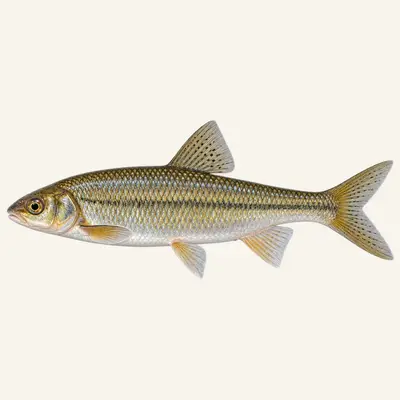
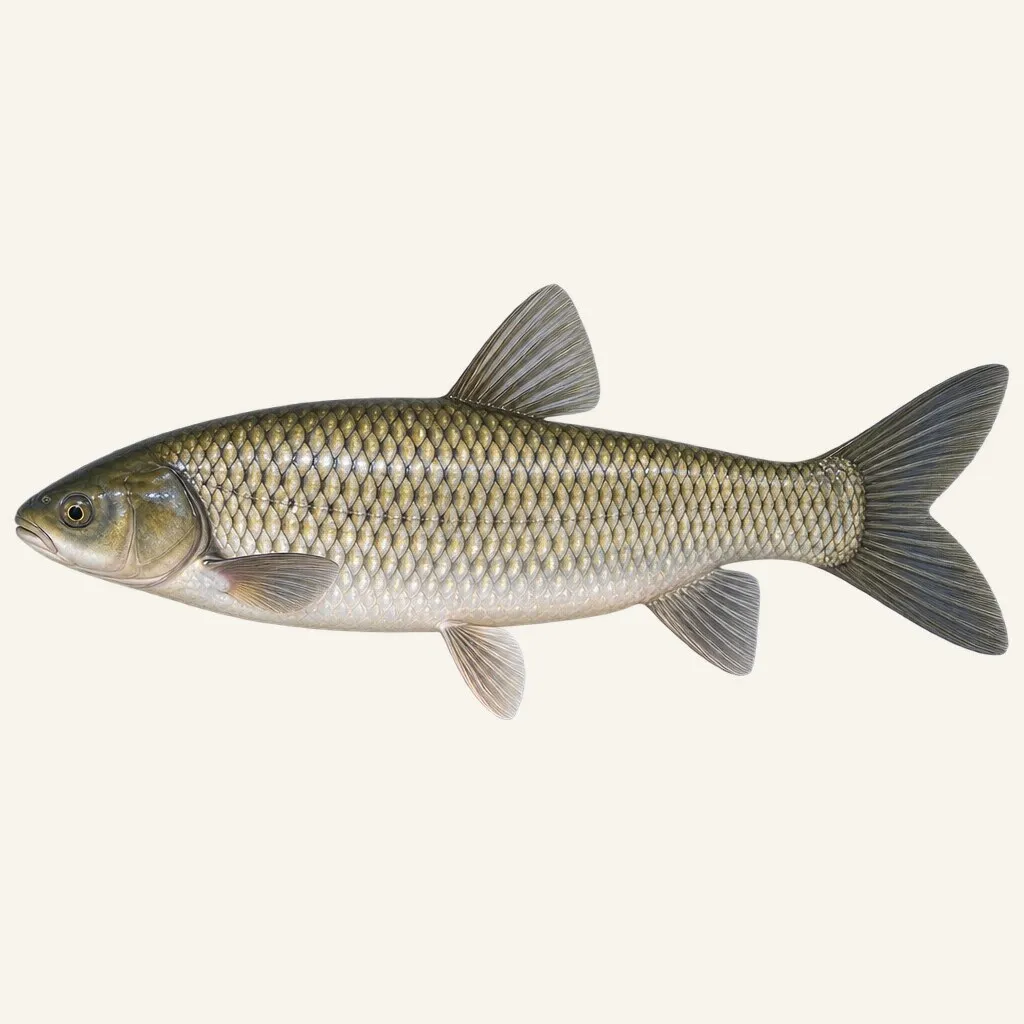
The grass carp is a large herbivorous cyprinid with an elongated, silver-olive body and clearly defined scales, native to East Asia and now widely introduced worldwide for aquatic weed control. It can exceed one metre in length and reach impressive weights in vegetation-rich waters.
Calendar
Recorded in 25 countries
Austria · Belgium · Canada · China · Czechia · Denmark · France · Germany · Hong Kong SAR China · Hungary · Italy · Japan · Luxembourg · Mexico · Netherlands · New Zealand · Poland · Russia · South Africa · Sweden · Switzerland · Taiwan · Ukraine · United Kingdom · United States
GBIF occurrence records — native and introduced populations combined.
Its range
The native waters are eastern China and the Amur system of eastern Siberia. Everything else is transport, and the transport was deliberate and worldwide.
Something else travelled with it. The introductions repeatedly brought the tapeworm Bothriocephalus acheilognathi, which established itself in local fish faunas and stayed. This is worth stating plainly because it is the part of an introduction that no management decision can undo: the carp can be removed from a water, the parasite it delivered cannot.
Several receiving countries have since put on record that the introduction did ecological harm, and in most of the places it was taken to the species is now classed as a pest.
Identifying it
No barbels. On a big heavy-scaled cyprinid in European or American water that single negative settles most of the question, because the fish it is taken for carries four of them.
The head is the next check and it is quick. The snout is very short — no longer than the eye is wide — while the part of the head behind the eye takes up more than half the head's length, so the eye sits well forward on a face that looks blunt and pushed in. The body is cylindrical rather than deep, olive to brassy green over the back, silvery white to yellow underneath. The dorsal carries 10 or 11 soft rays and the anal 10 to 14, with no spine in either, and there are 18 rays in the tail.
The character that actually defines the species is in the throat. The pharyngeal teeth are laterally compressed and serrated, with a groove running along the grinding face, set in what is usually a double row. That is a cutting comb, not a crusher, and it is what separates this fish from the black carp, which is nearly identical outside and carries a row of blunt molars instead. One is built to shear plants; the other is built to break shells. Their colour differs too — this one is green where the other is close to black — but colour is a judgement and teeth are not.
Breeding
Spawning happens over gravel in rivers, in very strong current, and the eggs are set free into it. They are pelagic. They hatch in two or three days, and they spend those days drifting downstream.
That is the constraint that governs everything about the species outside its native range. An egg that must stay suspended in adequate current for two or three days before hatching needs a long river, unobstructed and fast, with a nursery at the end of the drift. A lake cannot provide it. A canal cannot. A river cut into sections by weirs and dams cannot, because the drift ends in still water and the egg goes to the bottom.
The result is a fish present on every continent and reproducing on almost none of them. In Europe it persists only by stocking: every specimen encountered there was put in the water by somebody. First maturity comes at around 68 cm, within a recorded range of 58 to 79, and individuals have been aged at 21 years — a long-lived animal, which is what makes a stocked population look self-sustaining when it is not.
The water it needs
Adults hold in lakes, ponds, pools and the backwaters of large rivers, and the preference is consistent: big water, slow or standing, with vegetation in it. The fish wants the food and the slack together.
Its tolerances are close to absurd and they are the reason so few waters excluded it. It functions from zero to 38 degrees. It handles salinity up to 10 parts per thousand, which covers the inner reaches of an estuary. And it survives oxygen down to half a milligram per litre, a level at which most fish of comparable size are already dead. Between them, those three figures leave very little temperate or warm fresh water closed to it.
The asymmetry with its own reproduction is worth setting side by side. Almost any water will keep this fish alive; almost none will let it breed.
Areas
- Waters overgrown with vegetation
- ponds
- gravel pits
Techniques
- Surface rig
- Float
Baits
- Greens
- Corn
- Bread
- Fruit-flavored boilies
What it eats
It eats higher aquatic plants and submerged grasses. Detritus, insects and other invertebrates go down as well, but the plants are the diet and not a component of it.
Almost nothing else in the family does this. Cyprinids graze algae, sift plankton, crush molluscs and grub through sediment; a large one that mows vascular vegetation and turns it into flesh occupies a place in fresh water that was largely empty. The volume required is the striking part. Plant tissue is poor food, so an animal living on it has to process a great deal of it, and the fish's daily intake is measured against its own body weight rather than against a fraction of it.
That capacity, rather than the meat, is what carried the species around the world. It is one of the most heavily farmed fish on the planet and at the same time a tool: it was moved into canals, irrigation networks, ponds and reservoirs to clear vegetation, and in many of the places it now lives that was the entire reason for putting it there.
How to catch it
Herbivory rewrites the tackle box. There is no prey to imitate, so livebait, worms and the whole standard vocabulary of carp baits are beside the point. What works is what it eats: cut grass, tender stems, leaves, sweetcorn, soft vegetable pieces, fished in or beside the weed beds it is grazing.
It also feeds where it can be seen. A grazing grass carp works the surface and the upper layer of the vegetation, and it is one of very few large cyprinids that can be located by eye before a line is wet. Fishing for it blind on the bottom is fishing under it.
The scale of the animal decides the rest. It reaches weights that put it beyond ordinary float tackle, and it does so in exactly the cover it feeds in, so gear is chosen for getting a heavy fish out of weed rather than for casting distance or subtlety. Twenty-one years of growth in a well-vegetated water produces a fish that a light rod will simply lose.
Conservation
The subject here is not the state of the species but the state of the waters it has been put into, and the mechanism is not competition.
An adult herbivore of this size removes submerged vegetation. Once the vegetation is gone, so is the spawning substrate of every phytophilous fish in the water, the cover in which their fry survive their first weeks, and the physical structure the invertebrate community lives on. The effect runs through the whole assemblage without the carp ever touching another fish, which is why the damage is often noticed only after several seasons, when year classes of other species have quietly failed to appear.
There is one lever, and it comes from the drift requirement. A population that cannot reproduce locally lasts exactly as long as the fish that were introduced, so a decision to stop stocking is a decision that eventually takes effect. The tapeworm does not work that way.
Regulations
Strict regulations / Often prohibited to release
For guidance only. Legal sizes, quotas and open seasons vary by location and season: always check the local regulations in force before fishing.
Other names
Grass carp names the diet, and it is the only widely used English name that does. In North America the same fish is also the white amur, after the river it came from — so one language calls one animal after what it eats and after a Siberian tributary, and the two names are used by the same agencies in the same documents. A reader who does not know they are synonyms will read two species where there is one.
The genus name is the more informative label. Ctenopharyngodon assembles the Greek for comb, throat and tooth: the fish is named for those serrated pharyngeal combs, which is to say for the organ that does the cutting. It is rare and rather satisfying for a scientific name to point straight at the character that matters.
Sources: fishbase.se · api.gbif.org