Goldfish
Carassius auratus · Cyprinidae
- Freshwater
- Carp & coarse
- Easy
- Size
15–48 cm
- Weight
0.0–1.6 kg
- Lifespan
41 years
- Water temp.
0–41 °C
- Depth
0–20 m
Where to fish
- Canal
- Lake
- Pond
- River
Habitat icons: Flaticon
An omnivorous East Asian cyprinid with an often golden coloration, introduced and naturalized in many waters worldwide.
Calendar
Recorded in 31 countries
Australia · Austria · Belgium · Canada · China · Czechia · Denmark · France · Germany · Hong Kong SAR China · Iran · Italy · Japan · Luxembourg · Mexico · Netherlands · New Zealand · Norway · Poland · Portugal · Russia · South Africa · South Korea · Spain · Sweden · Switzerland · Taiwan · Ukraine · United Kingdom · United States · Vietnam
GBIF occurrence records — native and introduced populations combined.
Its range
The native range is confined to East Asia, China and Japan. Everything beyond that is the result of release, and the comparison with other travelling cyprinids ends there: the carp moved because it was eaten and the rainbow trout because it was fished for, while this fish spread because people kept it alive at home.
Its domestication began roughly a thousand years ago in China, from a wild olive-brown Carassius. Individuals that lost their dark pigment were separated out, held in tanks, then bred for colour, body form and fin development. Japan took up the culture in the sixteenth century and Europe met it in the seventeenth. Every ornamental household since has been a possible point of departure, because one emptied bowl is enough.
A documentary difficulty sits on top of that. The eastern European gibel carp was long filed under this name, so a good share of the older records of this species on the continent in fact refer to its relative. Maps built on those records overstate how long it has been here.
Identifying it
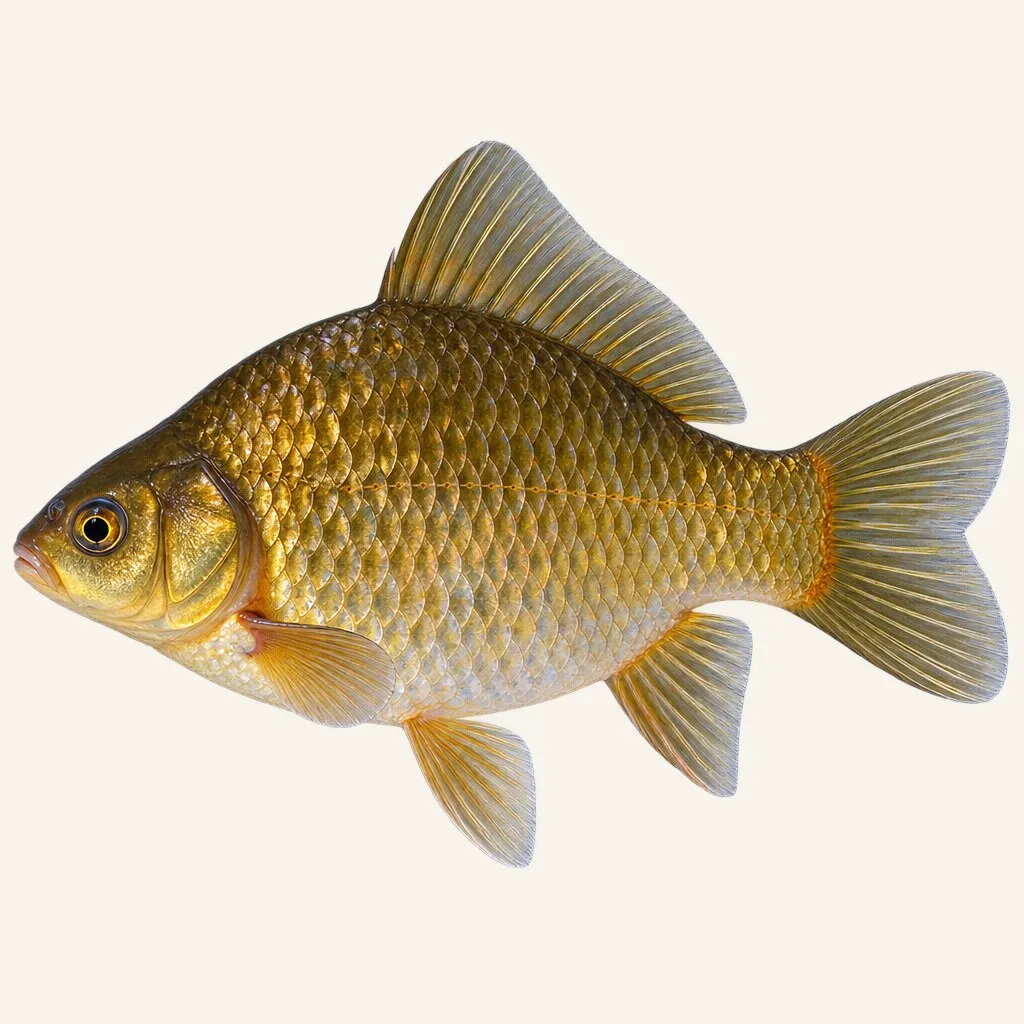
A goldfish taken from open water is not gold. Wild-caught individuals run olive-brown, slate-olive or olive-green with a bronze sheen, through silvery and greyish-yellow to grey-silver, and only sometimes to a true gold, usually blotched with black; the underside is yellowish white. Scarlet, pink, white, black and their combinations are ornamental lines, and the descendants of a released fish drift back to the drab colouring within a few generations. Colour, in short, identifies a strain and not a species.
The decisive character is an absence. There is no barbel anywhere — none on the upper jaw, none at the corners of the mouth. Faced with a stocky cyprinid in a canal or a park lake, that is the first thing to establish, because it separates this fish from the carp at a stroke.
The body is thick-set, the caudal peduncle short and deep. The head is naked and broadly triangular, the space between the eyes wide, the snout longer than the diameter of the eye, and the maxillary reaches the rear nostril or falls just short of the eye. The tail carries 17 to 19 rays, the spine 30 vertebrae. A breeding male shows fine nuptial tubercles on the gill cover, sometimes on the back and on a few pectoral rays.
Then there are the crosses. Hybridisation with the common carp happens readily and produces fish intermediate in nearly every character, barbels included. A stocky cyprinid carrying two short barbels instead of four is more likely to be a hybrid than a misread key.
Breeding
Winter governs the spawning. Without a spell of cold water the ova do not develop properly, so the cold is not an inconvenience the fish endures but a stage of the cycle it requires. A water kept tepid all year round therefore maintains adults without producing any young from them.
What follows demands the opposite. Spawning takes place in very shallow water among weed, often where willow roots hang exposed in the water, and over meadows drowned by the spring flood. Activity starts just before dawn and continues into the middle of the afternoon.
A female does not release everything at once: three to ten successive batches, eight to ten days apart. The eggs are sticky and attach to plants or to submerged objects, and the larvae go on to live in open water. The juveniles need warmth to grow.
The full cycle thus requires a marked contrast between seasons — a real winter to build the eggs, a warm summer to raise the fry. Few temperate waters fail to provide both, which is a large part of why releases so often take.
The water it needs
Still or slow-moving water, and rich: ponds, well-vegetated pools and canals, ditches, river backwaters, eutrophic lakes, down to about 20 m. These are high-production waters where plankton and organic deposits are abundant.
The thermal range is extraordinary, from water close to freezing to heat that few freshwater fish will accept, and the pH tolerated runs from six to eight. Growth, though, is better in cool water than in warm — a temperate climate suits this fish better than the tropics it has so often been carried to.
Salt stops it. Seventeen parts per thousand has been recorded as an extreme, but prolonged exposure above fifteen is not survivable. Brackish lagoons and diluted estuaries are open to it; the sea is not, which means a coastal pond is not a corridor to the next catchment.
Areas
- Vegetated margins
- Shallow sunlit zones
- Around lily pads
- Muddy bottoms
Techniques
- Pole fishing
- Waggler float fishing
- Light feeder
- Float fishing
Baits
- Maggots
- Earthworms
- Bread
- Sweetcorn
- Paste
What it eats
Plankton, benthic invertebrates, plant material, detritus. There is no indispensable item on that list, and that is the whole explanation of the species' success. An omnivore of this breadth waits for no particular resource before establishing itself, and an individual tipped into an unfamiliar water finds something to eat the same day.
The plankton component opens the green waters as well — the most productive and the ones that demanding species leave alone.
How to catch it
Nobody fishes for it, which does not prevent catching it. It works the same sediment as the other cyprinids of still water and takes the bottom baits intended for them.
The size surprises anyone who has only seen the species in a tank. The largest rod-caught individual on record measured 40 cm and weighed 2.3 kg, from a lake at Poole in Dorset in 2010 — more than the heaviest weight ever published for the species, which says less about the fish than about how little attention feral goldfish receive. Published figures for this animal disagree with each other, and any single number should be treated accordingly.
Identification counts for more than technique here. A golden carassius out of open water is a released fish or the descendant of one, and this is a species whose introduction is recorded as ecologically harmful in many places. What should be done with such a capture varies by water and is a question for the competent authority rather than for the bank.
Conservation
Nothing presses on this species; it is the thing doing the pressing. Its introduction is accompanied by reported adverse ecological effects across much of the world, and it is classed among potential pests. Crossing with the common carp adds a second effect, blurring local populations wherever the two live together.
The paradox is worth stating plainly: this is one of the most intensively bred fish on earth and one of the most frequently abandoned, and the two facts are not independent. A pet whose lifespan reaches 41 years outlives the reasons it was acquired for, and the nearest water settles the matter.
That longevity also governs how a capture should be read. A fish taken from a pond may have been put there before the angler holding it was born, and its presence is evidence about the history of the water as much as about its fauna.
Regulations
Often regarded as an introduced or invasive species depending on the country; follow local regulations (release is sometimes prohibited).
For guidance only. Legal sizes, quotas and open seasons vary by location and season: always check the local regulations in force before fishing.
Other names
Goldfish in English, where the name describes the domestic form rather than the species — which is the trap, since a wild one is precisely not gold. Golden carp appears in older sources for the same animal. The Japanese kingyo and the Chinese jinyu are written with the same characters and mean gold fish, and the epithet auratus, gilded, says it a third time.
The determination guides tend to prefer golden carassius, and it is the better term the moment a wild fish is under discussion. As for the older European literature, much of what it calls goldfish is the gibel carp, and the two cannot be separated after the fact without the original specimens.
Sources: fishbase.se · api.gbif.org · fishbase.se