Goldblotch grouper
Epinephelus costae · Serranidae
- Saltwater
- Coastal
- Hard
- Size
140 cm
- Depth
1–300 m
Where to fish
- Rocky shore
Habitat icons: Flaticon
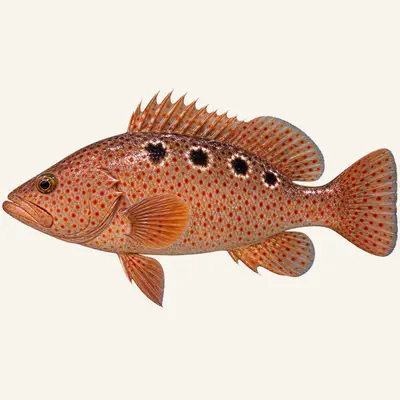
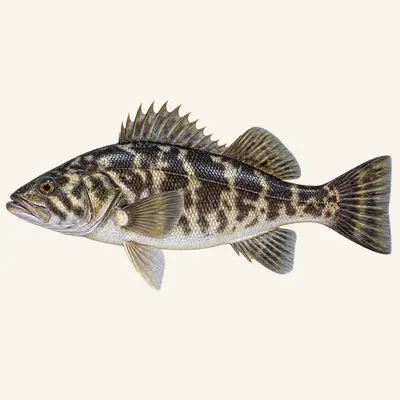
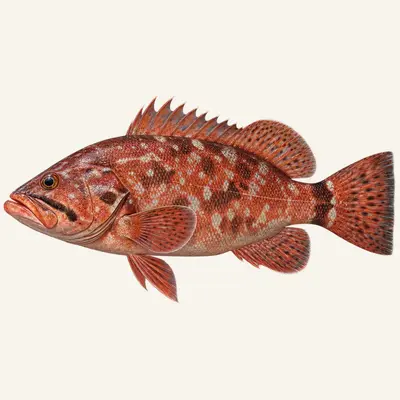
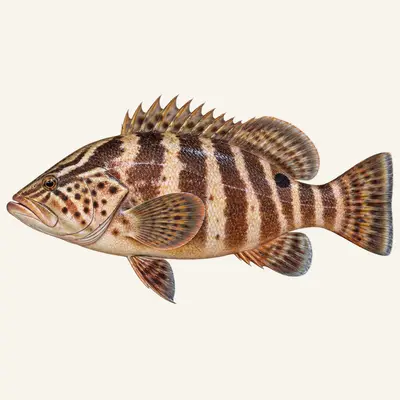
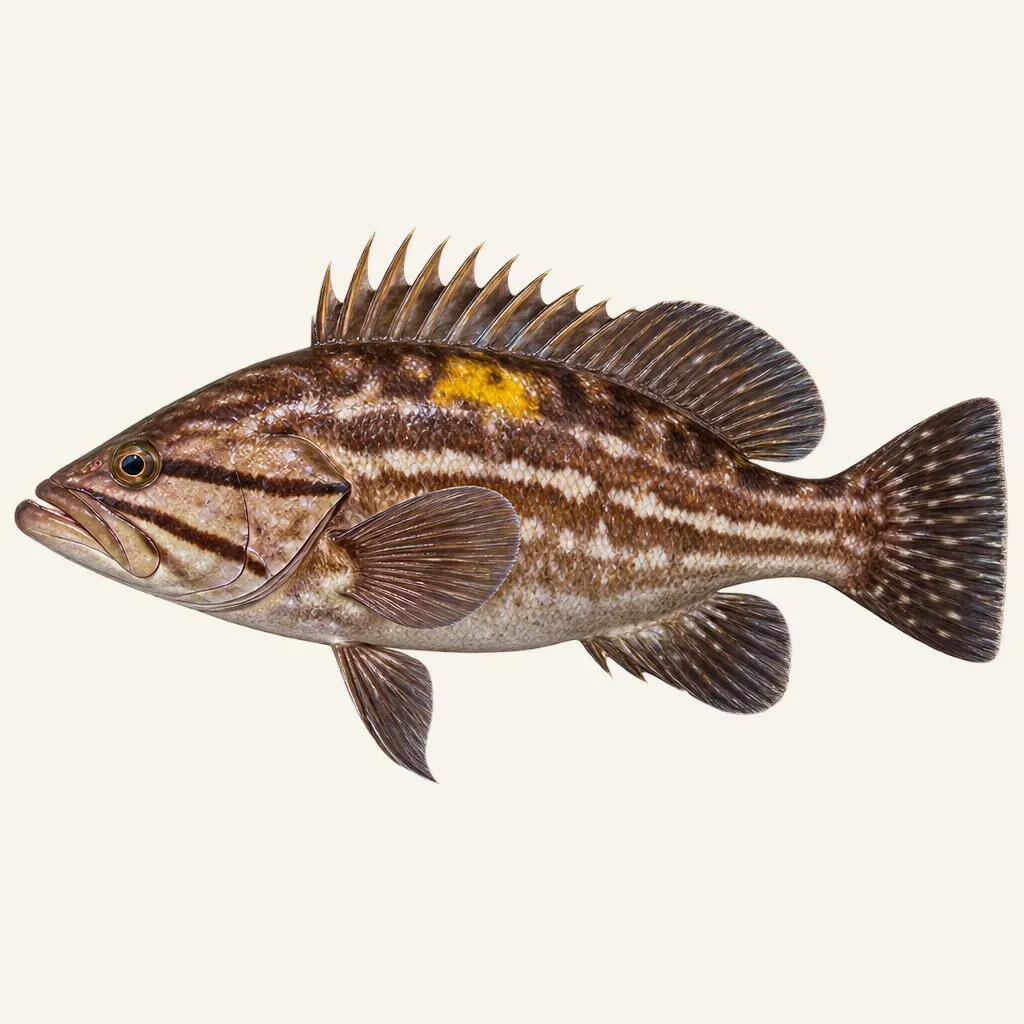
The goldblotch grouper is a medium-sized serranid recognisable by its olive-brown body adorned with small orange or golden spots on the flanks and fins. Less common than the dusky grouper, it inhabits shallow rocky bottoms of the Mediterranean and East Atlantic down to 200 metres.
Calendar
Its range
The eastern Atlantic and the Mediterranean, spanning roughly 47 degrees north to 13 degrees south.
That map needs a correction on its Atlantic side, and the correction is not a matter of nomenclature. Records reported from Madeira under the name Epinephelus alexandrinus appear to rest on misidentifications of Mycteroperca fusca — a fish in a different genus altogether. Points that belong to another animal have therefore been carried in this species' range for decades.
The effect of that is specific. A distribution inflated by error makes a species look more widely established than it is, and every subsequent assessment inherits the inflation. The island grouper responsible for the confusion is the same one that had to be disentangled from Mycteroperca rubra's range in 1991, so a single poorly known Atlantic fish has been quietly corrupting the maps of two others.
Identifying it
A clean yellow blotch sits on the flank, below the spiny part of the dorsal fin. It is the one character that settles the identification on its own, and four of the six languages have named the fish after that mark — French and Spanish went elsewhere.
Two dark lines cross the head, and they are worth looking for because they are constant. The first runs down from the lower edge of the eye towards the lower rear corner of the interopercle. The second starts at the dark streak on the maxilla and reaches the bottom of the preopercle. The ground colour in an adult is brown or greyish brown, with the fins darker than the body.
The proportions are of no use here, and that is worth saying rather than leaving to be discovered. Body depth is less than head length and is contained 3.0 to 3.4 times in standard length; the head goes in 2.5 to 2.7 times. Those intervals fall almost entirely inside the white grouper's, a species that shares a large part of the same range. Two of these fish side by side are separated by the yellow blotch and not by a tape measure.
The preopercle is angular with two or three enlarged serrations at the corner. The middle and lower spines of the gill cover are flat but distinct while the upper one is not apparent, and the upper edge of the cover is straight or a little convex. The maxilla usually reaches a vertical at the back of the eye, its lower edge shows a shallow step, and no scale covers it. The middle part of the lower jaw carries two rows of teeth. Flank scales are ctenoid, doubled by auxiliary scales in adults, and there are 17 pyloric caeca.
Eleven dorsal spines, 15 to 17 soft rays behind them, three anal spines and eight rays.
The water it needs
Sand, mud and rock, from the first metre down to 300, with the bulk of the occurrences between 4 and 160 m.
The young live somewhere else, and this is the most useful line in the species' biology: juveniles form small groups in shallow water. A gregarious grouper is already an exception. A gregarious grouper in the shallows, while the adults hold middle depths, means the animal occupies two unrelated levels in succession, and that anything happening in either one is invisible from the other.
It does not do well in captivity, which closes off the route by which most of what is known about grouper behaviour has been learned.
Areas
- Coastal rocky drop-offs
- Posidonia seagrass beds
- Caves and crevices
- Mixed rock and sand bottoms
Techniques
- Bottom fishing with natural bait
- Light coastal jigging
- Soft lure on rocky bottom
- Slow trolling
Baits
- Fresh squid
- Octopus piece
- Live fish
- Whole shrimp
- Cuttlefish
What it eats
Crustaceans, molluscs and fish. Three words, and their interest is that they map exactly onto the three bottom types the fish is recorded over: crustaceans and molluscs belong to sand and mud, fish to rock. A predator that works all three substrates has no need to rank them.
How to catch it
Maturity arrives at 32.5 cm on average, with the reported spread running from 30 to 35 — a small size for a fish that grows as large as this one does.
The operational consequence is direct. A group of small groupers in clear water is not necessarily a group of juveniles; at that length some of them are already breeding. The shortcut of judging maturity from bulk, which works reasonably well on the big species of the genus, fails here.
The second point is identification, and it is not academic. The yellow blotch is the only reliable separator between this fish and its neighbours, and the history of the species shows what happens when it is not checked: erroneous records went into the reference literature and stayed there. A catch note that does not record the blotch does not establish which species was caught.
Commercial interest in the fish is minor, which explains how little attention it receives on the market and in the statistics.
Conservation
What weighs on this species, ahead of any identified pressure, is the absence of information about it.
The gap is measurable. No published maximum weight. No recorded maximum age. And in the reference catalogue of the family, the section on reproduction carries a bibliography and nothing else — no spawning season, no fecundity, no indication of whether the fish changes sex, which most of its relatives do. For a large grouper living in the most intensively studied sea in the world, that is a remarkable blank.
Add the contamination of its range by false determinations. A species whose occurrence points are partly wrong and whose breeding biology is undescribed cannot be monitored, and cannot even be compared with itself over time.
The mechanism is straightforward: a species nobody counts cannot be shown to be declining. Its minor commercial value, which spares it a dedicated fishery, is also what keeps it out of the landings series where a downward trend would appear. The absence of an alarm is not the absence of a problem — and this is a Mediterranean grouper, in a sea where several of its close relatives had to be given legal protection after their stocks had already collapsed.
Regulations
Check the local regulations in force (legal size limits, closed seasons, bag limits).
For guidance only. Legal sizes, quotas and open seasons vary by location and season: always check the local regulations in force before fishing.
Other names
Goldblotch grouper in English, and the name is a piece of identification: it points at the only character that works.
Italian cernia dorata, German Goldfleck-Zackenbarsch and Portuguese garoupa-dourada all say the same thing. Spanish goes its own way with falso abadejo, the false pollack, which describes what the fish is not. French uses mérou badèche, where badèche is an old name from the coasts of Provence and Languedoc that is also applied to groupers of another genus entirely — a family name rather than a species name.
The name Epinephelus alexandrinus still circulates for this fish in the older literature. It is the name under which the Madeira records were published, and it is the one to be suspicious of when reading anything written before the genus was revised.
Sources: fishbase.se · api.gbif.org