Painted comber
Serranus scriba · Serranidae
- Saltwater
- Coastal
- Medium
- Size
25–36 cm
- Weight
0.2 kg
- Lifespan
16 years
- Depth
5–150 m
Where to fish
- Rocky shore
Habitat icons: Flaticon
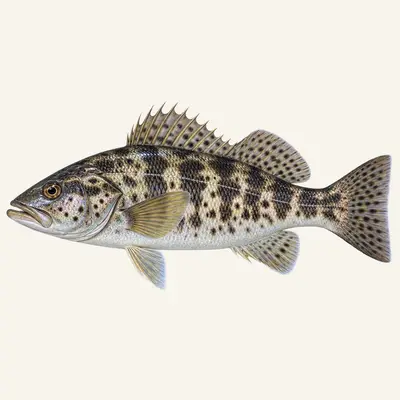
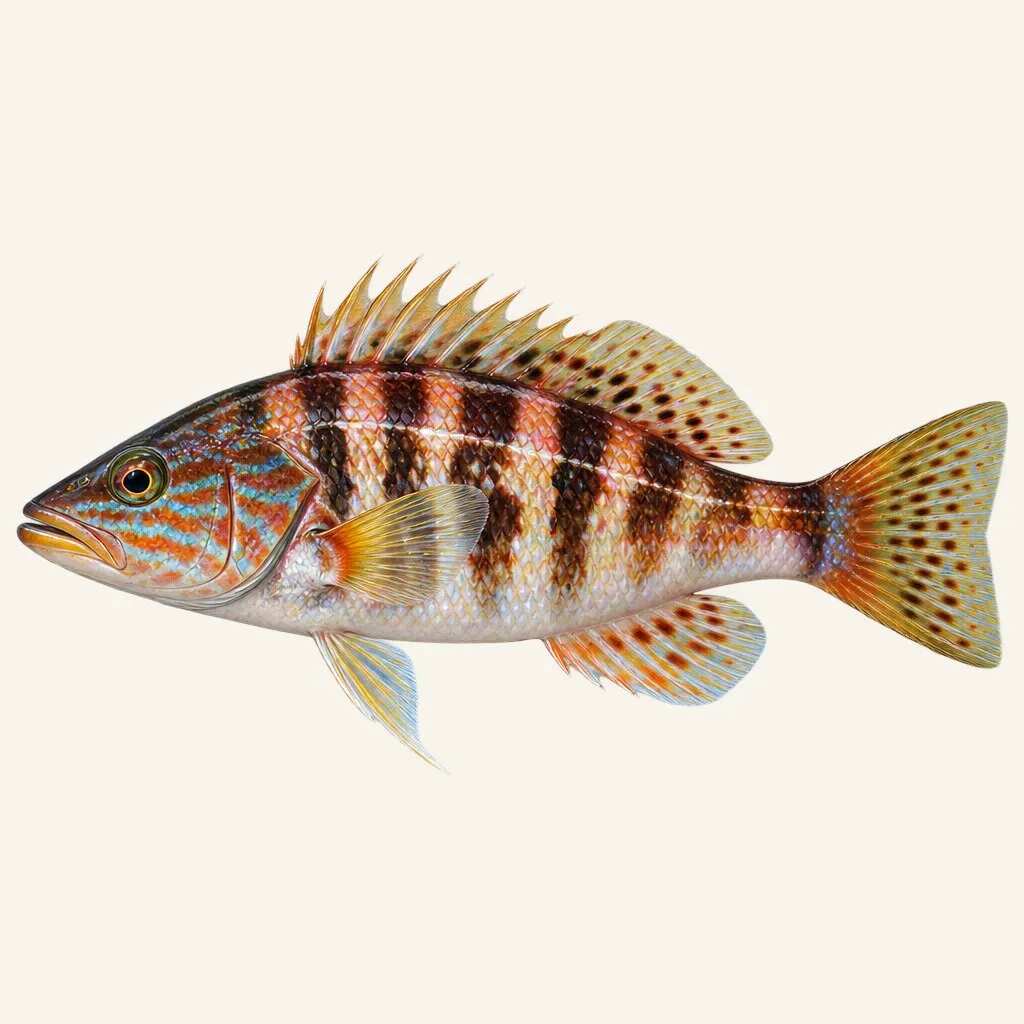
The painted comber is a small coastal serranid identifiable by its brown transverse bands on a beige-pink background and the distinctive blue patch on its belly. A simultaneous hermaphrodite, it inhabits rocky bottoms and seagrass beds in the Mediterranean and eastern Atlantic down to 150 metres.
Calendar
Identifying it
The name is the identification. Scriba means scribe, and what it records is the tangle of blue and red lines drawn across the head and the cheek, a scrawl that reads like handwriting. Every language that has a name for this fish has fixed on the same marking, which is a fair indication of how well it works in the field. Behind the head, the flank is crossed by dark reddish vertical bars over a paler ground.
That is where the description has to stop, because the record this page works from carries no meristics for the species at all: no fin counts, no proportions, no vertebral figure. Determination therefore rests on the pattern rather than on a count, which is unusual, and it means a faded or damaged specimen is genuinely harder to name here than in most of the family.
Format is modest. An ordinary fish is around 25 cm, and this is a small member of a family better known for its groupers.
Breeding
One individual carries functional ovarian and testicular tissue at the same time. This is a simultaneous hermaphrodite, and that fact reorganises everything else on the page.
It is worth setting against the arrangement the groupers of the same family use. In those species a fish is female first and becomes male later, at a size and an age that vary from one species to the next, so the largest individuals on a piece of reef are the males and taking them removes a sex that cannot be replaced for years. None of that applies here. There is no threshold at which this fish turns into a male, no age at which the sex ratio of a population tips, and no such thing as an irreplaceable individual. Removing the biggest fish from a patch of rock removes fish and nothing more.
The second consequence is about encounters. An animal scattered thinly over rock and seagrass does not meet others of its kind often, and carrying both sets of gonads means that any adult it does meet is a possible partner. Half the problem of finding a mate disappears. Self-fertilisation has been documented in some members of this genus, which is the logical end of the same arrangement — though what has been shown for a relative should not be asserted of this species.
Spawning tends to run from early spring into early summer. Fertility arrives at about 17 cm, from 16 upwards, well below the length of an everyday capture, so the ordinary fish on the end of a line has already bred.
Sixteen years is the greatest recorded age. For an animal of 25 cm that is a long tenancy, and it says that the fish on a given patch of rock is likely to have been there for a very long time.
The water it needs
Rocky bottom and Posidonia beds are the two habitats named first, with muddy ground and substrates overgrown with algae or seagrass added to them. The depth band runs from 5 to 150 m, and ordinary life happens above 30.
The list looks miscellaneous until the common factor is picked out, and the common factor is not the substrate. Rock, a seagrass meadow, an algal turf and even mud with weed growing through it all supply the same two things: something to hold station against, and cover to strike from. What the fish requires is structure, and it is indifferent to what the structure is made of.
The recorded limits run from about 50 degrees north to 16 north, and east to 42 degrees — bounds rather than a coastline, and they take in the eastern Atlantic seaboard along with the Mediterranean basin.
Areas
- Coastal rocky bottoms
- Seagrass beds
- Small drop-offs
- Algae zones
Techniques
- Bottom fishing
- Cast and retrieve with soft lure
- Coastal depth fishing
- Vertical fishing
Baits
- Marine worms
- Shrimp
- Small squid
- Slim soft lures
What it eats
Fishes and crustaceans.
Read that against the size of the animal, because that is where it becomes informative. A fish of 25 cm living on other fish is a predator in the full sense rather than a picker of small invertebrates, and it hunts from cover on ground where prey has to pass close. It also explains why the species turns up on tackle intended for something several times its weight.
How to catch it
This is the fish that takes the bait meant for another. Shallow rock and the margins of Posidonia, between about 5 and 30 m, hold it in numbers, and a predator of that size on that ground will attack a small bait or a small lure without much hesitation.
Two things follow for anyone deliberately after it. The presentation is small and worked tight to cover, since the fish strikes from structure and does not pursue across open ground. And there is no reason to search: it is resident, long-lived and attached to a spot, so a piece of rock either holds one or does not.
Commercially the species is of minor importance, which is why most captures are incidental. What that leaves is a fish that has almost certainly bred, carries no sex worth protecting from removal, and may have occupied its crevice for a decade or more. Those three facts do not point the same way, and the decision about a capture is worth making rather than defaulting.
Regulations
Check the local regulations in force (legal size limits, closed seasons, bag limits).
For guidance only. Legal sizes, quotas and open seasons vary by location and season: always check the local regulations in force before fishing.
Other names
Painted comber in English. Comber is the family word for the small Serranus of European coasts, and painted refers to the head markings.
The trap is the bare word. Comber on its own means a different species of the same genus, so painted comber and comber are two fish and not one described twice — a distinction that market names and catch reports frequently lose.
French serran écriture keeps the same image as the Latin, the writing on the head. Italian sciarrano, Spanish vaca serrana, the latter naming the barred flank rather than the scrawl. Every one of those names picks a different part of the same fish, which is what happens to a species that is universally recognised and almost nowhere commercially important.
Sources: fishbase.se · api.gbif.org