Kelp bass
Paralabrax clathratus · Serranidae
- Saltwater
- Coastal
- Medium
- Size
35–72 cm
- Weight
0.5–7.0 kg
- Lifespan
34 years
- Depth
1–61 m
Where to fish
- Reef
- Rocky shore
Habitat icons: Flaticon
Eastern Pacific sea bass, an ambush predator emblematic of the Californian kelp forests.
Calendar
Recorded in 2 countries
GBIF occurrence records — native and introduced populations combined.
Its range
From the mouth of the Columbia River in Washington south to the lower end of Baja California, between 48 and 23 degrees north.
That is the length of the California Current, and the shape of the range is best read as the shape of the habitat rather than of the fish. Kelp forests need cool water, hard bottom and light, and they occur along this coast and not along the warm sandy stretches beyond either end of it. A species tied to kelp inherits the distribution of kelp, and the northern and southern limits on the chart are limits on the plant at least as much as on the animal.
Identifying it
The record this page works from supplies no fin counts and no proportions for the species, so identification has to be built out of the two names it carries and the ground it is taken on.
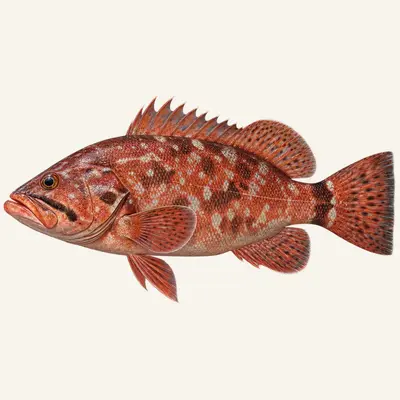
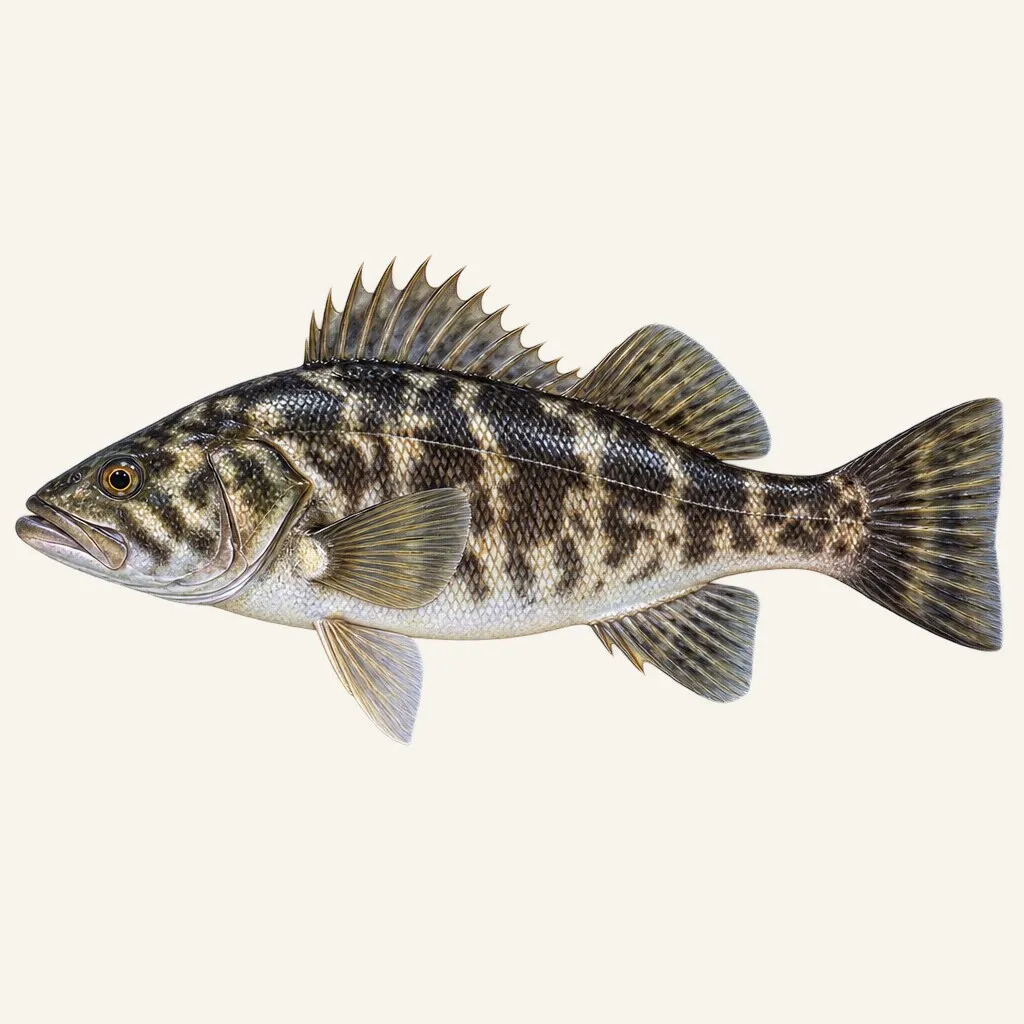
Clathratus means latticed, and it points at the mottling — the pattern of dark olive-brown broken by pale blotches that also gave the fish its angling name of calico bass. The second name is the more useful of the two in practice.
The other name, kelp bass, is the character. Three members of this genus share the Californian coast and two of them are called sand basses, because that is where they live. This one is named for kelp, and being in or over a kelp bed is the single most reliable thing about it. Habitat is doing the work a fin count normally does, which is unsatisfactory as taxonomy and effective on the water.
Breeding
The species is a pelagic spawner — eggs released into open water, with nothing built and nothing guarded — and spawning aggregations are described as a significant component of its reproductive behaviour.
That is as far as the record goes, and the gap in it is worth naming. No length at first maturity is given for this fish anywhere in the material available here, which leaves the most practical question about any capture unanswerable: whether the animal in hand has bred. For most species on this site that figure is the one that gives a size its meaning. Here it is missing.
What is on record instead is age, and the figure is 34 years. For a fish that does not exceed the low seventies of centimetres, three and a half decades implies slow growth over most of the length range, and it turns the depth gradient into an age gradient. The large fish in deeper water are not merely bigger; they are the individuals that took decades to get there.
The water it needs
In or near kelp beds. The recorded depth band runs from 1 to 61 m, most of the fish sit between about 2.4 and 21 m, and the usual working range given is 3 to 25.
Then comes the line that matters most on this page: the fish is found throughout the water column. That is not restlessness, it is a consequence of the habitat. A rocky reef provides structure along the bottom and nothing above it. A kelp forest provides structure from the bottom to a canopy at the surface, continuously, and a fish living inside one can hold at any height in it. The animal uses the whole volume because the whole volume is furnished.
Size then sorts itself by depth. Large individuals are usually found in deeper water, which turns depth into a search rule rather than a statistic: the outer and deeper margins of a bed are where the big fish are, and the shallow interior is where the numbers are.
Areas
- Southern California coast
- Baja California (Mexico)
- Kelp forests
- Rocky reefs and pinnacles
- Around artificial structures
Techniques
- Soft plastic fishing
- Jigging
- Live bait fishing
- Bottom fishing near structure
- Casting along kelp edges
Baits
- Live sardine
- Live anchovy
- Soft plastic lures
- Metal jigs
- Squid
What it eats
Juveniles live on bottom invertebrates, crustaceans above all. Adults take fishes and cephalopods. So far this is an ordinary progression through a predator's life.
The third entry is the one that repays attention: juveniles and adults alike may feed on plankton when it is abundant. A predator of fish and squid that will drop to filtering plankton during a bloom is abandoning its own trophic level whenever the water becomes rich enough to make that worthwhile, which is behaviour associated with far less specialised animals.
It also has a direct practical edge. A bed full of fish that ignore everything offered may be full of fish feeding on something no bait resembles.
How to catch it
Fish the column, not the bottom. That instruction follows straight from the biology and it is the main way this fishery differs from bass fishing over rock or sand: the fish may be at the base of the kelp, halfway up a stipe or right under the canopy, and covering only one of those heights covers a third of the habitat.
Depth then decides what size of fish is likely. The deeper edges of a bed hold the large old individuals; the shallow interior holds more fish and smaller ones. Choosing between the two is a real choice rather than a matter of access.
Adults eat fish and squid, so small baitfish, strips of squid and lures built to that profile are the answer. Troll lines are recorded among the commercial methods, and for a fish that lives inside a kelp forest that is a statement about geometry: a trolled line works the lanes, the outer edge and the open water above the canopy, never the interior.
This is an important game fish and rated an excellent food fish, and both facts bear on a decision about a capture — as does the possibility that the fish concerned is older than most of the boats on the water. Along the coast it occupies, this species is fished under management measures; those are held by the fisheries authority for the area and are what should be consulted before going out.
Conservation
The unusual exposure here is that the habitat is an organism.
Most structure-dependent fish are attached to something geological — a reef, a ledge, a gravel bar, a drop-off. Those features degrade slowly and do not die. A kelp forest is a living stand with a mortality rate: it can be stripped from a stretch of coast and it can grow back, and while it is absent the structure that gave this species the whole vertical volume it uses is simply not there. The habitat has a life expectancy, and the fish inherits it.
Longevity sets the pace of any recovery. An animal that takes decades to reach the top of its size range rebuilds a size structure slowly, whatever happens to its numbers: a population can return in count long before it returns in the presence of large old fish, and those are two different recoveries.
The aggregations add the last element, and the record is careful about them, calling them a significant part of the reproductive behaviour rather than the whole of it. That is worth respecting as written. What can be said is that some part of the reproduction of this species happens in gatherings, and that a gathering is the most concentrated form in which a stock can present itself.
Regulations
In California, a 14-inch (35.6 cm) minimum size and a limited daily bag apply; follow local regulations.
For guidance only. Legal sizes, quotas and open seasons vary by location and season: always check the local regulations in force before fishing.
Other names
Kelp bass is the standard English name, calico bass the common angling one, and the two describe the habitat and the pattern respectively.
The word bass is the trap, and the reason is a family matter rather than a regional one. This fish is a serranid — the family of the groupers and the combers — so it is a close relative of a Mediterranean grouper and no relation at all to the largemouth bass of fresh water or to the striped bass of the same American coast. Three fish called bass on one seaboard, from three families.
Mexican Spanish calls these fish cabrilla, a name that in Europe belongs to a small Mediterranean serranid of a different genus, and which is applied across the Americas to groupers as well. A record using it needs a locality before it means anything.
Sources: fishbase.se · api.gbif.org