Graysby
Cephalopholis cruentata · Serranidae
- Saltwater
- Coastal
- Medium
- Size
20–43 cm
- Weight
0.1–1.1 kg
- Lifespan
13 years
- Depth
0–170 m
Where to fish
- Reef
- Rocky shore
Habitat icons: Flaticon
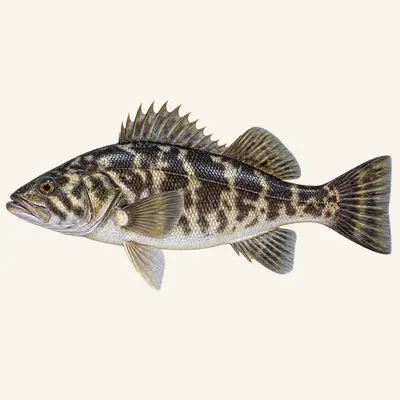
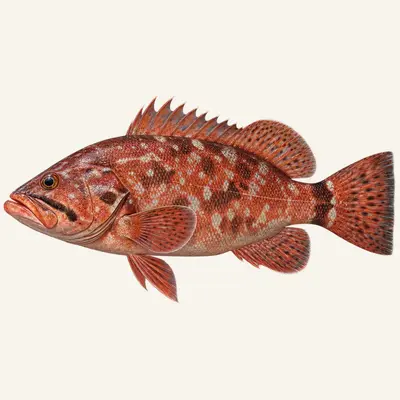
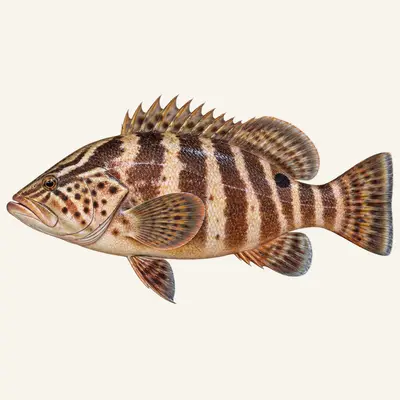
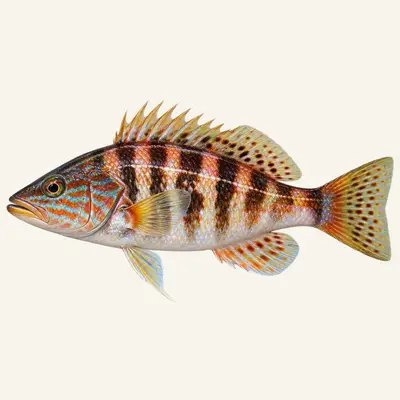
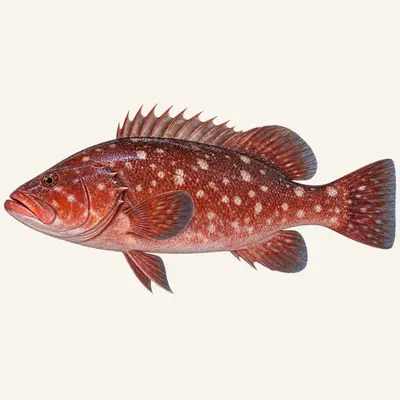
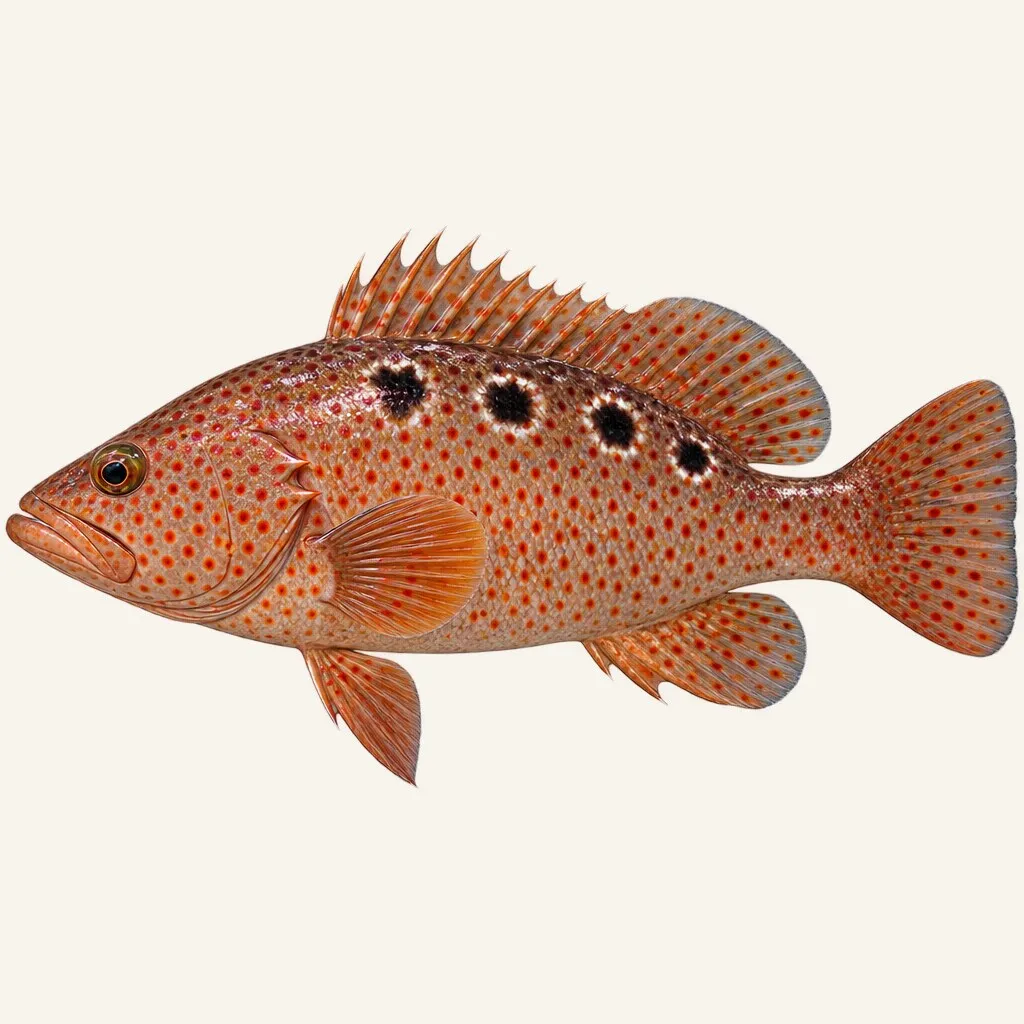
A stocky small grouper with a reddish or brown body dotted with white spots on the flanks and head, bearing the large mouth typical of the Serranidae family.
Calendar
Recorded in 19 countries
Bahamas · Belize · British Virgin Islands · Caribbean Netherlands · Cayman Islands · Colombia · Cuba · Curaçao · Dominica · Guadeloupe · Honduras · Jamaica · Martinique · Mexico · Panama · Puerto Rico · U.S. Virgin Islands · United States · Venezuela
GBIF occurrence records — native and introduced populations combined.
Identifying it
Four spots run along the flank beneath the base of the dorsal fin, and they are either white or black. The character is not the colour but the contrast: whichever way round the animal is showing them, four marks in a line under the dorsal base is the identification, and a fish that has switched them from pale to dark is the same fish.
The rest of the colouring is unreliable in exactly the way the spots are not. On a market slab it runs pale orange, grey or brown with reddish speckling, and the black spots sit high on the body below the dorsal.
The confirming character needs a lens. The opercle carries three flat spines, and they are ranked: the middle one is the largest, and the upper one is longer than the lowest. That ordering, rather than the number, is what settles the species. The pelvic fins are shorter than the pectorals, and the bases of the soft dorsal and of the anal are covered by scales and thick skin.
Body depth is contained 2.5 to 2.9 times in standard length and head length 2.4 to 2.6 times. Nine dorsal spines with 13 to 15 soft rays; three anal spines with eight rays.
Breeding
The change of sex is dated, and the date is the interesting part. Most individuals switch between 20 and 23 cm, at four or five years old, and the transition happens immediately after spawning, in August and September.
That is not a gradual process spread across the year. It is concentrated into the weeks that follow reproduction, which means a fish of 22 cm taken in July and a fish of 22 cm taken in October are not the same sex. Anyone building a sex ratio from a season's catches without recording the month is measuring the calendar rather than the population.
Fertility comes early by comparison, from 16 cm, with the lowest figure on record at 14. Recorded longevity reaches 13 years, so an individual has time to spend most of its life as a female and a good stretch of it as a male.
The water it needs
Two habitat types, not one: Thalassia beds of turtle grass, and coral reef. In the Gulf of Mexico the fish are found on rocky reef ledges below 27 m, and the whole recorded band runs from the surface to 170 m.
The figure that defines the animal, though, is neither a depth nor a bottom type. It is an area. This grouper prefers to stay within a home range of about 2,120 square metres, particularly during the day — a square roughly 46 m on a side, and that is the entire world one individual uses.
It is solitary and secretive within that square, holding close to cover through daylight hours. Divers find it easy to approach and it will take food from them, which is a great deal of habituation for a fish that spends its days hiding.
Areas
- Coral reefs
- Tropical rocky bottoms
- Coral cavities
- Coastal wrecks
Techniques
- Bottom fishing
- Cast and retrieve with small soft lure
- Live bait fishing
- Vertical fishing
Baits
- Small live fish
- Shrimp
- Cut squid
- Small soft lures
What it eats
A nocturnal hunter with a named preference. Adults live mainly on fish, and the literature singles out one prey species above the rest: Chromis multilineata, the brown chromis, a schooling damselfish of the reef. Juveniles take shrimps instead.
A diet recorded down to the name of a preferred prey species is rare in the published accounts of this family, and it ties this grouper's fortunes to the numbers of one small schooling fish over the same ground. Where the chromis are thick the grouper has a food supply arriving in front of its hole every evening; where they are not, a predator confined to a 46 m square has no option of going elsewhere to look.
How to catch it
The home range is the piece of information that governs everything. One fish occupies a patch of reef a few tens of metres across and does not travel. A ledge worked out therefore does not refill from the ledge next door within any useful period, and a mark that has produced two or three good fish has probably given what it holds.
The daily rhythm supplies the timing. Feeding is nocturnal and the fish stays tucked into cover by day, so the hours and the presentation are both decided: after dark, tight against structure, with something that behaves like a small reef fish.
Format sets the tackle. A common capture is around 20 cm and the species does not grow heavy, which makes this a grouper to fish fine — and which is also why it is not much sought after.
Ciguatera poisoning has been reported from the species, and the answer to whether a particular reef is affected is held locally.
Conservation
The unusual thing about this fish is that very little presses on it directly. It is described as not particularly sought after because of its size, and the fishery on it is minor. What it faces instead is arithmetic.
An animal that lives alone inside 2,120 square metres, changes sex only in the weeks after an August or September spawning, and depends on the local abundance of one damselfish, is an animal whose replacement is a local matter. Removing the fish above 23 cm from a stretch of reef removes its males, and the next cohort of males cannot appear until the following spawning has been and gone. Nothing about that is visible in a landings figure, because the landings figure is small.
Then there is the habituation. A secretive fish that has learnt to come out for divers has given up the one defence its behaviour provided, and it does so at the sites where people are most numerous.
One entry in the record deserves flagging rather than repeating. Between 1995 and 2000 at least 10 specimens were traded as aquarium fish at Ceará, in Brazil — well south of the range the same sources describe, which ends in the Caribbean. Either the range is understated or the fish were not what they were sold as, and both possibilities matter to anyone reading distribution data for this species.
Against all this, maturity at 16 cm and 13 years of life leave a genuine capacity to renew, provided the individual squares of reef are not emptied one after another.
Regulations
Check the local regulations in force (legal size limits, closed seasons, bag limits).
For guidance only. Legal sizes, quotas and open seasons vary by location and season: always check the local regulations in force before fishing.
Other names
Graysby in English, one word, and it is the only name in common use. Where the larger Epinephelus of the same water are groupers and the middling ones are hinds, this fish gets neither term — a reflection of a size that put it outside the commercial vocabulary altogether.
Caribbean Spanish says enjambre, which means swarm and fits a fish that lives alone about as badly as a name can. French uses coné ouatalibi tacheté for want of anything better established, or simply borrows the English.
The epithet cruentata means blood-stained, from the reddish speckling. The genus name is the more useful half: Cephalopholis collects the small groupers that hold tiny patches of ground, which is precisely what separates them from relatives that range over a whole reef.
Sources: fishbase.se · api.gbif.org