Mottled grouper
Mycteroperca rubra · Serranidae
- Saltwater
- Coastal
- Medium
- Size
80–144 cm
- Weight
5.6–50 kg
- Depth
15–200 m
Where to fish
- Reef
- Rocky shore
Habitat icons: Flaticon
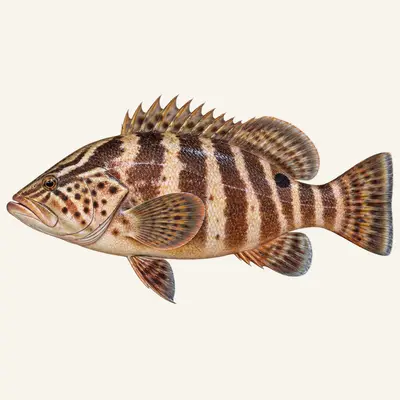
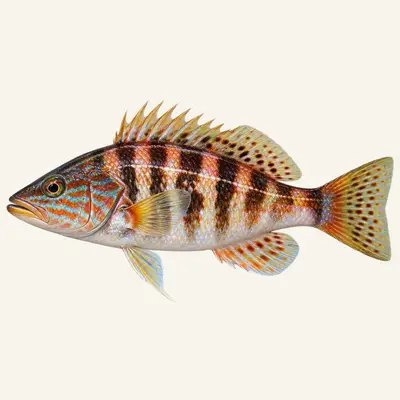
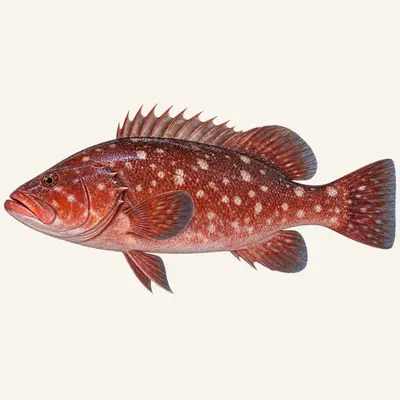
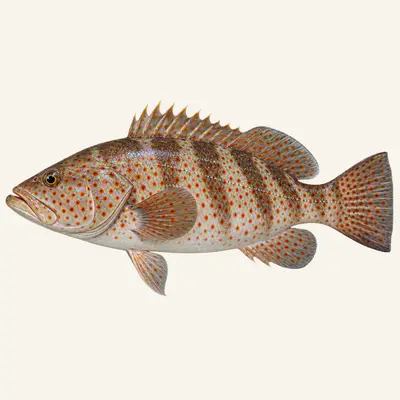
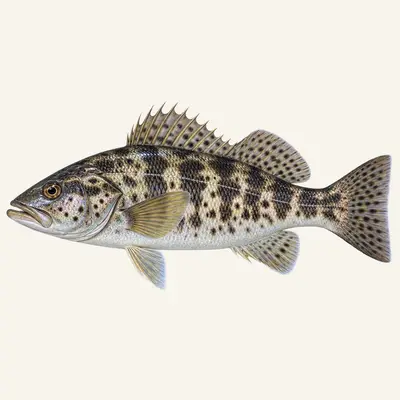
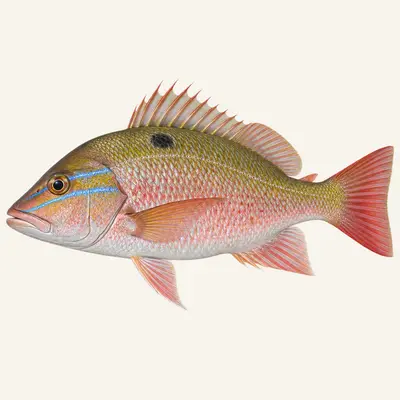
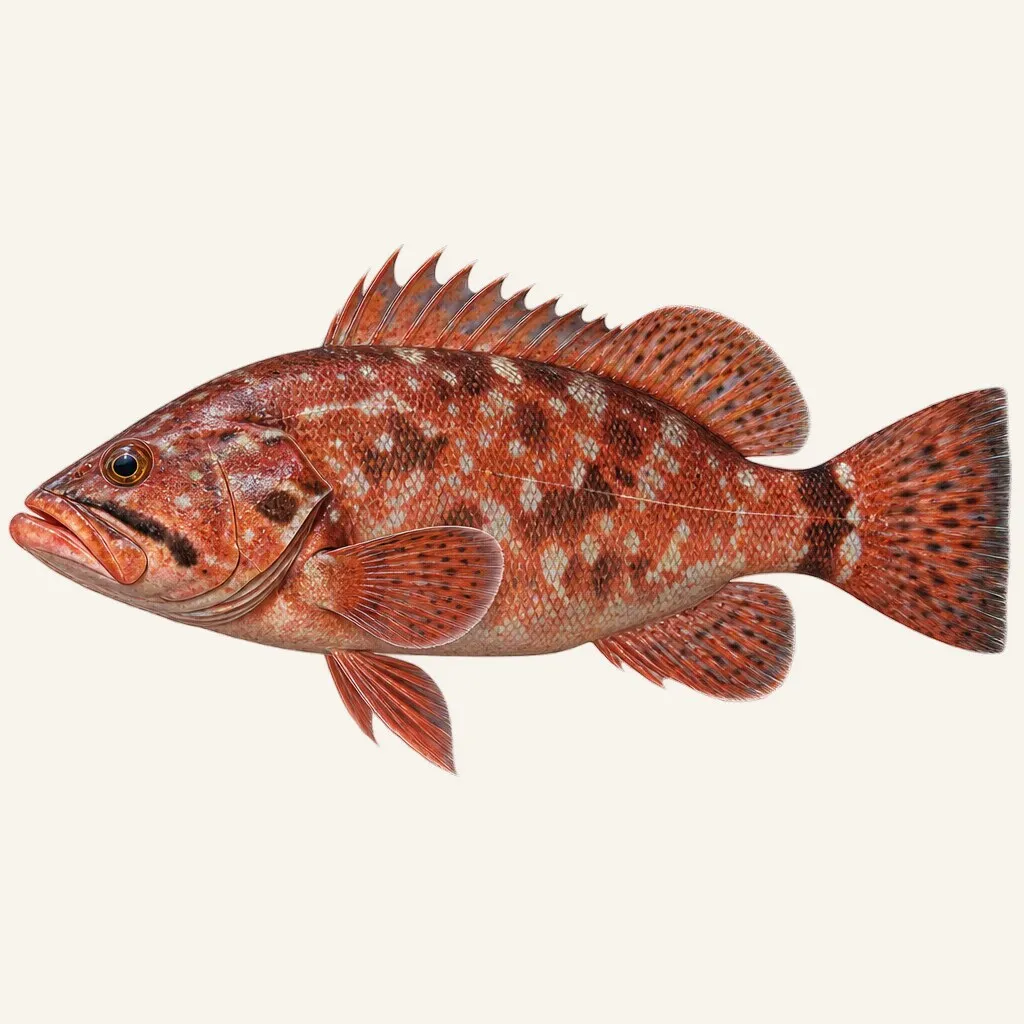
The mottled grouper is a Mediterranean and Atlantic serranid with a reddish-brown body crossed by irregular dark vertical bands, and a colouration that shifts with the fish's mood. A benthic predator, it stays close to rocks, caves and coastal seagrass beds.
Calendar
Its range
Portugal south to southern Angola. That is the range, and the story of how it got that short is the most instructive thing about this fish.
Island records had accumulated for decades — Madeira, the Azores, the Canaries, Cape Verde — and they gave the species an Atlantic range that included the whole eastern archipelago belt. In 1991 those specimens were re-examined. They were Mycteroperca fusca, a different species. The island populations attributed to this grouper were never this grouper.
The correction removes several thousand kilometres of apparent range at a stroke, and it has consequences that outlive the taxonomy. A large part of the older literature that names this species is in fact describing another animal, so any statement about its biology sourced from before the revision has to be checked against which fish was actually in the jar. Reports from the islands still require confirmation rather than being accepted.
The same island species had been quietly corrupting a second map: the records of the goldblotch grouper from Madeira turn out to be Mycteroperca fusca as well. One poorly known Atlantic grouper had been standing in for two better-known ones.
On the far side of the ocean, the ecological place this fish occupies is filled by Mycteroperca acutirostris. A range statement spanning the Atlantic would therefore be wrong twice over: wrong about the islands and wrong about the western basin.
Identifying it
The usual colour is reddish brown, sometimes broken by black mottling or pale grey spots, with a black streak running above the maxilla. Juveniles add a black saddle blotch on the caudal peduncle that adults lose.
The character that decides the species is at the corner of the preopercle. The serrations there are enlarged and form a rounded lobe, set off above by a distinct indentation. The black grouper of the western Atlantic has a perfectly smooth, evenly curved edge in the same place, with no lobe and no notch, so the comparison is direct and it does not depend on colour, condition or size.
The nostrils are a second check and they change with age: much the same size in juveniles, with the rear one about twice the front one in adults. The body is oblong and compressed, its depth contained 2.8 to 3.2 times in standard length and the head 2.5 to 2.7 times, and the space between the eyes is convex.
Eleven dorsal spines, 15 to 17 soft rays, and an anal fin of three spines and 11 or 12 rays.
The water it needs
Rock and sand, between 15 and 200 m, with the ordinary domain running 15 to 50.
That band is far more coastal than in its Caribbean relatives, which hold ground below 150 m and are effectively out of reach without deep gear. This is the accessible member of the genus, and the only one that can be met in water a diver or a small boat works routinely.
The young live somewhere else entirely: they are very common in mangrove-lined lagoons. The nursery is not a shallower version of the adult habitat but a different system with a different structure, and it is inside a habitat type that exists only where the coast provides it.
Areas
- Deep rocky bottoms
- Mediterranean drop-offs
- Atlantic reefs
- Wrecks
Techniques
- Bottom fishing
- Deep jigging
- Live bait fishing
- Cast and retrieve with soft lure
Baits
- Live or dead fish
- Squid
- Octopus
- Soft lures
What it eats
Molluscs — presumably cephalopods — and small fish.
The hedge in that sentence is the source's own and it is worth preserving rather than tidying away. A diet established from mollusc remains in a stomach does not always say which molluscs, and shell fragments and beaks survive digestion very differently. What can be said is that the fish takes soft-bodied prey and small fish, which is a hunter's diet rather than a crusher's.
How to catch it
Fifteen to fifty metres over rock or sand: this is the one Mycteroperca that can be reached from a small boat, and from some broken rocky shore marks as well. Every other member of the genus in this catalogue implies a deep-water trip.
The size structure runs opposite to the family pattern, and it is the fact that changes what a capture means. First maturity arrives at 34 cm, the published figures spanning 32 to 36, while the common length of the species is around 80 cm. Most fish encountered have therefore bred, and bred repeatedly — which is the reverse of the situation in the late-maturing groupers, where the ordinary capture is a fish that has not yet reproduced at all.
That does not make a large one an ordinary fish. At 80 cm this is still a substantial animal on rock at 30 m, and the tackle has to hold it away from the ground on the first run.
The prey list points to soft baits and to lures worked near the bottom rather than to crab and shellfish presentations.
Conservation
Early maturity is the species' main advantage and it is worth stating in comparative terms. Where the black grouper produces no male at all before fifteen and a half years, this fish is breeding at a third of its eventual length, so its stock responds to a management decision within a few years rather than within a generation.
The pressure point is the mangrove. The young depend on mangrove-lined lagoons, and the retreat of those lagoons along the West African coast acts on recruitment without any fishing effort being involved. It is also a habitat that cannot be substituted: rock and sand at 20 m will not hold a juvenile that needs mangrove roots.
The taxonomic confusion constitutes a pressure of its own, and this is the part specific to this species. For as long as the island records were credited to it, the fish appeared to occupy a wider range and to be present in more places than it is. Any assessment made on that basis overstated its security, and the baseline against which a decline would be measured was itself wrong. Commercial interest in the species is minor, so there is little in the way of landings data to correct the picture from the other direction.
Regulations
Check the local regulations in force (legal size limits, closed seasons, bag limits).
For guidance only. Legal sizes, quotas and open seasons vary by location and season: always check the local regulations in force before fishing.
Other names
Mottled grouper in English, after the black and grey mottling that appears on some individuals and not on others — a name built on a variable character, which is a poor arrangement but a common one in this family.
Spanish abadejo, Italian cernia rossa, French badèche rouge. The French name red grouper is also heard for this fish and should be avoided: it collides with several unrelated species, including the western Atlantic Epinephelus morio, which owns the name in English.
Rubra means red, which is fair enough for the ground colour and no help at all in distinguishing it from the other reddish-brown groupers of the same coast. The preopercle is what does that.
Sources: fishbase.se · api.gbif.org