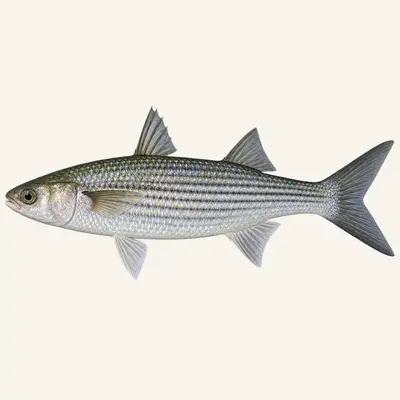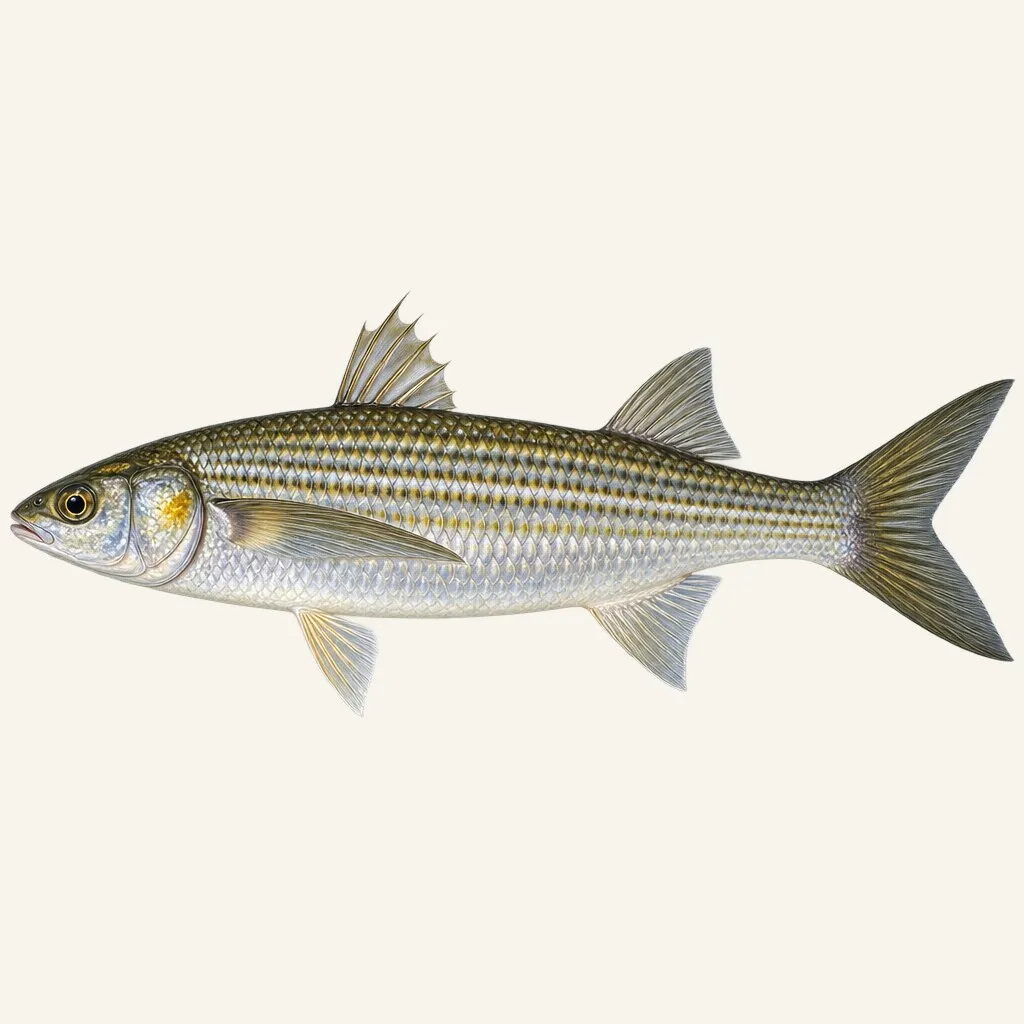
Golden grey mullet
Chelon auratus · Mugilidae
- Saltwater
- Coastal
- Medium
- Size
30–61 cm
- Weight
0.2–2.5 kg
- Depth
10–20 m
Where to fish
- Estuary
- Beach
- Rocky shore
Habitat icons: Flaticon
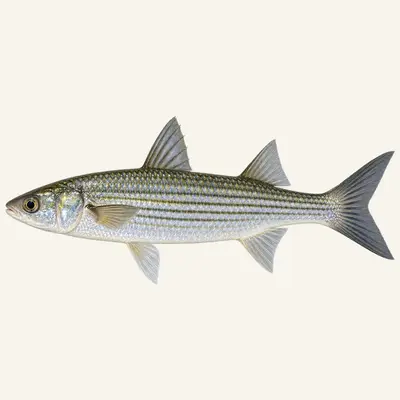
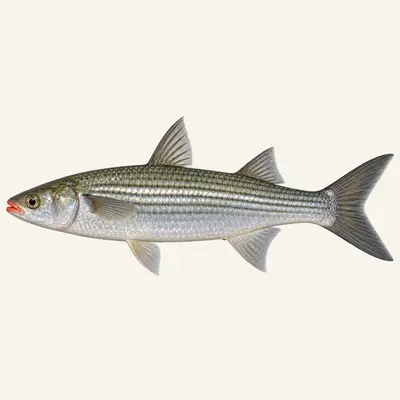
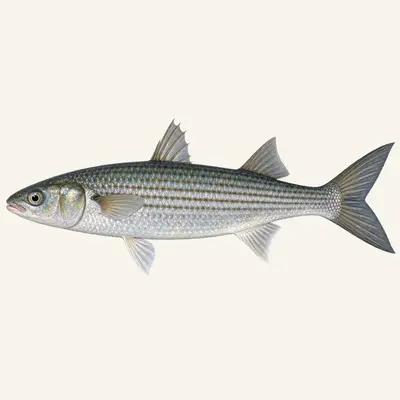
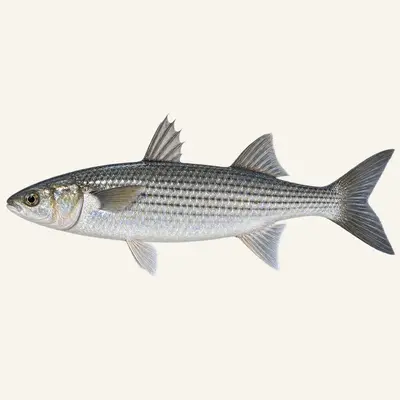
The golden grey mullet is distinguished by its vivid yellow-orange opercular spot, larger than in other mullets. Its streamlined silvery body bears fine dark stripes; it colonises estuaries, harbours, and open coasts.
Calendar
Recorded in 8 countries
Belgium · France · Greece · Italy · Netherlands · Spain · Ukraine · United Kingdom
GBIF occurrence records — native and introduced populations combined.
Its range
The eastern Atlantic list is long and it runs further north than expected: the British Isles, the North Sea, the Norwegian Sea and the Barents Sea, the Bay of Biscay, the West African coast, and the offshore archipelagos — Canaries, Azores, Madeira. Add the Mediterranean and the Black Sea.
The Barents Sea entry is the surprising one. A family with a southern reputation reaching the Arctic shelf says that temperature is less of a constraint on this group than its market image suggests.
The species has also been introduced to the Caspian Sea. The sources record the introduction without recording an outcome, which is worth knowing as a limit on what can be said: the fish is there, and what it has done there is not documented here.
Identifying it
A golden patch marks the gill cover. It is what the fish is named for in every language that names it at all, and it is the first thing to look for.
Two further characters work by comparison rather than on their own. The pectoral fins are longer than in the related grey mullets. And there is no black spot at the base of those pectorals, an absence that carries weight because the spot is present in others of the group.
The counts distinguish nothing: five dorsal spines, seven to nine soft rays, three anal spines, which is the pattern of the genus. That is precisely why the golden patch has to do all the work, and why a mullet identified without checking the gill cover has not really been identified.
Breeding
Everything reproductive happens offshore, from July to November. The eggs are released free into the water, float, and adhere to nothing.
The young then move into coastal lagoons and estuaries in winter, and the movement intensifies markedly in spring.
That timing is the fact worth carrying, because it can be set against the others in the group. This species starts sending juveniles into the lagoons in winter; the thicklip does it between April and June; the thinlip does not use a lagoon window at all and colonises the open shoreline instead. Three grey mullets on the same coast, three separate arrangements for the same problem — and none of them is visible on the fish. What separates them in the field is a date and a depth, not a shape.
First maturity arrives at about 29 cm.
The water it needs
Adults are neritic — shallow coastal water, 10 to 20 m — usually in schools, and they enter lagoons and the lower parts of estuaries. They rarely go into fresh water.
That reluctance is the substantive difference between this fish and its two congeners, both of which run up rivers readily. Here the whole life is spent between the sea and the brackish margin. It is not a fish to look for high in an estuary, and it is not affected by what happens above the tidal limit.
The consequence is a cycle with only two compartments, sea and lagoon, and a single connection between them. Everything depends on that connection staying open at the right time of year.
Areas
- Estuaries and lagoons
- Harbour quays
- Sheltered beaches
- Brackish river mouths
Techniques
- Fine float fishing
- Floating bread fishing
- Light feeder fishing
- Shore pole fishing
Baits
- White bread
- Bloodworm
- Cooked corn
- Sticky rice
- Paste ball
What it eats
The adult diet is small bottom organisms and detritus, with insects and plankton taken occasionally.
The insects are the entry that repays attention. A marine fish eating insects is feeding at a margin where the land supplies the water — lagoon edges, sheltered shallows, the downwind side of a bank where whatever the wind carried off the shore ends up floating. It confirms where the animal actually spends its time better than the depth figures do.
Juveniles, by contrast, take zooplankton and nothing else, so the adult's opportunism is a late acquisition rather than a family trait.
How to catch it
Lagoons, river mouths and the lower estuary, and not fresh water. That negative is what narrows the search relative to the other grey mullets, and it saves the effort of working the upper reaches where they would be found and this one would not.
The feeding method is the family's. The fish grazes and draws food in rather than striking at it, so soft baits are the answer and the bite is faint enough that the tackle has to be built around detecting it rather than around the size of the fish.
One point about the table is worth reporting accurately, because it is often stated more confidently than the sources support: the quality of the flesh in this species is described as variable. That is consistent with an animal that grazes sediment, since what it has been grazing differs from one lagoon to the next. The fish is commercially fished and also farmed, and neither fact settles what an individual capture will be like.
Conservation · Near Threatened (IUCN) — This species is in decline. Release your catch quickly and handle it with care — wet hands, as little time out of the water as possible.
Conservation
The bottleneck is the same as in the rest of the group, but it opens earlier: from winter, and above all through the spring. Shutting a lagoon during those months cuts off the renewal of a population without any visible effect on a single adult, and the adults are the only part of the stock anyone counts.
There is a compensation, and it is structural. Because this species rarely enters fresh water, the river obstacles that weigh on its congeners do not weigh on it. Weirs, locks and impassable sills are irrelevant to a life cycle that runs entirely between the sea and the brackish margin.
What that leaves is a concentration of risk in one habitat type. Everything the species needs on the inshore side of its life happens in coastal lagoons and lower estuaries, and those are among the most heavily modified habitats on the coasts it occupies. It has no third option to fall back on.
Regulations
Check the local regulations in force (legal size limits, closed seasons, bag limits).
For guidance only. Legal sizes, quotas and open seasons vary by location and season: always check the local regulations in force before fishing.
Other names
Golden grey mullet in English, after the patch on the gill cover — the same character that every other language picked, and rightly, since it is the only reliable one.
Spanish uses galupe and also dorada, which is a genuine problem: dorada is the standard Spanish name of the gilt-head bream, a fish of a completely different family that turns up on the same market stalls. Italian cefalo dorato, French mulet doré.
The older scientific name Liza aurata is still in wide circulation for this species and appears throughout the earlier literature and in some fisheries records. Anyone reconciling old data with new needs both names in hand.
Sources: fishbase.se · api.gbif.org