Nassau grouper
Epinephelus striatus · Serranidae
- Saltwater
- Coastal
- Medium
- Size
122 cm
- Weight
25 kg
- Lifespan
29 years
- Depth
1–90 m
Where to fish
- Reef
- Rocky shore
Habitat icons: Flaticon
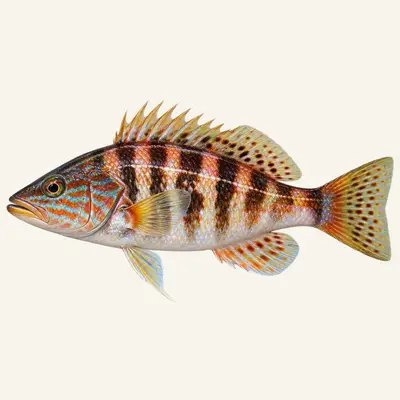
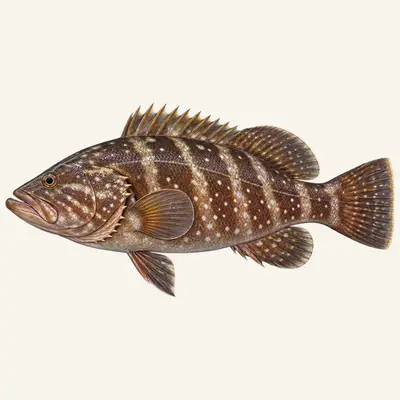
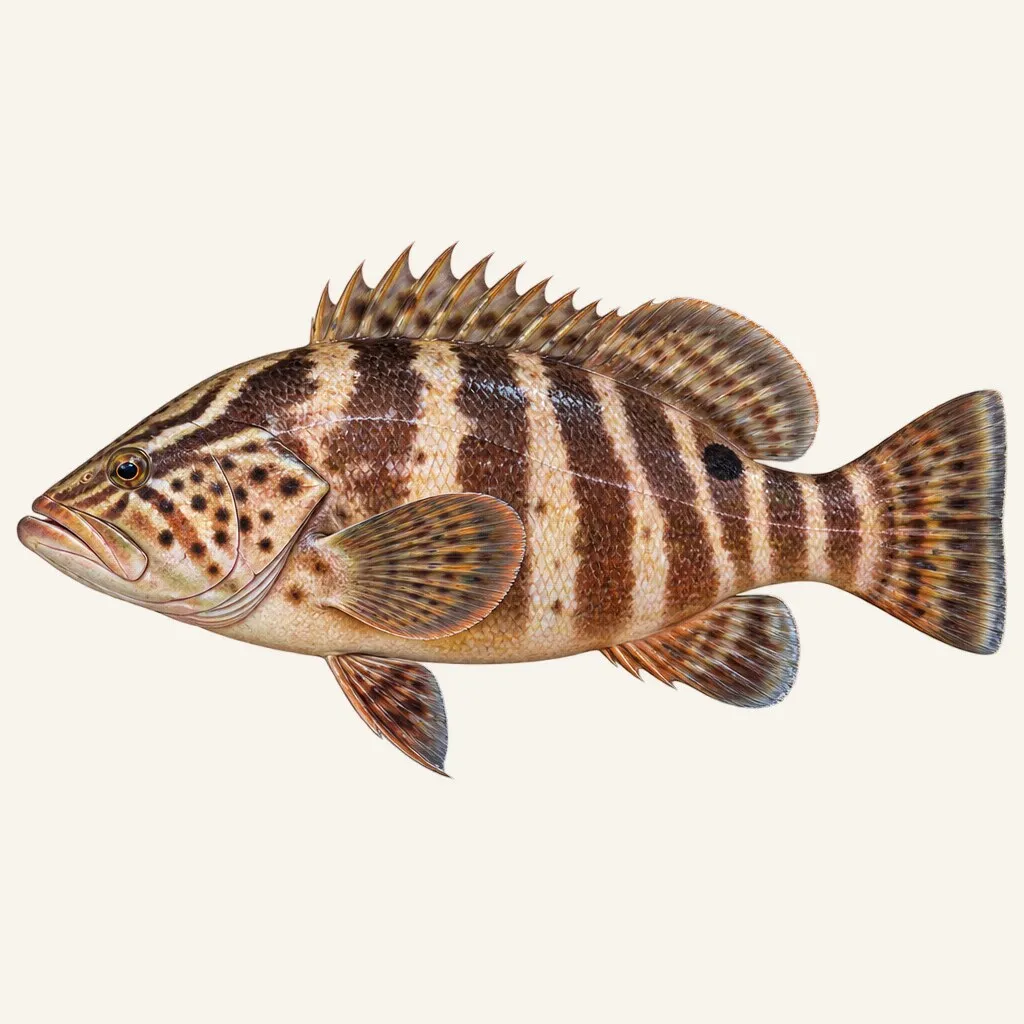
The Nassau grouper is a Caribbean serranid with a tan-brown body marked by five bold dark vertical bars and a distinctive black spot at the caudal base. It inhabits shallow coral reefs in the warm waters of the North-West Atlantic, hunting fish and crustaceans.
Calendar
Recorded in 19 countries
Bahamas · Belize · Bermuda · Cayman Islands · Cuba · Guadeloupe · Haiti · Honduras · Jamaica · Martinique · Mexico · Panama · Puerto Rico · Sint Maarten · St. Barthélemy · St. Martin · Turks & Caicos Islands · U.S. Virgin Islands · United States
GBIF occurrence records — native and introduced populations combined.
Its range
The species occupies the western Atlantic: Bermuda, Florida, the Bahamas, the Yucatán peninsula and the whole of the Caribbean, south to Brazil.
The informative part is a gap. It is absent from the Gulf of Mexico except at the Campeche Bank off Yucatán, at the Tortugas and off Key West. A grouper carrying the W mark inside the Gulf is a geographic exception rather than an ordinary catch, which is a useful thing to know before recording one.
Identifying it
Look above the eye for a W. The third and fourth vertical bars of the body divide where they cross the lateral line and meet again to draw that shape, and it is the one mark that holds whatever else the fish is doing. A second permanent feature runs along the top of the head: a dark stripe shaped like a tuning fork, splitting just behind the eyes. Several distinct black spots sit below and behind the eye as well.
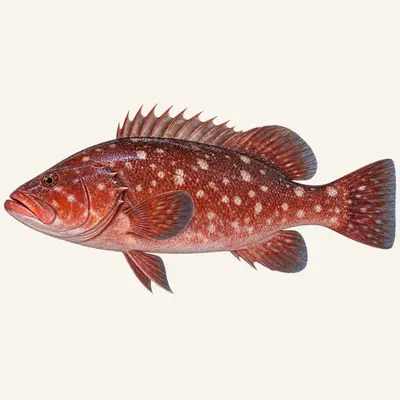
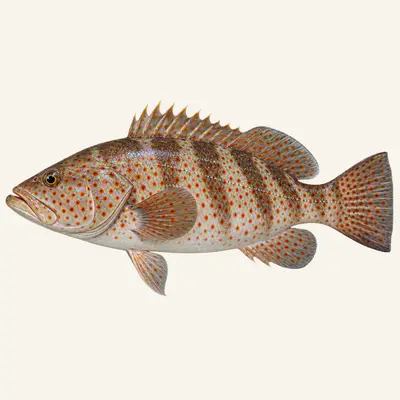
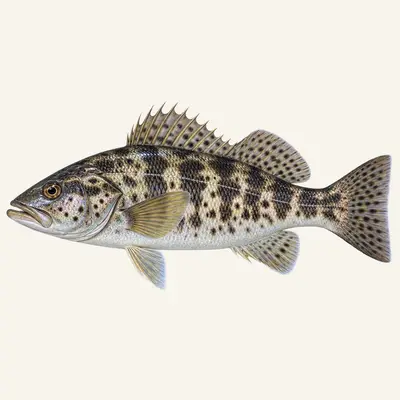
Everything else about the appearance moves. Ground colour is tawny in fish from shallow water and shades to pink or red in fish brought up from deeper, sometimes with an orange cast. More strikingly, the animal can go from almost white to uniform dark brown in a few minutes according to mood, so the same individual seen twice on one dive may not look like the same species.
The dorsal fin is notched between the forward spines, the third or fourth being the longest. Scales are small and heavily overlapping, and thick scaled skin covers the bases of the soft dorsal and anal fins. Juveniles have a rounded tail.
Breeding
Spawning is set by the moon. It happens around the new moon, and up to 30,000 fish gather at certain sites to do it.
That number is the central fact of the species. A population spread thinly over hundreds of kilometres of reef assembles, on a predictable date, at a handful of places that have been used for generations — and the knowledge of where those places are is carried by the fish, not written down anywhere.
The courtship is described in detail: vertical spiralling, short upward runs, a rapid bunching followed by an equally rapid scattering, and horizontal runs close to the bottom. Most males and females take on a two-tone pattern while it lasts. Spawning is pelagic, the eggs released into the water column.
One point of biology has been corrected since the older accounts. Protogyny was assumed for years; separate sexes from the outset have since been demonstrated, and primary males have been found. Sex reversal is nonetheless reported between 30 and 80 cm standard length. Maturity comes at around 48 cm, and the maximum reported age is 29 years.
The water it needs
From the shoreline down to at least 90 m, generally close to caves. Adults are solitary and mainly active by day, though they will occasionally form schools outside the breeding period.
Juveniles occupy a different habitat entirely: seagrass beds, in shallow water, where they are common. The two halves of the life cycle therefore depend on two separate systems, and losing the seagrass costs the reef its next generation of groupers without anything visible happening on the reef itself.
Areas
- Coastal coral reefs
- Caribbean rocky bottoms
- Reef drop-offs
- Coastal wrecks
Techniques
- Bottom fishing with natural bait
- Reef jigging
- Slow coastal trolling
- Soft lure on reef structure
Baits
- Fresh squid
- Live or dead fish (large)
- Crab
- Whole shrimp
- Octopus
What it eats
The diet has been quantified: 54 per cent fish, 23 per cent crabs, the remainder other crustaceans and molluscs.
Those proportions place the species firmly among the fish-eating groupers, which is not the norm in the genus. The Mediterranean dusky grouper, on comparable rocky ground, lives mainly on crabs and octopus. Two large ambush predators of the same family divide their prey along different lines.
How to catch it
The literature calls this the least wary and most approachable of all the groupers. Applied to a large coastal grouper, that is a statement of a problem rather than a compliment.
It is the most important commercial grouper in the West Indies, sold fresh and mostly at between 2 and 10 kg, and it has carried Caribbean fisheries for as long as those fisheries have been recorded.
Its vulnerability is entirely in the aggregations. Tens of thousands of fish assembled on a lunar date at a site everybody knows is a resource that a few boats can exhaust in a single season, and that is what has happened repeatedly. Fishing for this species and access to its spawning sites are restricted in numerous countries across its range, and the current provisions must be checked with the competent authority.
Outside the aggregation, the search follows caves and drop-offs, with seagrass for the young fish.
There is also a consumption note that belongs to no other page in this genus: ciguatera poisoning has been reported from this species, and the risk is regional rather than general.
Conservation · Critically Endangered (IUCN) — This species is threatened with extinction. Always release it (no-kill), handle it with the utmost care and check local rules — fishing for it may be prohibited.
Conservation
The mechanism is understood, documented and still running. A species whose entire reproduction passes through a few predictable gatherings has no statistical protection at all. Being scattered for the rest of the year compensates for nothing, because the fishing happens at the gathering.
Several historic aggregation sites have stopped forming. That is the part worth dwelling on: a site does not come back once it has gone. The location is transmitted between fish, from the ones that have been there to the ones that follow, and breaking that chain removes the reproduction of an entire region rather than reducing it. The stock can still be present on the reefs and produce nothing.
This is the case that shaped how spawning aggregations are managed everywhere else, in the Caribbean and beyond, and it is the reason aggregation sites are now treated as habitat to be protected rather than as fishing marks.
Regulations
Check the local regulations in force (legal size limits, closed seasons, bag limits).
For guidance only. Legal sizes, quotas and open seasons vary by location and season: always check the local regulations in force before fishing.
Other names
Nassau grouper, after the Bahamian capital, where the species was described and where it has supported a fishery for centuries. The name says nothing about the range, which covers the whole Caribbean; it records where the first specimen was handled.
Spanish in the Caribbean gives cherna criolla, and there are creole names in most island languages, one per fishing community.
The English trouble with this fish is the word grouper on a menu or a fish counter. It is applied across dozens of species, some abundant and some in serious difficulty, and nothing about the label distinguishes them once the fish is filleted. The W above the eye is the only reliable identification, and it is on a part of the animal that a buyer never sees.
Sources: fishbase.se · api.gbif.org