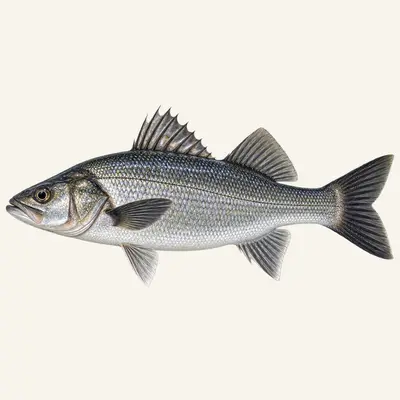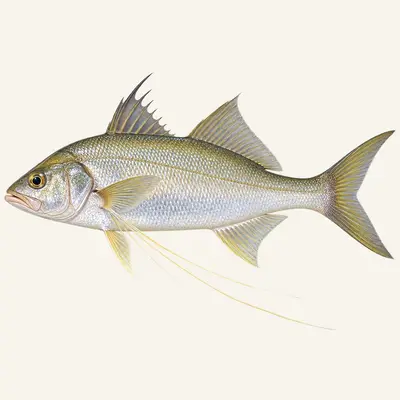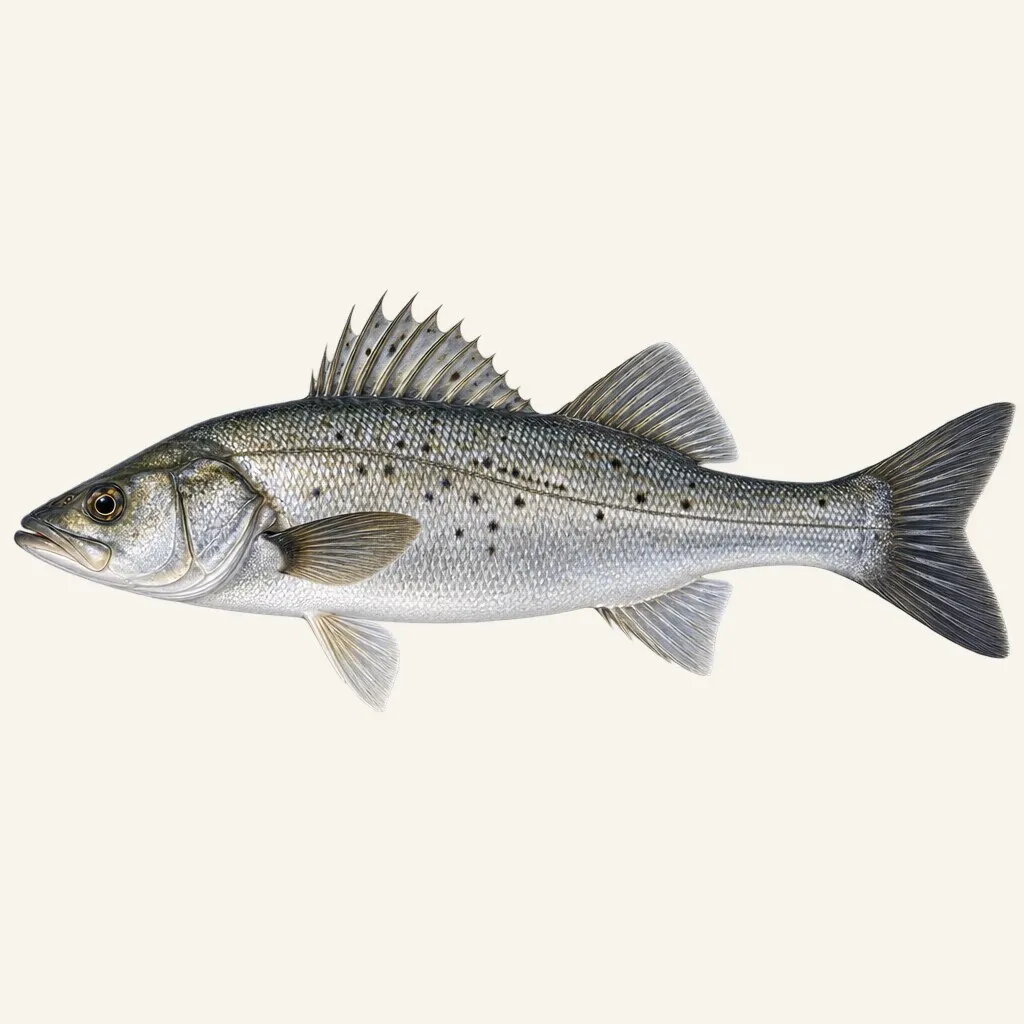
Japanese seabass
Lateolabrax japonicus · Lateolabracidae
- Saltwater
- Coastal
- Medium
- Size
16–102 cm
- Weight
0.1–8.7 kg
Where to fish
- Estuary
- Rocky shore
Habitat icons: Flaticon
Inhabits moving water of inshore rocky reefs. Juveniles may ascend rivers and return to the sea to spawn
Calendar
Recorded in 5 countries
China · Hong Kong SAR China · Japan · South Korea · Taiwan
GBIF occurrence records — native and introduced populations combined.
Its range
A catadromous coastal fish cannot cross an ocean, and this one's map is the proof. Each generation needs a river mouth: the juveniles go up, the adults come back down to spawn at sea. Where there is no continental margin fed by rivers, there is no population, and none is known from open water.
What the record gives is not a country list but a rectangle — 15 to 44 degrees north, 106 to 143 degrees east. That covers the eastern face of Asia, from the northern end of the Japanese archipelago to the China seas, and nothing beyond it.
Identifying it
Count the first dorsal fin. It carries 12 to 15 spines, and that number is the identification, because nothing on the flank is. Behind the spines come 12 to 14 soft rays; the anal fin has three spines and seven to nine rays; the body is fusiform.
The count is high for a fish built like a bass. The European sea bass, which a photograph would not separate from this one, is described with eight to 10 spines in the same fin. Two silver fish, one difference, and it is a difference nobody can see at ten metres.
No character of colour or pattern is retained in the key at all. The whole diagnosis sits in the counts, which means the fish has to be handled rather than judged in the water.
Breeding
Every Japanese seabass begins its adult life as a male. Maturation comes at two years old and the sex change follows it, running one way only: male first, female afterwards.
Two conclusions come out of that without touching the animal. A large individual is a female. A gathering of small mature fish is a gathering of males. Size does the sexing, and no external character is needed.
Spawning falls in winter, on the deeper rocky reefs or in the inshore band. Two maturity figures circulate — age two for the sex change, 50 cm as the foot of the recorded length range at first maturity — and they are not measured on the same scale. Forcing them to agree produces a fish that does not exist.
The water it needs
The station is named without ambiguity: moving water on inshore rocky reefs. Three conditions in six words — rock, coast, current — and the fish is recorded from 5 m down.
Its salinity range is the whole of one. It occurs in the sea, in brackish water and in fresh, and the tolerance is not a laboratory curiosity but the mechanism of the life cycle itself.
The order of that cycle is the reverse of a salmon's: the growing is done in the river, the breeding at sea. On the water it translates directly. A fish taken several kilometres above a river mouth is a young one. In the same season, the breeders are out on the offshore rock.
Areas
- Estuaries and river mouths
- Rocky coastal zones
- Harbors and breakwaters
- Coastal seagrass beds
Techniques
- Surface lure casting
- Stickbait fishing
- Coastal jigging
- Drift live bait fishing
Baits
- Surface lures
- Stickbaits
- Live shrimp
- Small dead baitfish
What it eats
Zooplankton to begin with, then small fish and shrimps. The changeover is total: the adult takes nothing from open water in the manner of a plankton feeder. It hunts.
The place of shrimps in that menu deserves attention. A predator taking as many crustaceans as fish can be fished on two registers, and the crustacean register is the one that gets left out of the tackle box.
How to catch it
Winter gathers the breeding fish on deep rock and along the inshore band. For the rest of the year the marks are the reefs worked by current, the harbour walls and the river mouths — and since the fish is at home in fresh water, it is worth looking well away from the sea. The boundary between coastal fishing and estuary fishing means nothing to it.
The sex change decides what a good fish is. Large fish are females, and the female carries the spawning on her own, so keeping a big one here does not cost what it costs in a species with fixed sexes.
One figure has to be read for what it is. The commonly recorded length, 16.1 cm, comes from landings and sampling rather than from anglers' notebooks. It describes what the nets bring in, not the size of fish met on a line.
Conservation
Sequential hermaphroditism is what makes this species sensitive to a perfectly ordinary level of fishing. Since every large fish is female, a fishery that keeps the big ones and returns the small ones returns males. The sex ratio then rebuilds only as fast as individual fish change sex, which is to say slowly.
The other dependency is the river mouth. Juveniles ascend rivers, so an estuary cut by a structure removes a year class without a line being wetted.
Two things pull the other way. The species is farmed commercially, which shifts part of the demand off the wild stock. Against that, it is also used in Chinese medicine — a demand that does not follow the food market and does not fall when fish get scarce on the slab.
Regulations
Check the local regulations in force (legal size limits, closed seasons, bag limits).
For guidance only. Legal sizes, quotas and open seasons vary by location and season: always check the local regulations in force before fishing.
Other names
Suzuki is the Japanese name, and it has passed into the working vocabulary of lure anglers a long way outside Japan. Five of the six names this catalogue carries keep the word in brackets after the local one. English is the exception: Japanese seabass, with the loan dropped.
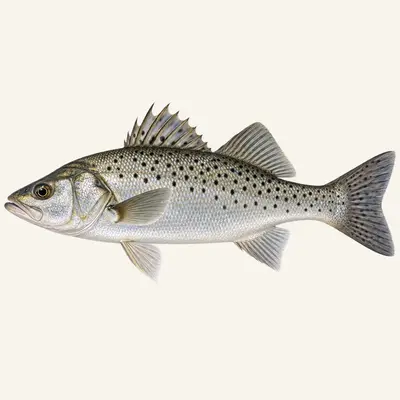
The English name has a worse problem than a missing word. One entry away, Lateolabrax maculatus is given the same English name in this catalogue — which is a fair summary of the state of the genus, and a reason to write the binomial down whenever the fish is recorded.
The family is not settled either. The record flags the placement of the genus as uncertain; catalogues, this one included, file it in a family of its own, the Lateolabracidae, without the question being closed.
Sources: fishbase.se · api.gbif.org