John Dory
Zeus faber · Zeidae
- Saltwater
- Coastal
- Medium
- Size
40–90 cm
- Weight
0.8–8.0 kg
- Lifespan
12 years
- Depth
5–400 m
Where to fish
- Rocky shore
Habitat icons: Flaticon
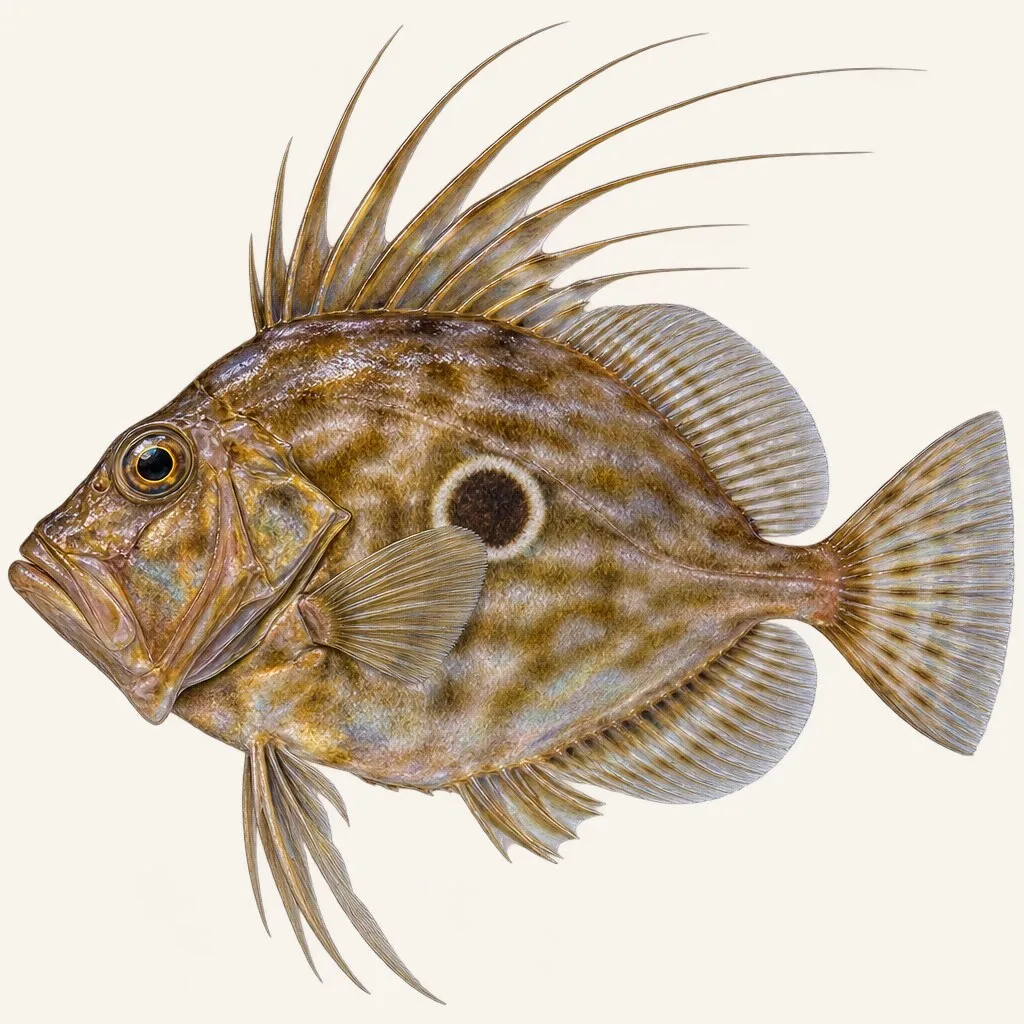
A highly laterally compressed marine fish bearing a distinctive black eye-spot on each flank and a strongly protrusible mouth.
Calendar
Recorded in 42 countries
Albania · Algeria · Angola · Australia · Belgium · Cameroon · China · Congo - Brazzaville · Côte d’Ivoire · Croatia · Denmark · France · Gabon · Ghana · Greece · Guinea · Guinea-Bissau · Ireland · Isle of Man · Israel · Italy · Japan · Lebanon · Liberia · Mauritania · Morocco · Mozambique · Netherlands · New Zealand · Nigeria · Norway · Portugal · Senegal · Sierra Leone · South Africa · South Korea · Spain · Sweden · Taiwan · Türkiye · United Kingdom · Western Sahara
GBIF occurrence records — native and introduced populations combined.
Its range
Worldwide: the eastern Atlantic from Norway to South Africa, the Mediterranean and the Black Sea, the western Pacific off Japan, Korea, Australia and New Zealand, and the Indian Ocean as well.
A range that size, in a fish with pelagic eggs and a near-bottom adult life, is more of a question than a fact — and the reproduction entry above is why it stays one. A species whose early life history has not been studied in one of the countries that fishes it is a species whose worldwide range has never really been tested.
Identifying it
The dark spot on each flank, ringed by a lighter halo, is the mark everyone knows, and it is the reason four of the catalogue's six languages name the fish after Saint Peter.
The rest is just as distinctive. The body is highly compressed and deep, the scales are minute, and the fin formula is heavy in spines: nine to 11 dorsal spines with 22 to 24 soft rays, and four anal spines with 20 to 23.
Breeding
Reproduction happens at the end of winter and the start of spring in the northeastern Atlantic, and earlier in the Mediterranean. The eggs are pelagic. Maturity is reached at four years, at 35.1 cm within a range of 29 to 35.
Then the sentence that should be read twice: no studies of reproductive development or early life history have been undertaken in Australia. This is a species with a worldwide distribution and a commercial fishery on several continents, and its early life is unexamined across a substantial part of that range.
The water it needs
Close to the sea bed, generally alone, between five and 400 m and usually between 50 and 150.
That band is deeper than the fish's reputation implies. It is familiar as a market fish, so it tends to be thought of as a coastal animal; the record puts its ordinary working depth out on the shelf proper, well below anything that could be called inshore.
Areas
- Eastern Atlantic
- English Channel
- Mediterranean
- Rocky and sandy coastlines
Techniques
- Live baiting
- Soft lure fishing
- Jigging
- Coastal casting
Baits
- Small live fish
- Sardines
- Soft lures
- Squid strips
What it eats
A solitary fish that eats schooling fish has a problem, and the entire anatomy of this animal is the answer to it.
It feeds mainly on schooling bony fishes, occasionally on cephalopods and crustaceans, and it is generally solitary. Nothing about it is built for a chase. What it has instead is three things that work together: a body so highly compressed that head-on there is almost no width to see, a mouth that shoots forward — the catalogue description on this page calls it strongly protrusible — and gill rakers that are rudimentary, which is what a fish has when it swallows prey whole and filters nothing.
The method follows from the three. Approach a school from the front, where a knife-thin fish is nearly invisible, close the distance, and take one by suction rather than by speed. This animal does not need to be fast. It needs not to be seen, and to be able to reach.
How to catch it
Slow, deep, and close to the bottom. A live bait or a small-fish imitation presented near the bed is what the recorded biology dictates: the fish is down there, it is alone, and it is hunting schools.
The apparent sluggishness is the trap. This animal does not pursue, it closes and inhales, so a fast retrieve solves a problem it does not have and misses the one it does. What it needs is time in front of the fish.
The flesh is described as excellent, with one oddity attached: it is little used in West Africa. What a John Dory is worth depends less on the fish than on the coast it was landed on.
Common length is 40 cm and the maximum reported age 12 years.
Conservation
The pressure here is documentary rather than ecological, and it is worth stating, because saying nothing would imply that everything is known.
Maturity at four years and 35 cm, against a common length of 40, puts the average fish just above the size at which it first breeds. That is a narrow margin, and it is on the right side.
What is missing is knowledge. A globally distributed, commercially fished species whose reproductive development and early life history have not been studied across a substantial part of its range cannot be assessed the same way everywhere, and work done where the studies exist does not transfer to where they do not. The reference assessment dates from 2013.
Regulations
Check the local regulations in force (legal size limits, closed seasons, bag limits).
For guidance only. Legal sizes, quotas and open seasons vary by location and season: always check the local regulations in force before fishing.
Other names
John Dory in English. The usual account takes dory from the French dorée, gilded, describing the colour rather than the shape; where John came from is unexplained and probably not recoverable.
Four of the catalogue's languages name Saint Peter instead: Saint-Pierre in French, pez de San Pedro in Spanish, Petersfisch in German, pesce San Pietro in Italian. The tradition reads the flank spot as the mark of the apostle's thumb, and the reason that explanation has lasted is that the mark really does look like a thumbprint. German offers a second name as well, Heringskönig, herring king.
Brazilian Portuguese went somewhere else entirely: peixe-galo, cockerel fish, which in this catalogue is also the name of the roosterfish of the eastern Pacific. The two animals have nothing in common beyond a tall spiny first dorsal.
Zeus is the god. Faber is the smith.
Sources: fishbase.se · api.gbif.org