Lane snapper
Lutjanus synagris · Lutjanidae
- Saltwater
- Coastal
- Medium
- Size
25–60 cm
- Weight
0.2–3.5 kg
- Lifespan
10 years
- Depth
10–400 m
Where to fish
- Reef
- Beach
Habitat icons: Flaticon
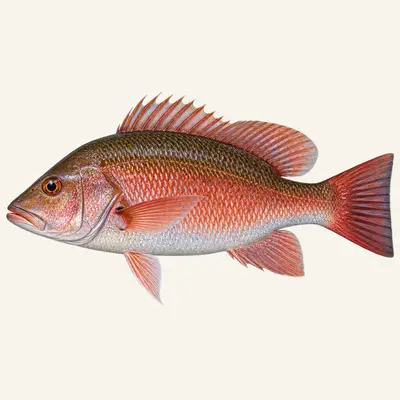
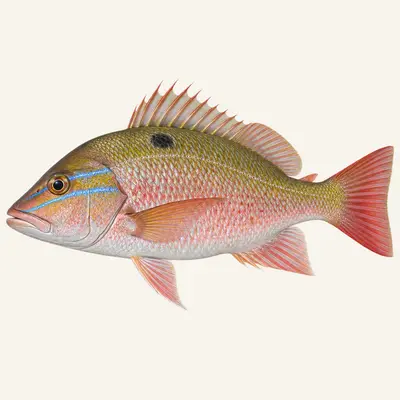
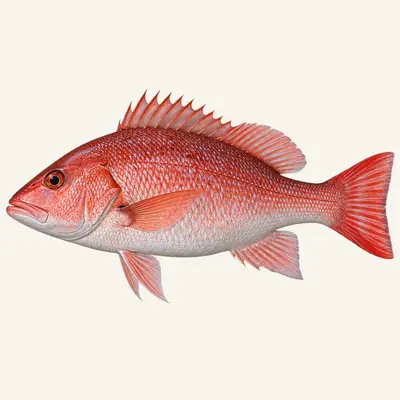
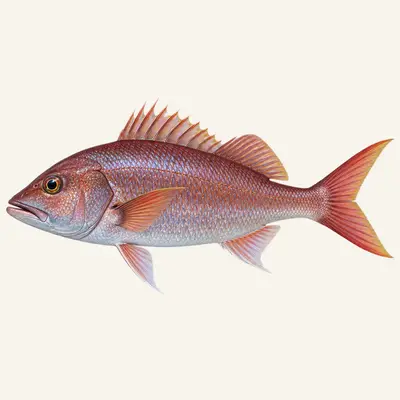
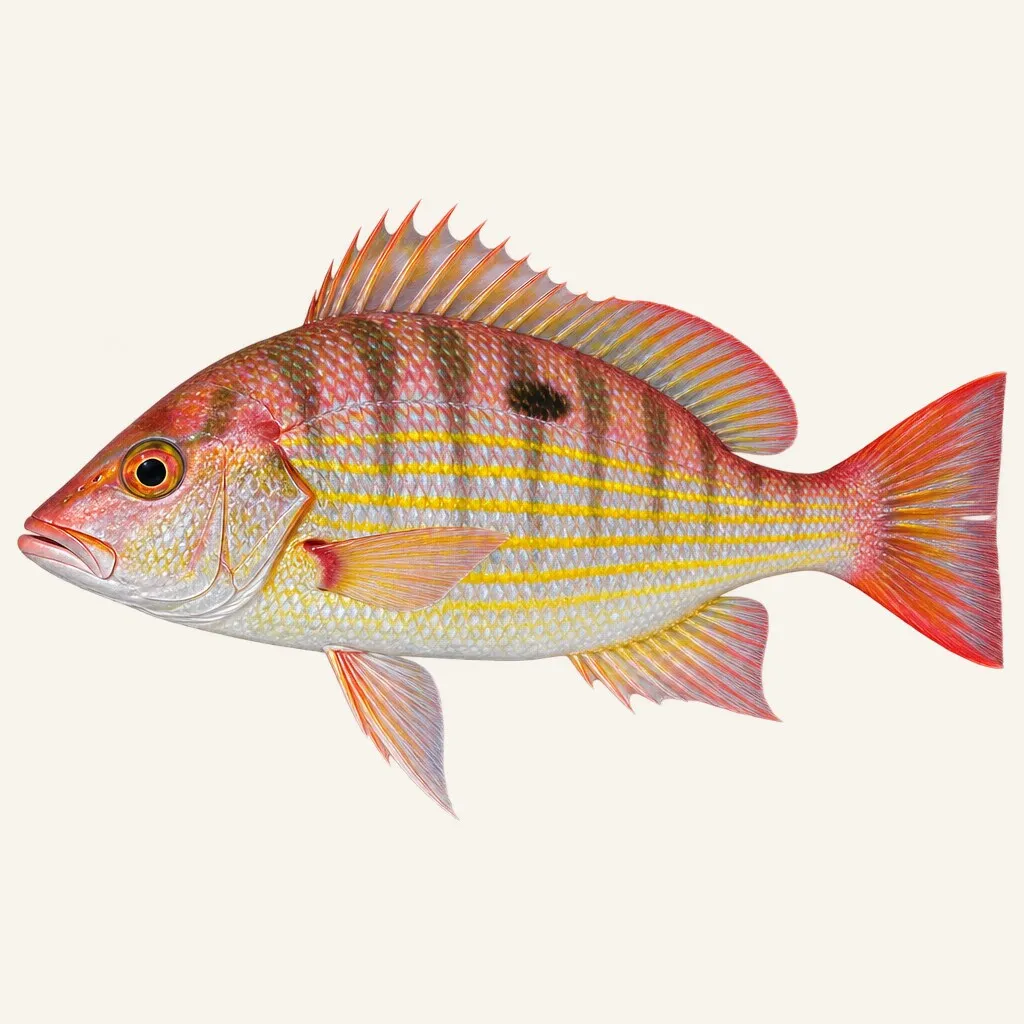
The lane snapper is a slender reef fish with a pinkish-red back, yellowish longitudinal stripes on the flanks, and a characteristic dark spot below the dorsal fin. It inhabits coral reefs and shallow grassy bottoms in the Caribbean and Gulf of Mexico.
Calendar
Recorded in 16 countries
Bahamas · Belize · Brazil · Caribbean Netherlands · Colombia · Guadeloupe · Honduras · Jamaica · Martinique · Mexico · Panama · Puerto Rico · Trinidad & Tobago · U.S. Virgin Islands · United States · Venezuela
GBIF occurrence records — native and introduced populations combined.
Its range
The outline of the range is unremarkable — Bermuda and North Carolina to south-eastern Brazil, taking in the Gulf of Mexico and the Caribbean. The density is not.
The fish is abundant around the Antilles, on the Campeche Bank, off Panama and along the northern coast of South America: broad shallow banks and island arcs, in other words. Towards the ends of the range it becomes occasional. Working north of Florida means working the edge of a distribution rather than its centre, and that shows in the catch rate before anything about tackle does.
Identifying it
Count the stripes. Eight to ten yellow or golden lines run horizontally along the flank, sharp enough to be counted on a fish lying on the deck, and they are constant.
A second set of marks crosses them the other way: diffuse dark bars over the back and upper flank that cut the yellow lines without interrupting them. That loose grid belongs to no other snapper on this coast. The ground colour is pink to reddish above with a greenish cast, and the silver of the belly turns towards yellow.
A smudged black mark sits mostly above the lateral line, beneath the leading soft dorsal rays. Plenty of western Atlantic snappers carry one, so it confirms an identification and never settles it.
The character that settles it is the pectoral fin. Folded back along the body, it is short here and stops well before the vent, where several close relatives reach it. No lens, no counting. For the record, the dorsal carries ten spines and 12 or 13 soft rays, the anal three spines and eight or nine, and both the notch and the knob on the preopercle are weak.
Breeding
Maturity comes early and small: between 16 and 21.5 cm depending on the individual, 23.4 cm on average. First spawning therefore falls inside the first third of the growth curve.
Spawning concentrates the population. Large aggregations form for it, and although this species shoals outside the season as well, that is when the groups are densest.
The other figure to hold is maximum age: ten years. Among snappers, which pass three decades routinely, this one lives fast.
Areas
- Shallow coral reefs
- Tropical seagrass beds
- Coastal sandy bottoms
Techniques
- Bottom fishing on reef
- Light rod fishing
- Vertical soft lure fishing
Baits
- Shrimp
- Squid
- Small live fish
- Marine worm
What it eats
Hunting happens at night, on the bottom. Small fishes, bottom-dwelling crabs, shrimps, worms, gastropods and cephalopods make up the list.
Worms and burrowing crabs tilt the diet towards soft ground rather than open water. This snapper searches sand and seagrass at least as much as it hunts above coral, and small natural baits fished on or just off the bottom follow directly from that.
How to catch it
Adults hold over every kind of bottom — coral, vegetated sand, turbid water as readily as clear. That makes the species available almost everywhere and impossible to locate by relief alone. What concentrates it is the shoal, and the shoals are dense.
Size dictates the tackle. A common fish measures 25 cm, so a light rod, small hooks and a fine trace produce more bites than bottom gear built for its larger relatives. Dusk and darkness are the active windows, in line with a nocturnal diet, and a slow drift just off the bottom beats sitting at anchor over the banks and grass beds.
One figure to know before dropping: the depth range runs from 10 to 400 m, with the usual band between 21 and 70. Four hundred metres is remarkable for a reef fish of this size, and it means the species also comes up in deepwater gear that is not looking for it.
Conservation · Near Threatened (IUCN) — This species is in decline. Release your catch quickly and handle it with care — wet hands, as little time out of the water as possible.
Conservation
Two numbers side by side describe the situation. Average maturity falls at 23.4 cm; the common length of captured fish is 25. The fishery works just above the threshold of first spawning with no margin at all, so a small downward shift in mean catch size moves a large share of the landings below maturity at once, with nothing to announce it.
Longevity offers no cushion either. Ten years leaves few year classes alive at any moment, unlike the congeners that bank three decades of adults. A run of poor recruitment reaches the catch quickly, because there are no old fish holding the stock up behind it.
The breeding aggregations close the loop. They gather, at one time and in places the fisheries know, animals whose entire population sits in three or four year classes. It is that combination — short life, capture at the threshold of first spawning, exploited aggregations — that gives concern, rather than any observed collapse: the species remains common where it is dense.
Regulations
Check the local regulations in force (legal size limits, closed seasons, bag limits).
For guidance only. Legal sizes, quotas and open seasons vary by location and season: always check the local regulations in force before fishing.
Other names
The naming problem on this fish is a binomial that names no species at all. Lutjanus ambiguus, published by Poey in 1860, was demonstrated in 1992 to be a hybrid between this snapper and the yellowtail, Ocyurus chrysurus — a cross that spans two genera. Descriptions issued under that name disagreed with each other because each one was based on a separate intermediate individual, and no amount of comparison was ever going to reconcile them.
Lane snapper is the standard English name, its origin unrecorded, and the fish at least carries lanes. Cuban Spanish says biajaiba and Brazilian Portuguese ariacó, both local words that describe nothing and both more reliable in their own markets than any translated name.
Sources: fishbase.se · api.gbif.org