King threadfin
Polydactylus macrochir · Polynemidae
- Saltwater
- Coastal
- Medium
- Size
60–170 cm
- Weight
2.3–45 kg
- Lifespan
20 years
- Depth
0–6 m
Where to fish
- Estuary
Habitat icons: Flaticon
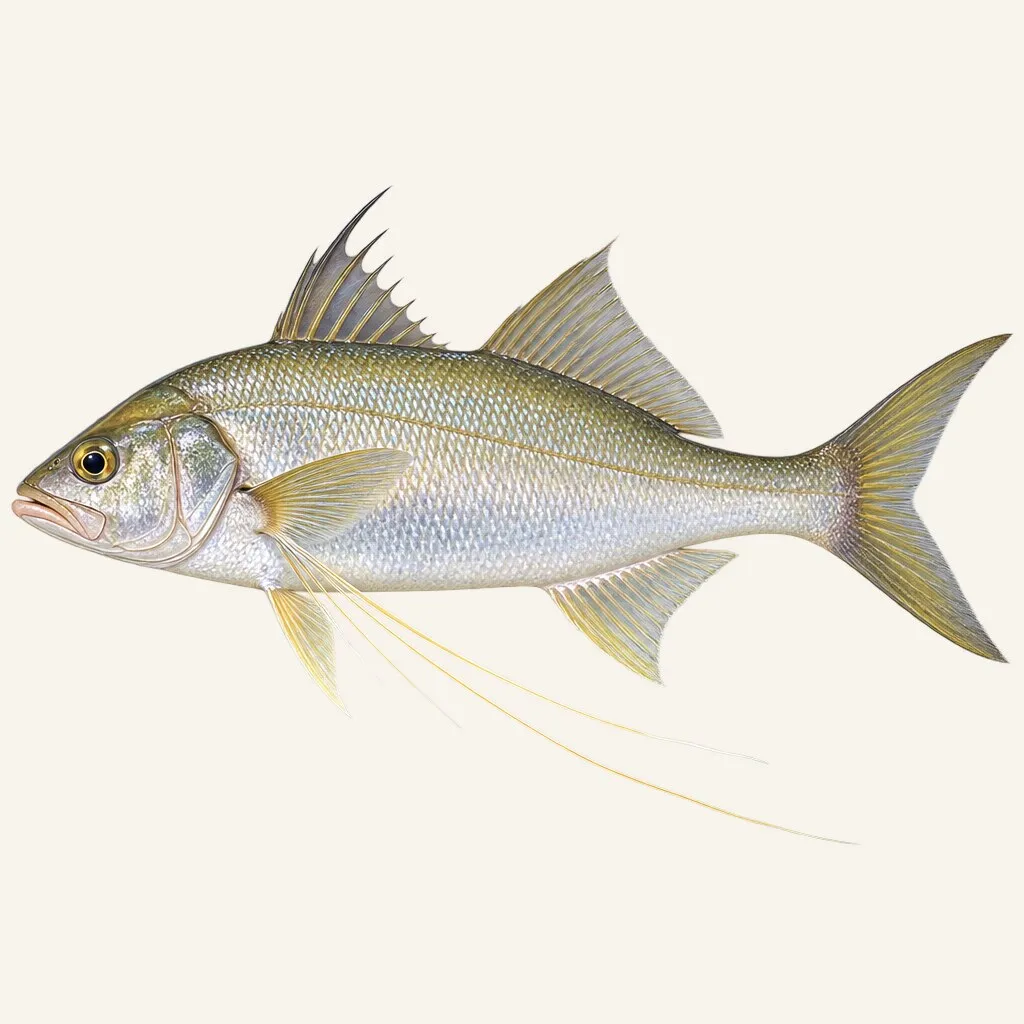
Large Indo-Pacific threadfin recognizable by its long sensory pectoral filaments, prized for its fighting power and table quality.
Calendar
Recorded in 1 country
GBIF occurrence records — native and introduced populations combined.
Its range
Irian Jaya in Indonesia and Papua New Guinea to southern Queensland: a narrow range, three countries, and effectively the Arafura Sea and its approaches.
That is a small territory for a large fish carrying a commercial fishery, and it concentrates the whole management question into one region. There is no population elsewhere to buffer a bad decade, and a measure taken in any one of the three countries covers only part of the range.
Identifying it
The fourth pectoral filament is the character, and it is a large one: 40 to 53 per cent of standard length. The free filaments hanging below the pectoral fin are the family's badge, and on this species one of them runs to half the length of the fish.
The body is plain, without spots or stripes, which removes a good part of the family at a glance. The second dorsal spine is more robust than the rest. The rear margin of the maxilla extends considerably beyond the back edge of the adipose eyelid. The pectoral rays are unbranched, and so is the lateral scaling on the caudal fin.
One character in the published description is there for specialists, and it is worth quoting for what it says about how finely this family has to be divided: the lower tip of the seventh proximal pterygiophore of the first dorsal fin is directed backward. Identification in the threadfins reaches down to the skeleton of a fin support.
Breeding
This fish changes sex upward, and the file gives the switch in numbers.
It is a protandrous hermaphrodite — male first, female later. Between 70 and 100 cm fork length, individuals may be transitional: they carry mature male tissue and immature female tissue at the same time, and they function as males. Below 80 cm most are males. Above 95 cm most are females.
The seasonality is the part easily missed. Transitional fish are found mostly in June, July, August and September, so the change is not spread evenly through the year. It happens in a season, which means the sex composition of a catch depends on the month it was taken as much as on the sizes in it.
The nurseries are inshore, shallow and of low salinity. Beyond that, there is little information on the larvae — a real gap for a species carrying a commercial fishery.
The water it needs
Turbid water, and not much of it: the depth range runs from the surface to six metres. Shallow coastal water, estuaries, mangrove creeks and mangrove-lined rivers, over sandbanks and mud.
The species is catadromous and its nurseries are low-salinity, and those two entries together mean the fish needs the river as much as the coast. A mangrove creek is not somewhere it visits. It is a stage in the life cycle.
Loose schools are the norm, with the larger fish more often in pairs or alone.
Areas
- Northern Australia
- Gulf of Carpentaria
- Southern New Guinea
- Tropical estuaries
Techniques
- Lure casting and retrieve
- Drift fishing with natural baits
- Estuary float fishing
- Surfcasting
Baits
- Live prawns
- Baitfish
- Soft plastics
- Spoons and swimbaits
What it eats
Prawns and fish — both animals of the sediment and the near-bottom, taken in water where nothing can be seen.
This is where the filaments earn their length. They are sensory organs trailing ahead of the fish, sweeping ground it has no way of looking at. Hunting by touch is the only method available in turbid water over mud, and the length of the fourth filament is the measure of how much of the work it does.
How to catch it
Turbid water is the context and it is not an obstacle. A fish that feels for its food does not need to see, and the water this species prefers is water an angler cannot read.
The marks are the estuaries, the mangrove creeks and the mangrove-lined rivers, over sand and mud, in less than six metres. Prawn baits on the bottom match the recorded diet directly, without any interpretation needed.
The decision that matters comes at the end. Common length is 48 cm. The maximum reported age is 20 years. And above 95 cm most fish are females. A large king threadfin is almost certainly female, and in a protandrous species a female is a fish that took the longest to become what it is. Nothing about the sex shows on the outside — length is the only indication available at the boat.
Conservation
Protandry is the whole of it, and it is unusually well quantified. Above 95 cm, a fishery is taking females.
Set that against the size distribution. Common length is 48 cm, and the fish worth targeting are much larger, so a fishery selecting for size in this species selects for reproductive females almost exclusively. A stock stripped of its large individuals loses its spawning capacity before it loses its numbers, and that failure is invisible in a catch that still weighs the same.
The habitat supplies the independent pressure. Mangrove creeks, turbid estuaries and shallow low-salinity nursery ground are all coastal margin, and coastal margin is what gets cleared, walled and dredged.
The species has not been assessed. For a fish with a narrow range, a commercial fishery, a recreational fishery and a sex-change threshold sitting inside the size range that is targeted, that is the most uncomfortable line in the file.
Regulations
Species subject to minimum sizes and bag limits in Australia; follow local regulations.
For guidance only. Legal sizes, quotas and open seasons vary by location and season: always check the local regulations in force before fishing.
Other names
King threadfin in English, and threadfin names the right thing — the free pectoral filaments.
The other languages of the catalogue converge on the same feature through a different image. Spanish has barbudo rey, the bearded king; Italian barbo reale, the royal barbel; German König-Fädenfisch, king thread-fish. French says capitaine royal, which follows the West African use of capitaine for the threadfins and keeps the rank while dropping the filaments. Five languages, one fish, and four of them naming the same appendages as threads or as whiskers.
The fish is of high value in northern Australia, where it supports a commercial fishery and a recreational one on the same stock.
Sources: fishbase.se · api.gbif.org