Leatherjacket
Oligoplites saurus · Carangidae
- Saltwater
- Coastal
- Medium
- Size
27–35 cm
- Weight
0.1–0.3 kg
- Depth
0–50 m
Where to fish
- Estuary
- Beach
Habitat icons: Flaticon
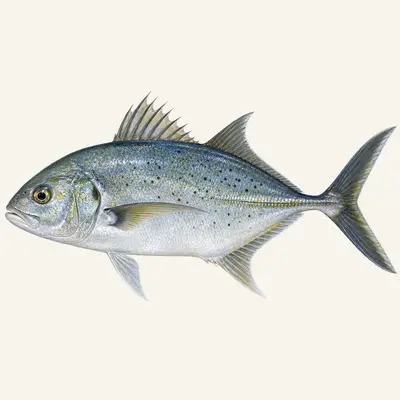
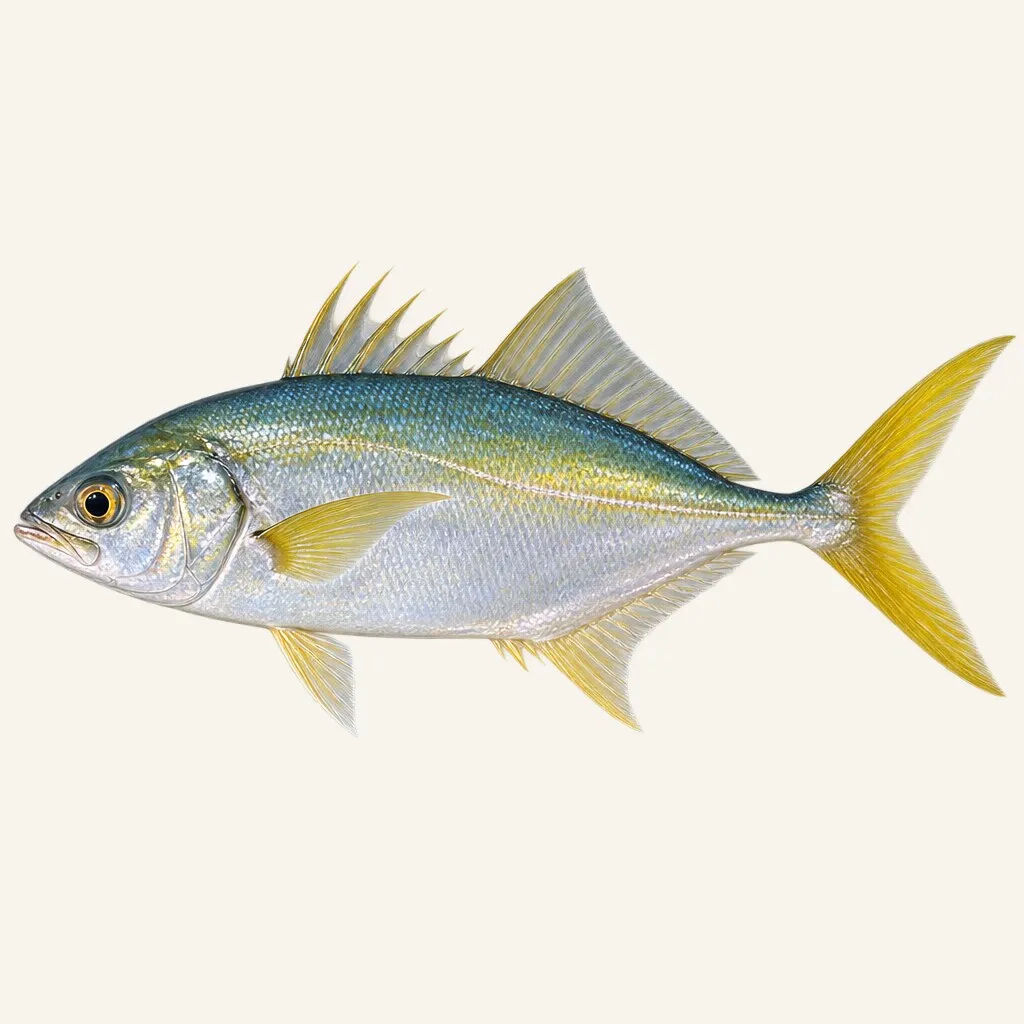
The leatherjacket is a coastal carangid of tropical Atlantic waters across North and South America, featuring an elongated silver body and multiple rows of sharp teeth, a distinctive trait among American carangids. It inhabits shallow areas, estuaries and sandy zones where it preys on small fish and shrimp.
Calendar
Recorded in 13 countries
Brazil · Colombia · Costa Rica · Cuba · Ecuador · Jamaica · Martinique · Mexico · Panama · Puerto Rico · Trinidad & Tobago · United States · Venezuela
GBIF occurrence records — native and introduced populations combined.
Its range
The range comes in two halves, and they have been given separate names. Oligoplites saurus saurus holds the western Atlantic, from Maine and the northern Gulf of Mexico to Uruguay and through most of the West Indies. Oligoplites saurus inornatus holds the eastern Pacific, from Baja California to Ecuador.
Two populations sitting on either side of Central America, already distinct enough to be formally separated, is the signature of a coastal range cut in two by the rise of the isthmus. Neither half can now reach the other along a shore, which is the only way this fish travels.
One negative entry stands out inside the Atlantic half: the species is absent from the Bahamas. It is an animal that goes up into estuaries and into fresh water, and the Bahamian banks are clear carbonate platforms with no rivers running off them. There is nothing there for it to enter.
Identifying it
Run a hand along the flank and the fish identifies itself before anything is counted. The scales are small, needle-shaped and sunk into the skin, so the surface reads as smooth hide rather than as armour. That single character is what the English name records, and it is available in the dark.
The build is a blade. The body is elongate and strongly compressed, its depth going 3.5 to 4.4 times into the standard length, which sets it apart from the deep-bodied jacks at a glance and from every distance.
The dorsal is the second thing to look at. Five spines stand at the front of it, and the description calls them nearly separate — spines carrying little or no membrane between them, standing as a row of points along the back rather than as a fin. Behind that come 19 to 21 soft rays, and the anal answers with two or three spines and 18 to 21 rays.
The head is built for a bigger mouth than the fish appears to need. The rear end of the upper jaw reaches back to the hind rim of the eye, and the teeth in that jaw are small and villiform — a brush rather than a set of fangs. The lower limb of the first gill arch carries 14 to 18 rakers.
Colour is a blue-green back over silvery to white flanks and belly, sometimes with yellow or golden lights in it, and yellowish pectoral and caudal fins.
The water it needs
Inshore water, from the surface down to 50 m and in practice within a fraction of that. Sandy beaches, bays and inlets, the mangroves, and up into the estuaries and beyond them into fresh water. The account adds a preference that most fish are described as tolerating rather than seeking: it prefers turbid water.
The schools are large, fast, and given to leaping clear of the surface. A moving school of this species announces itself, which is unusual in a fish this size and is the whole basis of the fishery for it.
The young behave in the exact opposite way. Juveniles float at the surface with the tail bent and the head hanging down — motionless, at an angle no swimming fish adopts, in the same water where the adults are travelling at speed. Anyone scanning the surface for the school will pass over the juveniles without registering them as fish at all.
Areas
- Shallow coastal waters
- Estuaries
- Sandy beaches
- Mangroves
Techniques
- Small soft lure fishing
- Light casting
- Live bait fishing
- Drop shot fishing
Baits
- Small live fish
- Shrimp
- Soft grubs
- Shiny lures
What it eats
Adults take fishes and crustaceans. The juveniles do something else entirely, and the record ties the change to a measurable feature.
Young fish carry incisor-like outer teeth and act as cleaners, working over other fishes and taking parasites and loose tissue off them. As the animal grows, those teeth turn conical and the diet changes with them. Tooth shape and feeding change together, which means a specimen can be assigned to one side of the switch or the other by looking into its mouth.
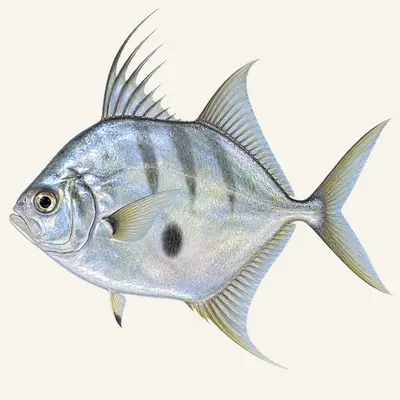
It is a living taken off the flanks of other fish, and it has a mirror image in this family. The juvenile doublespotted queenfish also feeds on the sides of schooling fish, but it tears scales and skin away and gives nothing back. Same surface, same age class, opposite arrangement.
How to catch it
The surf beaches and the river mouths are the ground, and every part of it is reachable on foot. This is a fish caught from the bank across its whole range, and it is one of the very few carangids of which that is true.
The schools are the method. They travel fast and they show themselves, so the fishing is a matter of intercepting something visible rather than searching blind water — small lures worked quickly at or just under the surface, put in front of a school that is already moving. That combination of accessibility and eagerness makes this the first jack a great many shore anglers ever land in the American tropics.
Its main value is not on a plate. The flesh is sold fresh, salted or dried, and the record notes without softening it that it is not highly esteemed; the commercial fishery is minor. What the species is genuinely wanted for is bait — a small, lively fish to swim in front of something a great deal larger — and that demand, rather than the food fishery, accounts for much of what is taken.
Unhooking calls for a tool, and the reason is a contradiction the file carries in full. The dorsal and anal spines are recorded as connected to venom glands capable of inflicting painful wounds, and the human-hazard rubric on this species reads venomous. The same file then states that no glands were visible and none could be confirmed on the specimen examined, and that the claim needs verification. The record flags the hazard and withdraws it on the same page. The practical answer does not wait on the outcome: the spines are fine, sharp and numerous whatever they are or are not connected to, and a fish this small is worth no risk of finding out.
Regulations
Check the local regulations in force (legal size limits, closed seasons, bag limits).
For guidance only. Legal sizes, quotas and open seasons vary by location and season: always check the local regulations in force before fishing.
Other names
Leatherjacket is the English name and it describes the skin exactly — needle-shaped scales buried in it, and a hide that takes a grip like leather rather than a scaled flank that slips. Spanish arrived at the same material by another trade: zapatero, the shoemaker.
The trouble with the English name is that it belongs to several unrelated animals. In Australia and New Zealand, leatherjacket means a filefish, one of the Monacanthidae, with nothing in common with this fish beyond a tough skin. In Britain and Ireland the word is not a fish at all — it is the larva of the crane fly, a lawn pest. The scientific name is not a formality on this species; it is the only way to be sure which animal is under discussion.
Two other languages named the behaviour instead of the hide. French has oligoplite sauteur and Italian oligoplite saltatore, both meaning the leaper, and both are describing the schools that come out of the water. German went to the fins with Langflossen-Stachelmakrele. Brazilian Portuguese kept a local word, guaivira, that translates nothing.
The genus name is built on Greek oligos, few, and the epithet saurus is a lizard.
Sources: fishbase.se · api.gbif.org