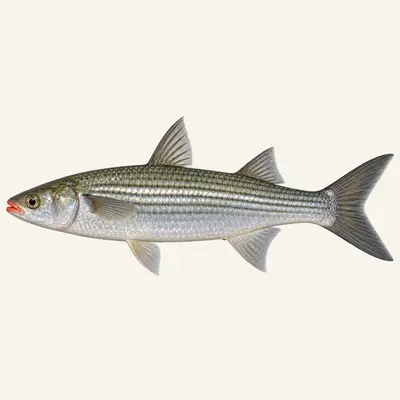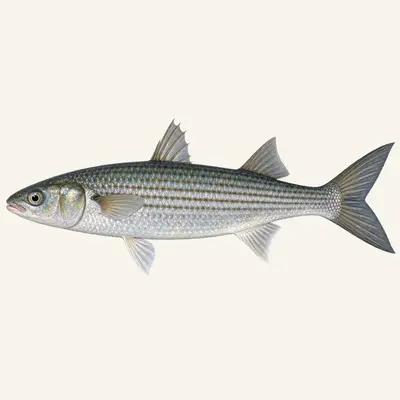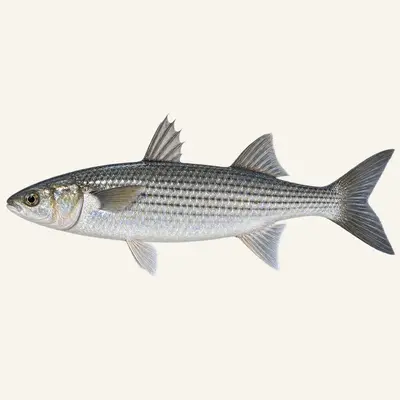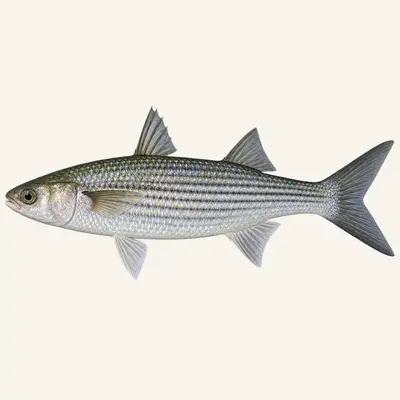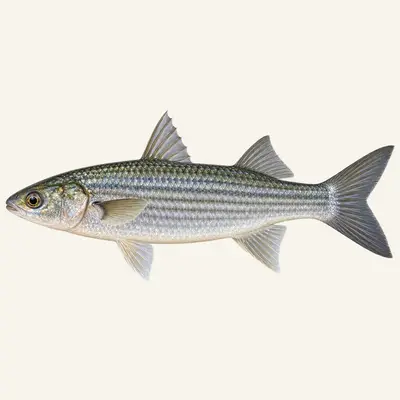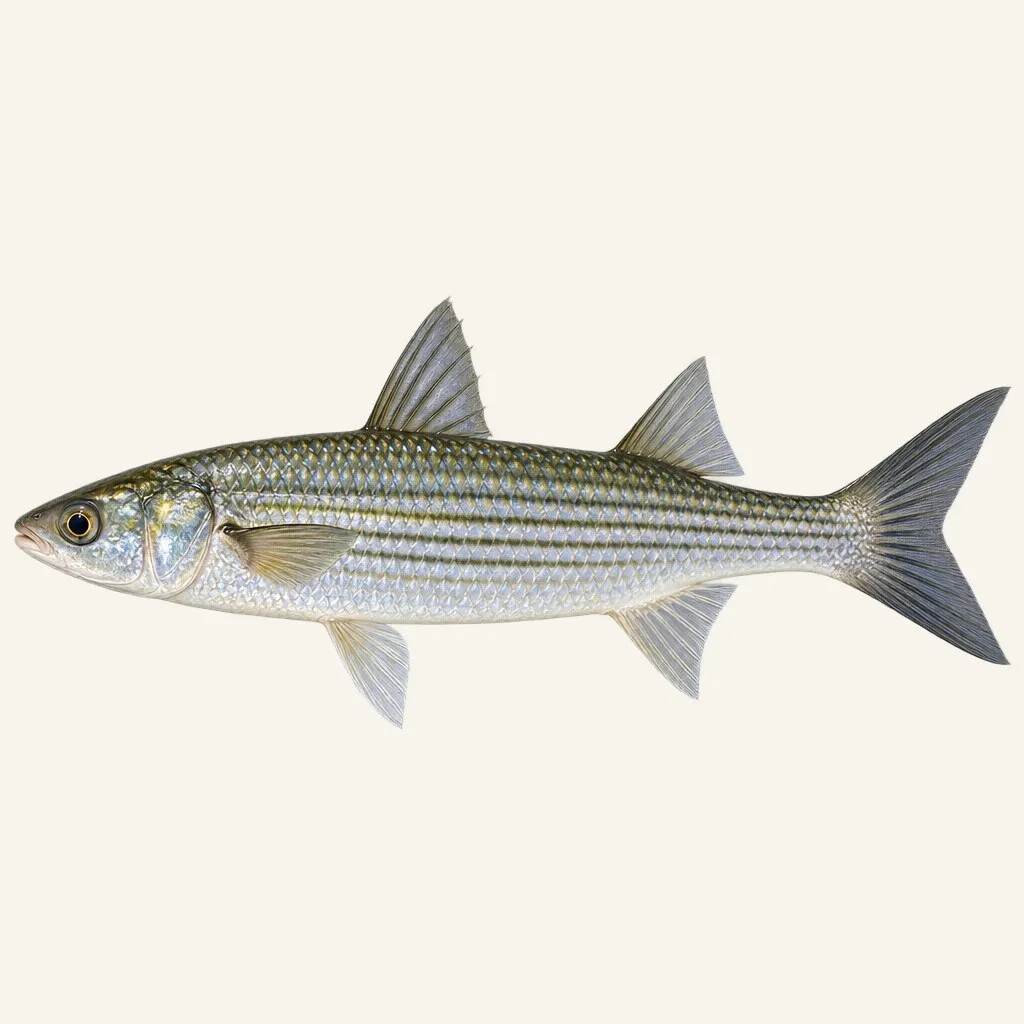
Leaping mullet
Chelon saliens · Mugilidae
- Saltwater
- Coastal
- Medium
- Size
30–40 cm
- Weight
0.3 kg
- Lifespan
4 years
Where to fish
- Estuary
- Rocky shore
Habitat icons: Flaticon
The leaping mullet owes its name to its spectacular behaviour: it leaps clear of the water when fleeing or in shallow areas. An elongated, silvery body with fine dark longitudinal lines, it inhabits coastal waters, estuaries, and lagoons.
Calendar
Its range
An introduction has become a range. The fish was put into Iran, and it now occupies the Caspian basin, where the sources record it as naturally occurring. A transfer that stops being a report and turns into a distribution is the most complete result an introduction can produce, and it does not run backwards.
The rest of the map is narrow. The latitude band is 29 to 47 degrees north; on the Atlantic seaboard the species reaches France and stops, where two of its relatives on those same coasts run to Iceland and to the Barents Sea. This is a warm-temperate animal, and the Mediterranean, the Black Sea and the Sea of Azov hold the bulk of it.
Identifying it
The fish leaves the water. Disturbed, or crossing shallow ground, it clears the surface entirely, and a school going up in series along a rock wall announces itself at a hundred metres, before a whole fish has been seen.
The body is the family's: elongate, silver, marked with fine dark lines running the length of the flank. The sources consulted stop there. No fin formula, no head proportion, nothing about the lip or the eye — none of the characters that ordinarily separate two mullets laid side by side on a table.
So what identifies this one is a behaviour, and a behaviour is not a character to check in the hand. It is a character to use at range, before the fish is anywhere near a landing net.
Breeding
Spawning is in summer, at sea. The eggs float free and fasten to nothing.
The rest of the calendar is written in the movement of the young. At about 2 cm they enter the coastal lagoons and estuaries, in summer and through autumn — the late slot in a nursery the other grey mullets of the same coasts occupy earlier in the year. One lagoon, several species, and a rota.
First maturity comes at 21.3 cm, within a range of 17 to 22. That is early, and it fits the other end of the life: the maximum reported age is four years.
The water it needs
Adults hold coastal water in schools and go into lagoons and estuaries only sometimes. The qualification carries weight. Here the diluted water is a nursery and the adult remains a fish of the sea — rock armour, quay walls and the approaches to a lagoon mouth take the place that other mugilids give to the head of an estuary.
The depth record is thin: a floor of 10 m and no ceiling. It does not say how deep the fish will go, and it does not contradict what is seen from the shore, where the species works in very little water. The record classes it as demersal.
Areas
- Coastal lagoons
- Estuaries and river mouths
- Rocky coastal areas
- Harbors and piers
Techniques
- Lightweight float fishing
- Bread fishing
- Light ledger fishing
- Fixed pole fishing
Baits
- Bread crumb
- Sea algae
- Sandworm
- Small green algae
- Flavored paste
What it eats
Three diets follow one another before the fish is as long as a finger. The fry filter zooplankton to about 3 cm, take bottom organisms up to 5 cm, and then change for good.
The adult is herbivorous — algae and vegetable detritus. No animal prey is credited to it after that last change, which puts this species at the plant end of a family several of whose members go on swallowing small invertebrates along with the sediment.
Two size thresholds for two changes of food is unusual precision, and it has a consequence for the habitat: a summer lagoon has to supply the same individual with three different foods inside a few weeks.
How to catch it
The leap is the prospecting tool. A fish that shows itself by leaving the water gives away the school, its heading and the depth it is working, with nothing to be sounded, and a session gets organised around what has been seen in the air.
Then comes the difficulty every plant-eater sets. Nothing this fish eats has ever moved: bread, paste, weed and a fine worm are the baits, fished light, and the indication is a hesitation rather than a take.
Marks follow the food — algae-covered margins, harbour walls, lagoon mouths, river mouths. Common length is 30 cm, and at that size the rig is decided by how fine it is rather than by how strong.
Conservation · Near Threatened (IUCN) — This species is in decline. Release your catch quickly and handle it with care — wet hands, as little time out of the water as possible.
Conservation
The reference assessment of 7 June 2022 weighed two pressures together: the condition of the habitats the species occupies, and the level of exploitation it carries.
The first is about the lagoon. A 2 cm fish that finds the channel shut in August has nowhere else to go, and the adults offshore show no sign of that failure for several seasons afterwards.
The second is about females. This mullet is taken for its roe as much as for its flesh, and a market that pays for gonads points the effort at fish caught in the weeks before they spawn.
One trait works in the opposite direction. Four years of life means a population never holds more than four year classes in reserve. Two poor recruitments show up at once — and so do two good ones. This is a stock that reports on itself quickly, in both directions.
Regulations
Check the local regulations in force (legal size limits, closed seasons, bag limits).
For guidance only. Legal sizes, quotas and open seasons vary by location and season: always check the local regulations in force before fishing.
Other names
Leaping mullet in English, and the leap is in five of the six names this catalogue carries, as well as in the epithet saliens. Italian is the exception with cefalo verzelata, a fisherman's word that refers to none of it.
Spanish comes with a warning attached. Galúa saltona is a compound, and galúa on its own is the thinlip grey mullet: the adjective is the whole of the difference between two species. A report that keeps the noun and drops the adjective has not said which fish it means.
Much of the literature files this species in Liza, and it is still catalogued that way here. Current sources place it in Chelon with most of the European grey mullets. The binomial changed; the animal did not.
Sources: fishbase.se · api.gbif.org