Longnose gar
Lepisosteus osseus · Lepisosteidae
- Freshwater
- Predators
- Medium
- Size
18–200 cm
- Weight
0.0–23 kg
- Lifespan
36 years
- Water temp.
12–20 °C
Where to fish
- Lake
- River
Habitat icons: Flaticon
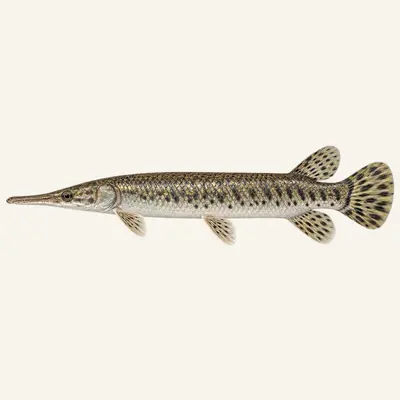
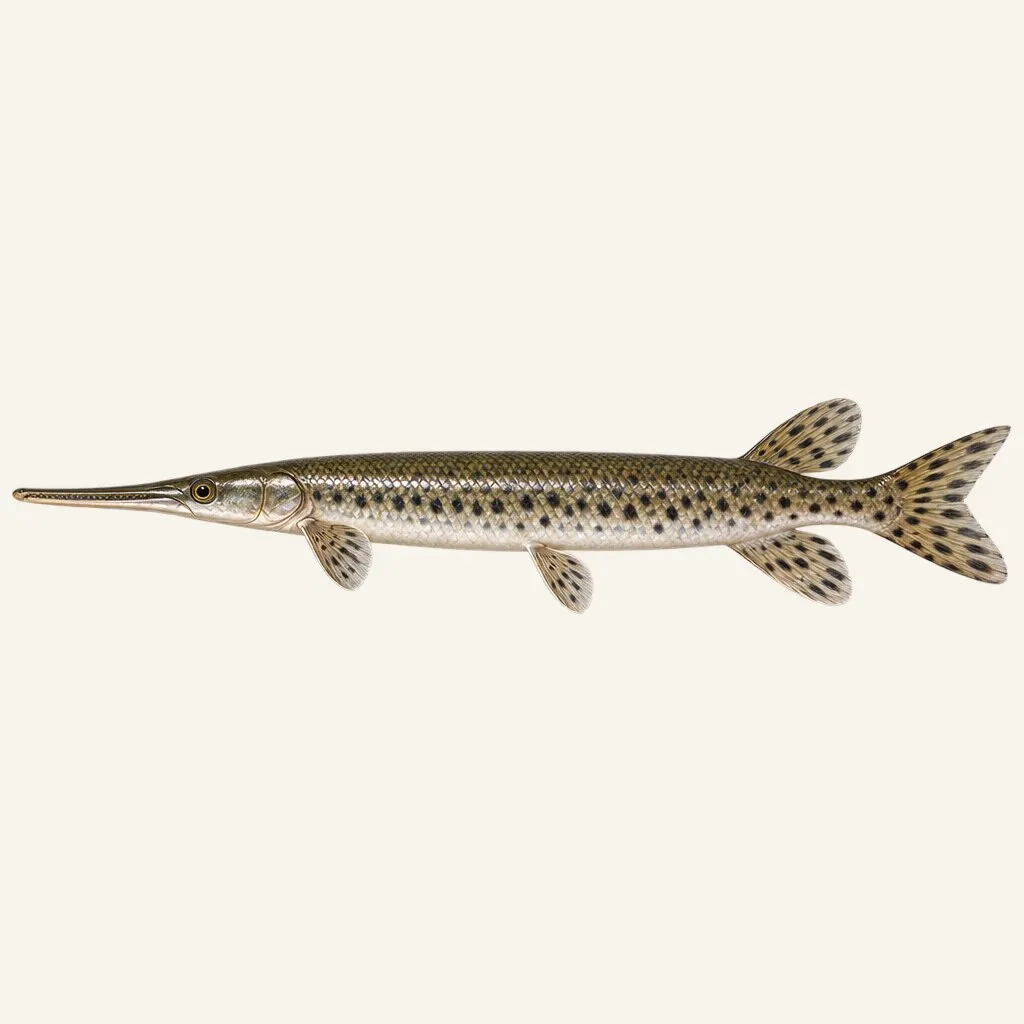
The longnose gar is a primitive North American fish with a long body covered in hard ganoid scales, featuring a very thin and elongated snout lined with small hooked teeth, resembling an armored pike.
Calendar
Recorded in 3 countries
GBIF occurrence records — native and introduced populations combined.
Its range
This is the most widely spread gar by a wide margin, and the list of waters explains why the species is the one most anglers meet. On the Atlantic slope it runs from the Delaware in New Jersey to central Florida. Inland it holds the St Lawrence in Quebec, the Great Lakes and the whole Mississippi basin, reaching the Red River of the Hudson Bay drainage and North Dakota at its northern edge and Louisiana at its southern. On the Gulf slope it continues from central Florida west to the Rio Grande in Texas and Mexico.
Three tolerances account for that reach. The fish works between 12 and 20 degrees, it enters brackish water when it meets it, and it can breathe air. A predator that is not stopped by warm stagnant water, by a river mouth, or by an oxygen crash has very little left to stop it short of the climate.
Identifying it
The snout does it alone. It is long and narrow, longer than in any other gar, drawn out to something like twice the length of the rest of the head — a beak rather than a jaw. Nothing else in the fresh water of the continent has that outline.
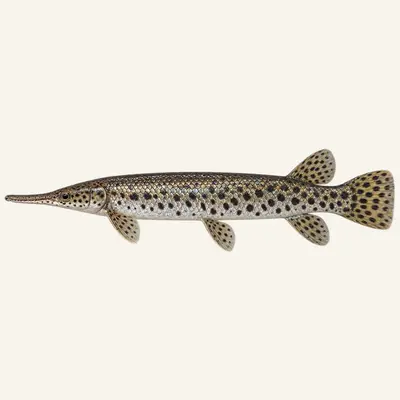
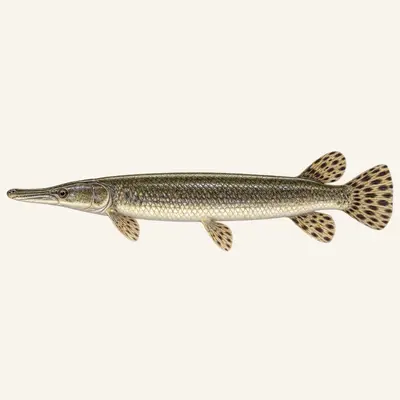
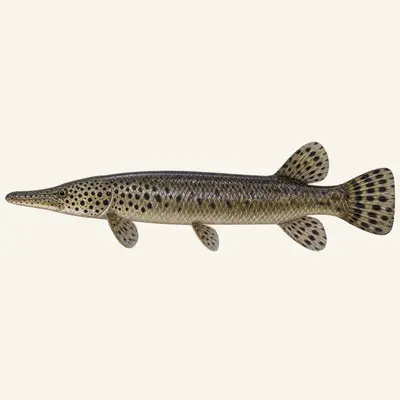
The body is elongated and circular in cross-section, olive-brown above and white below, with dark spots on the median fins and scattered over the trunk. Fin rays are soft throughout: six to nine in the dorsal, eight to ten in the anal, no spines anywhere.
Then there is the skin, which is not skin as other fish have it. The scales are ganoid — enamelled, rigid, set in an oblique mosaic and hinged to one another rather than overlapping loosely. The result is armour in the literal sense, and it is an inherited character that places this animal among the few survivors of a very old lineage. Thin bony scutes reinforce the leading edge of each unpaired fin and both edges of the tail.
Breeding
The roe is poisonous. That is the single most important thing on this page: the flesh of a gar is eaten and has been for as long as the rivers have been fished, and the eggs are toxic to people, a property established long ago and shared across the genus. Anyone cleaning a ripe female needs to know it before the knife goes in, not afterwards.
Spawning takes place in fresh water and possibly in slightly brackish water, after a run up the rivers in the breeding season. Eggs and larvae are demersal and adhesive: they fasten to the bed and to whatever is lying on it instead of drifting away.
First maturity comes at around 67 cm, with reports up to 80. Set against a maximum recorded age of 36 years, that is a fish which spends a long apprenticeship before contributing anything, and which then contributes for decades.
The water it needs
Sluggish pools, backwaters and oxbows of medium to large rivers, and lakes; usually somewhere near vegetation; occasionally out into brackish water. What ties that list together is the absence of current and the presence of cover.
The mechanism behind it is the swim bladder, which is vascularised and works as an accessory lung. Air-breathing here is facultative, not obligatory: the fish comes up and gulps when the water runs short of oxygen, but it is under no permanent compulsion to do so.
That is what opens the warm, turbid, half-stagnant backwater of high summer. Oxygen there collapses, the resident prey fish are in difficulty, and the other large predators have effectively shut down. The gar keeps hunting and takes a breath at the surface when it needs one.
Areas
- Vegetated banks
- Shallow coves
- Shaded river sections
- Wooded swamps
Techniques
- Surface lures
- Fly fishing
- Live baitfish near surface
- Slow deadbait retrieve
Baits
- Small live fish
- Streamers
- Floating lures
- Dead baitfish
What it eats
A voracious predator, feeding on fish of various kinds and on crustaceans.
The long beak is not a grasping tool. It is a scythe. The fish comes alongside its prey and strikes sideways with a flick of the head, and the fine teeth that line the jaws hold what has been slashed until it can be turned and swallowed head first. The whole design trades bite force for reach and speed of sweep, which is why the snout can afford to be that thin.
How to catch it
Warm water short of oxygen is the ground to cover. Backwaters, cut-off meanders and slow pools in the middle of summer: precisely where other predators have stopped, and where this one is still working.
Those trips to the surface are the best presence indicator available in coloured water. A gar breathing is visible, repeatable and roughly on a schedule, and it locates a fish that sonar and casting would both miss.
Hooking is the real problem. A narrow, bony beak covered in fine teeth offers almost nothing for a conventional hook point to enter, and the drop-off rate is high enough to have produced a class of tackle of its own: rigs made from frayed rope, which tangle in the dentition instead of trying to pierce it. They exist because the orthodox approach fails often enough to be worth abandoning.
Handling is its own hazard. Ganoid scales are hard, edged, and quite capable of opening a bare hand, and the beak is not a handle. Given the age these fish reach, a large one has been in the river since before most of the tackle in the boat was manufactured.
Conservation
The pressure on this species is not fishing, it is plumbing. A gar needs slack, warm, vegetated water and a run up the river in spring; that combination lives in oxbows, backwaters and floodplain side-channels, which is exactly the inventory that channelisation, levees and level regulation remove.
The demographics make the loss slow to see and slow to repair. Late maturity at around 67 cm and a lifespan reaching 36 years mean adults remain visible in the main channel for decades after recruitment has stopped, and a depleted population needs the same decades to rebuild. Nothing about the fish gives an early warning.
That longevity is also what a landed fish commits the angler to. A large individual represents thirty-odd years of a river that no longer exists in the same form, and there is no fast way to replace it.
Regulations
Check the local regulations in force (legal size limits, closed seasons, bag limits).
For guidance only. Legal sizes, quotas and open seasons vary by location and season: always check the local regulations in force before fishing.
Other names
Longnose gar in English, and the name is doing honest work: among the North American gars it is the one told apart on snout proportion alone.
The word gar descends from an old English term for a spear, in reference to that snout. The confusion it invites is the marine one — the needlefishes are called garfish in Britain and carry a similar beak, and they are not related to this family at all. Convergence on a shape is not kinship. The epithet osseus means bony, which is a fair summary of the whole animal, from the beak to the enamelled plates.
Sources: fishbase.se · api.gbif.org