Olive barb
Systomus sarana · Cyprinidae
- Freshwater
- Carp & coarse
- Medium
- Size
42 cm
- Weight
1.4 kg
Where to fish
- Lake
- River
Habitat icons: Flaticon
Olive barb - coarse fish, Southeast Asia
Calendar
Recorded in 2 countries
India · Sri Lanka
GBIF occurrence records — native and introduced populations combined.
Its range
The range crosses the subcontinent from Afghanistan to Sri Lanka, taking in Pakistan, India, Nepal, Bangladesh and Bhutan, and it includes the Himalayan slope.
At the eastern end the wording of the record changes. Myanmar and Thailand are entered as reported, not as established. That is the standard distinction between a documented presence and a mention passed from one compilation to the next, and it marks the edge of what is actually known rather than the edge of the animal. A range map will not show the difference; the text does.
Identifying it
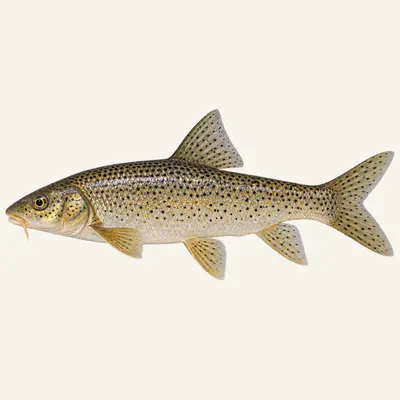
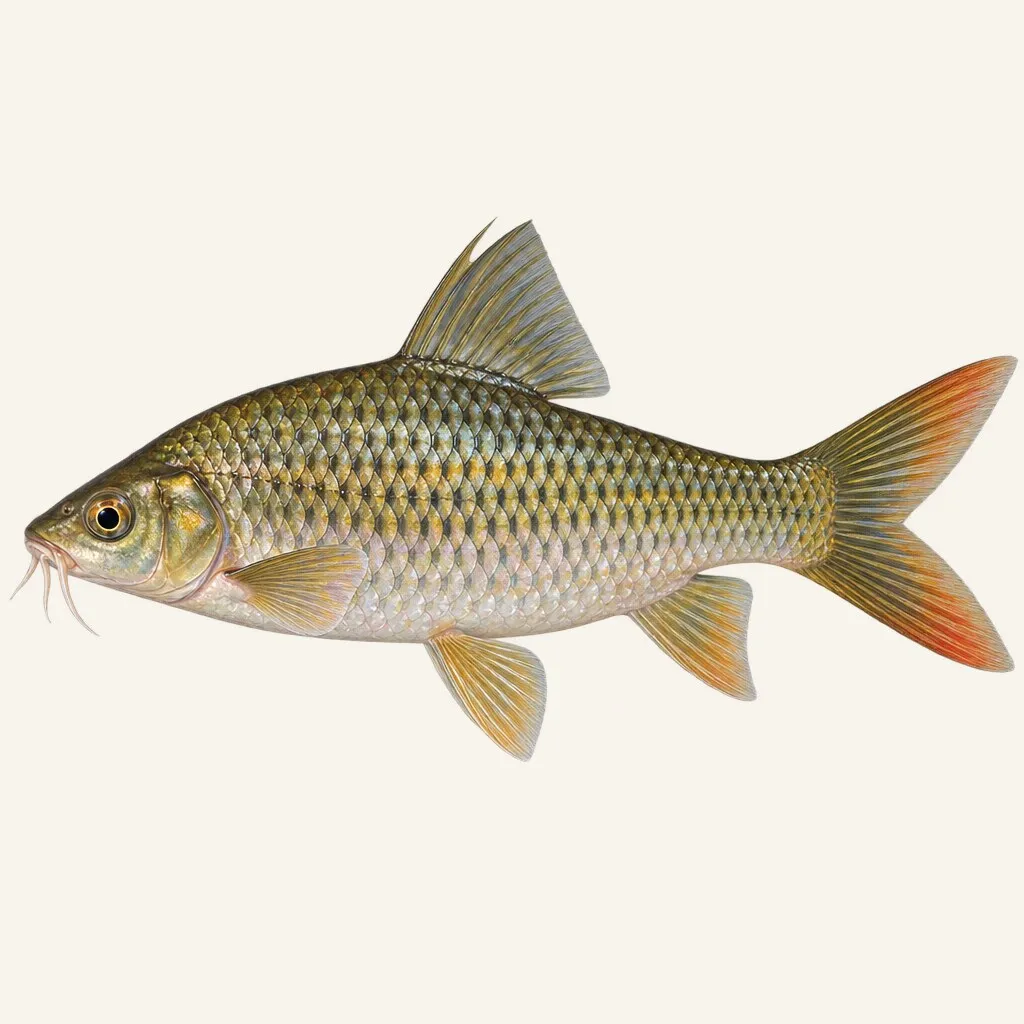
Both pairs of barbels are measured against the eye, and the answers go in opposite directions. The maxillary pair, at the corners of the mouth, is longer than the diameter of the orbit. The rostral pair, on the snout, is shorter than it. Neither measurement needs an instrument: the eye is already on the fish and serves as the ruler.
That two-step comparison is the whole determination in practice. The rest of the description is unremarkable — an oblong body, a small head — and the fin formulae are three hardened rays and eight soft ones in the dorsal, two and five in the anal.
Nothing about colour appears in the published diagnosis at all, which is worth knowing before a fish is named on its livery.
Breeding
Spawning takes place in running water, among submerged boulders and vegetation.
The requirement stands out against everything else on record. A fish that accepts lakes, backwaters and brackish margins for the rest of its life returns to current in order to breed. This is the single point in the cycle where the type of water stops being negotiable, and it means a population living in still water is dependent on running water it may not be occupying at the time.
The water it needs
The list of waters this species accepts is close to a list of freshwater habitats: rivers, streams, lakes and backwaters. It also tolerates salinity, which adds the lower parts of deltas and the mixed water beyond them.
Almost nothing about the setting excludes it, and that has a consequence for anyone searching. Where a specialist is found by reading water, this fish is found by covering it. The type of water narrows the search hardly at all.
Shoals are small. Four or five individuals, sometimes a few dozen — not the massed aggregations that other cyprinids of comparable size form, and the difference shows directly in what a productive swim can return.
Areas
- Large lowland rivers
- Reservoirs
- Lake margins
- Calm areas
Techniques
- Feeder fishing
- Float fishing
- Bottom fishing
- Toc fishing
Baits
- Earthworm
- Maggot
- Boilie
- Cooked seeds
What it eats
Aquatic insects, fish, algae and shrimps. Four items, and they do not belong to one trade.
Insects and shrimps are the diet of an ordinary bottom-working barb. Algae belong to a grazer. Fish belong to a predator, and that is the entry that changes the fishing.
A cyprinid of this size taking prey of its own kind is not confined to fine baits and small hooks. The predatory fraction of the diet licenses presentations — a boilie, a substantial bait moved rather than laid still — that would be pointless in front of a strict invertebrate feeder, and it puts the species within reach of two quite different sets of tackle.
How to catch it
Three uses are recorded at once for this species: a minor commercial fishery, a recognised sport fishery, and a commercial aquarium trade that takes only the small individuals. Few freshwater fish carry all three, and it means the species is met by three groups of people who do not read each other's records.
The diet leaves the choice open. Earthworm, maggot, cooked seeds and boilies all sit inside the published menu, so the fish can be approached from the fine end or the coarse end with equal justification — a latitude that is rare in a cyprinid and worth exploiting when one approach fails.
What sets the expectation is shoal size. A handful of fish to a few dozen means a swim yields a short session rather than a day, and time is better spent moving between spots than building a heavy bed of bait in one. Large lowland rivers, reservoirs, lake margins and calm water are where they are met; the current holds them at spawning time and rarely otherwise.
Regulations
Check the local regulations in force (legal size limits, closed seasons, bag limits).
For guidance only. Legal sizes, quotas and open seasons vary by location and season: always check the local regulations in force before fishing.
Other names
The character that identifies this fish — two pairs of barbels of unequal length, each read against the eye — has been named in none of the six languages this catalogue carries.
What every one of them names instead is a colour. Olive barb in English, and the same word in French, Spanish, German, Italian and Portuguese. Six naming traditions agreeing on one adjective is a strong indication about the appearance of a live fish, and the agreement is the only reason to trust it here, because the published diagnosis of the species records no colour whatever. The names supply a character the description leaves out.
That is a reasonable trade for a common name and a poor one for a determination. Olive is a shade, it changes with water and with light, and it is shared with a great many barbs across the same rivers. The barbels are on the fish whatever the light is doing.
Sources: fishbase.se · api.gbif.org