Redbelly tilapia
Coptodon zillii · Cichlidae
- Freshwater
- Other
- Medium
- Size
30–40 cm
- Weight
0.4–0.3 kg
- Lifespan
7 years
- Water temp.
11–36 °C
- Depth
1–7 m
Where to fish
- Estuary
- Lake
- Pond
- River
Habitat icons: Flaticon
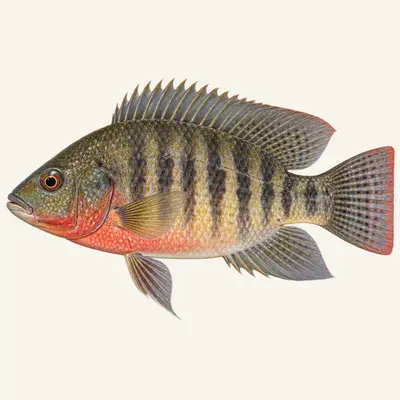
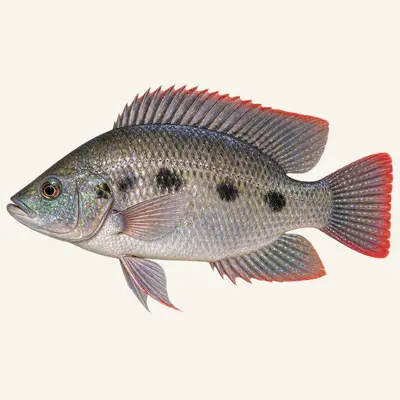
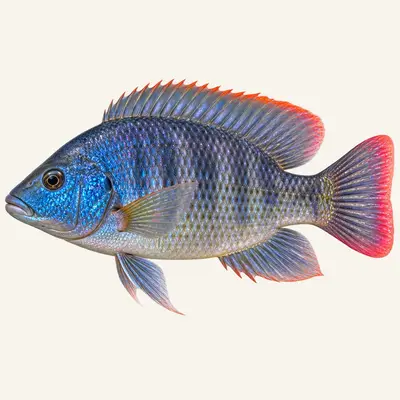
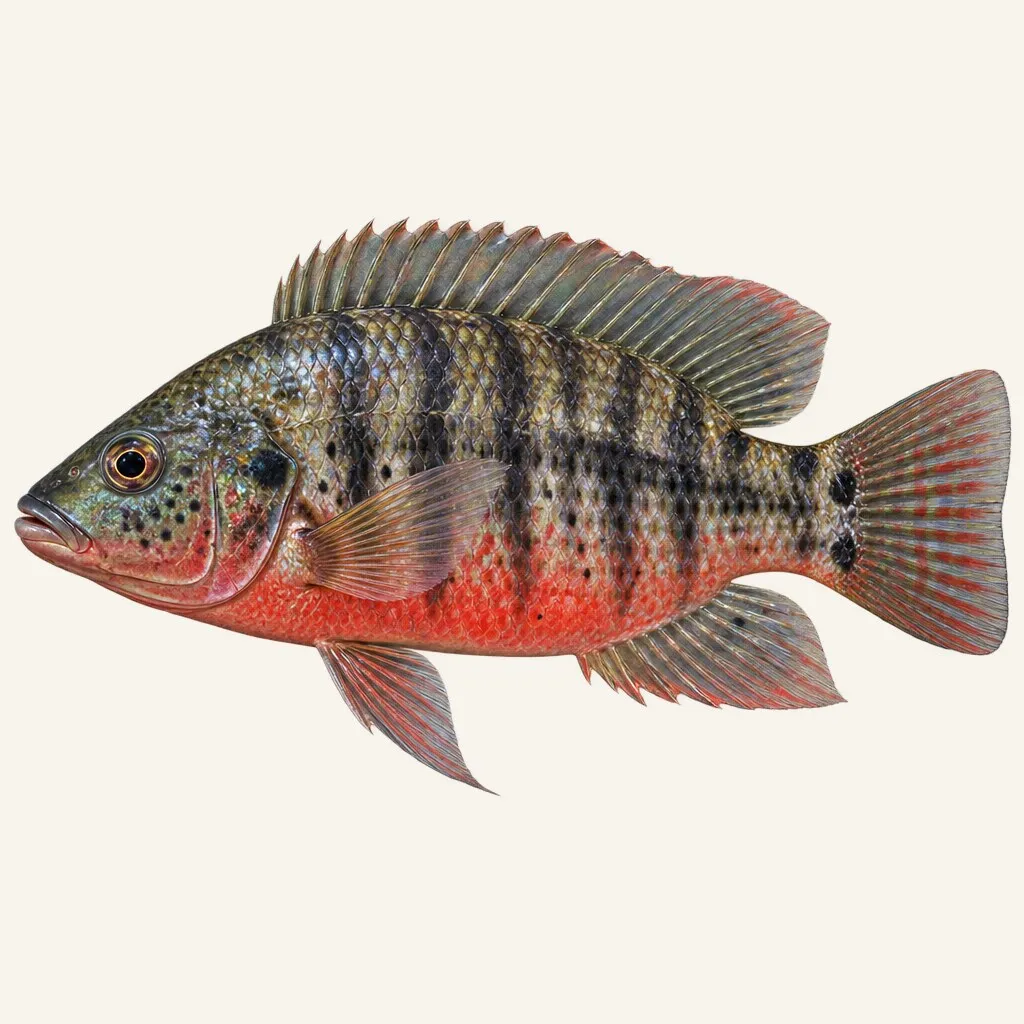
The redbelly tilapia is a medium-sized cichlid recognisable by its grey-olive flanks with rows of dark spots and its bright orange-to-red belly, especially vivid during the breeding season. It inhabits rivers, lakes, and freshwater canals in Africa, the Middle East, and various regions where it has been introduced.
Calendar
Recorded in 11 countries
China · Côte d’Ivoire · Egypt · Hong Kong SAR China · Israel · Macao SAR China · Mali · Mexico · Taiwan · Uganda · United States
GBIF occurrence records — native and introduced populations combined.
Its range
What is worth understanding about this range is that its edges are not physiological. With a pH window from 6 to 9, temperatures from 6.5 to 42.5 at the extremes, and salt no obstacle, there is almost nothing in an African or Levantine water body that excludes this animal. Where it occurs is a record of where warm water is and where the fish has managed to arrive — not of what it can withstand.
The list is correspondingly long: southern Morocco and Saharan water, the Niger-Benue system, the Senegal, the coastal rivers of Côte d'Ivoire and Ghana, the Volta, the Chad-Chari system, the middle Congo through the Ubangi, Uele, Itimbiri, Aruwimi and Lindi-Tshopo, Lakes Albert and Turkana, the Nile, and the Jordan.
Beyond all that it has been moved, and several countries record adverse ecological effects afterwards.
Identifying it
Check the border, not the spot. The tilapian mark at the back of the dorsal fin is large, running from the last spine to the fourth soft ray, and it is always edged with a yellow band. Plenty of cichlids carry a dark blotch there; the yellow surround is the part that belongs to this fish.
The rest of the description is generous. A bright red belly with prominent vertical barring, lips a definite green, a pinkish chest, and a brownish-olive body shot through with an iridescent blue sheen. Dorsal, caudal and anal are olive-brown scattered with yellow spots, with a narrow orange line finishing the dorsal and the anal. The body is deep, the head narrow with an upper profile that is not convex, and the jaws small but strong. Counts run 13 to 16 dorsal spines, 10 to 14 soft rays behind them, three anal spines and eight to 10 anal rays, over eight to 11 rakers on the lower limb.
One character reports age rather than identity. Below 14 cm standard length the caudal fin is uniformly yellowish or greyish with no dots at all; above it, the fin turns greyish and carries dots over its whole surface, growing larger as the fish does. A specimen in the hand can be placed on one side or the other of that line at a glance.
And one reports mood. A dark longitudinal band appears along the flanks when the animal is agitated and fades when it settles. It is a state signal, not a species mark, and reading it as a diagnostic will mislead.
Breeding
This fish lays its eggs on the ground and stays with them, which puts it on the far side of the main division running through the tilapias.
In the mouth-brooding genus Oreochromis, the female collects the clutch off the bottom immediately and carries it away in her mouth. Here the eggs remain where they were laid. A pair forms, digs a pit in the mud, and deposits adhesive eggs on the substrate — by preference on a hard surface, on lake bottoms of pebble or sand with plenty of vegetation. A large female may put down a thousand at a spawning.
Then both fish stand over them, and the source calls that care very thorough. Hatching comes about 96 hours after laying, the young are swimming freely four to six days later, and the larvae develop in close contact with the substrate throughout.
The cost of that arrangement is the interesting part. A mouth brooder takes its clutch with it and remains mobile; a substrate spawner cannot. For the better part of a week two adults are tied to a depression a few decimetres wide, in shallow water, reacting to anything that approaches it. The clutch is either defended where it lies or it is lost, and there is no third option.
The maturity figure is unsettled. The published length at first maturity is 7 cm, while the reported range in the same line starts at 20. The file does not reconcile the two, and neither should a page written from it.
The water it needs
Three age classes occupy three zones. Adults keep to shallow vegetated water between one and seven metres, the fry stay in the marginal vegetation, and the juveniles move out onto the seasonal floodplain. Within a single water body, position is read off size.
The species is mainly diurnal and forms schools occasionally rather than habitually.
Its tolerance is the most remarkable thing about it. The natural temperature range runs 10.5 to 36 °C and the extended one 6.5 to 42.5; pH from 6 to 9 is accepted; salinity is taken across a very wide span, with survival recorded in fully marine conditions. A freshwater fish able to sit in sea water can move from one coastal basin to the next without anybody's help.
Areas
- Vegetated margins
- Shallow lakes and ponds
- Calm river areas
Techniques
- Feeder fishing
- Bread fishing
- Match fishing
Baits
- Bread
- Soft algae
- Corn
- Vegetable pellets
What it eats
Adults are herbivorous, working through the leaves and stems of submerged plants along with algae and vegetative detritus. The small strong jaws in the diagnosis are cutting tools rather than grasping ones, and they are the right tool for that ration.
Among the fish anglers actually pursue, this diet is the exception. Most of what appears on a list of sport species is either carnivorous or opportunistically omnivorous, and every tackle tradition worth the name is built on that assumption.
How to catch it
Bait is matched to a plant diet, and that correspondence settles the outcome before anything else does. Bread, soft algae, corn and vegetable pellets are what this fish eats; animal baits are addressed to a species this is not.
Diurnal activity simplifies the day. The fish is looked for in the middle of it, along vegetated margins and shallows between one and seven metres, where the feeding happens.
The nesting period is a double-edged window. It concentrates adults into very little water and makes them reactive, which is exactly what an angler wants. It also pins two fish to one clutch, so taking either of them leaves the other on a pit it can no longer hold alone.
There is a last point that is not about catching. This species is listed as a potential pest wherever it has been introduced. Carrying it alive and returning it to water outside its own basin falls under rules that are not uniform between countries, and they have to be checked wherever you are standing.
Conservation
Nothing presses on this species, and the question here runs in the other direction.
Where it has been put, a large grazer works on the structure of a water body before it works on anything living in it: the submerged plants go, and with them the spawning substrate and the cover the rest of the community was using. That is the most likely route by which the adverse effects several countries report actually arrive.
Its envelope is what makes such an establishment final. An animal that holds between 6.5 and 42.5 °C, across pH 6 to 9, and through salt water, has no season and no water quality that will clear it out again. Removal is not on the table; containment is the only thing that is.
Regulations
Check the local regulations in force (legal size limits, closed seasons, bag limits).
For guidance only. Legal sizes, quotas and open seasons vary by location and season: always check the local regulations in force before fishing.
Other names
The fish has changed genus. It was Tilapia zillii for a long time and has belonged, since the 2013 molecular revision of the cichlids formerly lumped as tilapias, to Coptodon. Both names mean this animal, and everything written before that date uses the first.
This site carries the split in plain sight. The identifier of this page is still built on the old binomial, while the scientific name it prints is the new one. That is an accurate picture of the literature rather than an inconsistency: the old name is what you search under and the new one is what you cite.
Redbelly tilapia is the English name, and all six vernacular entries pick the same character. They are naming something that is at its clearest on a ripe fish in the breeding season and at its least reliable on a young one — which is a fair description of most colour-based fish names.
Sources: fishbase.se · api.gbif.org