Pinima peacock bass
Cichla pinima · Cichlidae
- Freshwater
- Predators
- Medium
- Size
52 cm
Where to fish
- Estuary
- River
Habitat icons: Flaticon
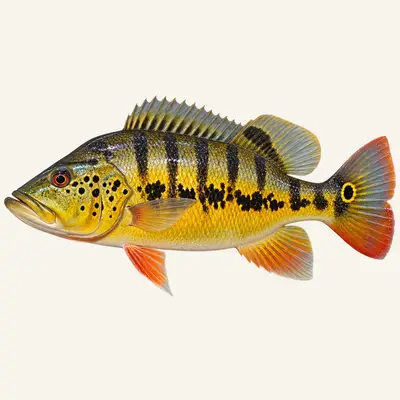
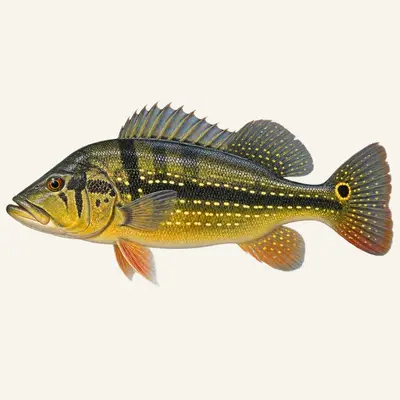
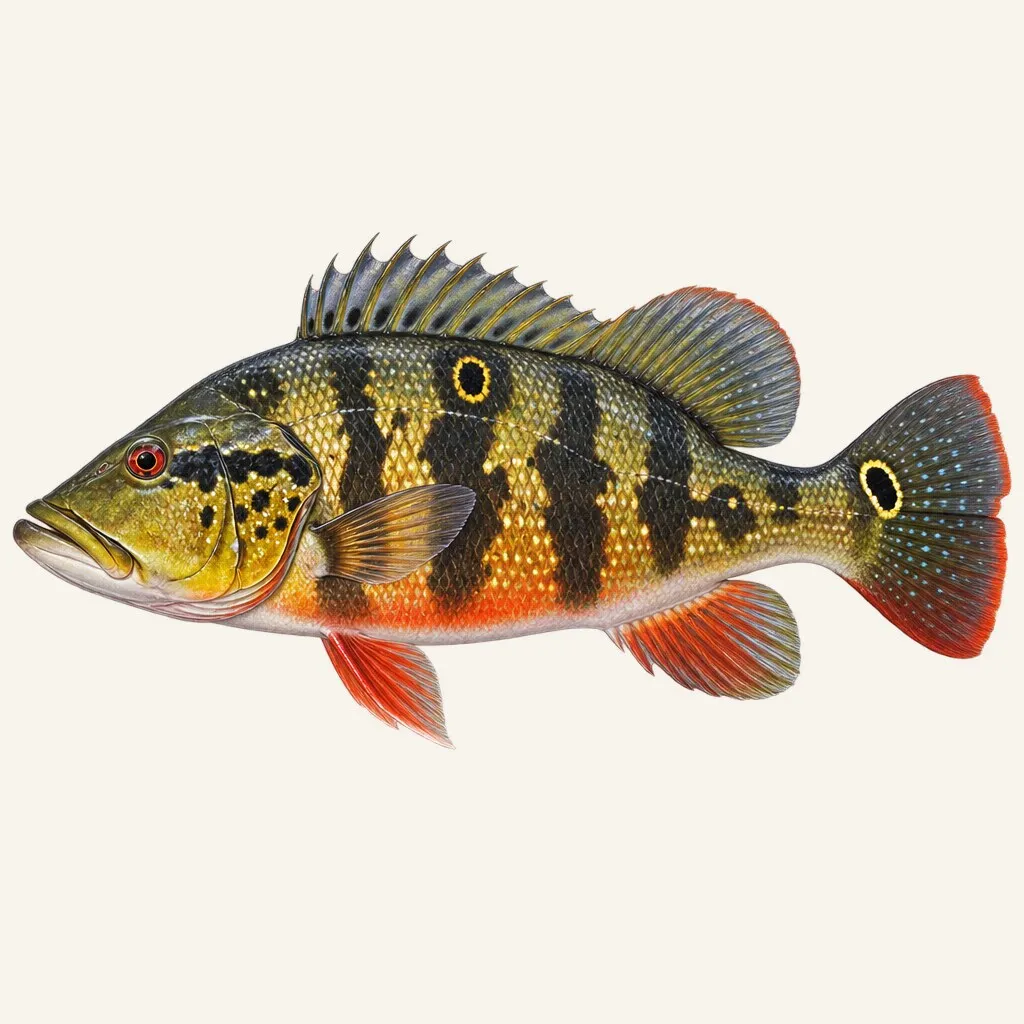
The pinima peacock bass is a predatory cichlid endemic to the lower Tapajós River and its tributaries in the Brazilian Amazon. Its reticulated pattern of spots and stripes on a pale to yellowish background gives it a distinctive livery among peacock bass, resembling a tiger-like design.
Calendar
Recorded in 1 country
GBIF occurrence records — native and introduced populations combined.
Identifying it
A ringed dark blotch occupies the top of the third bar. That is where determination begins, because the species it gets confused with most often has no such mark at any size, and the two are otherwise close enough that a single name covered both for as long as anyone was counting.
The pattern reads in two stages according to age. Subadults and large females show four or more horizontal rows of pale spots along the side. Adults instead carry black bars or patches with bright margins, strongly contrasted against the flank. The first bar behaves oddly and that oddity is usable: it often appears as a round patch, or splits into two or three, instead of descending straight and at a uniform width.
Scales resolve the close calls better than the colour does. The counted row holds 86 to 105, usually under 100, against 98 to 128 — usually over 110 — in the large speckled species, and against 77 to 90 in C. thyrorus. The lateral line here is commonly broken, where both of those keep it whole.
Against C. vazzoleri the margin is thin. Scales run slightly larger, but the two ranges overlap, so the workable character becomes the usual absence of a row of pale spots low on the belly side — a row that persists in the other species.
Fish in breeding dress carry three ringed bars. They stay continuous above the upper lateral line where they extend past it, and the back stays free of the isolated blotches that appear then in some relatives, which show three vertical groups of three, three and two.
The one length on record for the species is a standard length, taken to the base of the tail.
Areas
- Shallow sandy bottoms
- Rocky lower Tocantins banks
- Tributary mouths
- Calm areas along current edges
Techniques
- Surface cast and retrieve
- Light jigging
- Live bait fishing
- Dead-bait fishing
Baits
- Surface lures
- Shallow-diving minnow plugs
- Light jigs
- Live fish
- Soft plastic lures
Regulations
Check the local regulations in force (legal size limits, closed seasons, bag limits).
For guidance only. Legal sizes, quotas and open seasons vary by location and season: always check the local regulations in force before fishing.
Other names
What this name covers today, another name covered yesterday. The spotted peacock bass of the lower Amazon were filed under Cichla temensis until the 2006 review of the genus described nine new species and redistributed the old ones. This is one of the nine.
The date matters before any older source is opened. A growth curve, a stomach-content study or a note on behaviour published under the name of the big speckled species before that date may perfectly well concern this fish, and nothing in the text will indicate it.
The consequence is the main thing to know here. Its own file is almost entirely a morphological diagnosis, with the biology left empty, so what circulates about spotted peacock bass in general is extrapolated from the two or three members of the genus that have actually been studied — and applied to this one for want of anything better. Reading it as a description of C. pinima is reading a placeholder as a result.
Sources: fishbase.se · api.gbif.org