Pike characin
Acestrorhynchus falcatus · Acestrorhynchidae
- Freshwater
- Predators
- Medium
- Size
30 cm
- Weight
0.3 kg
Where to fish
- Estuary
- Lake
- River
Habitat icons: Flaticon
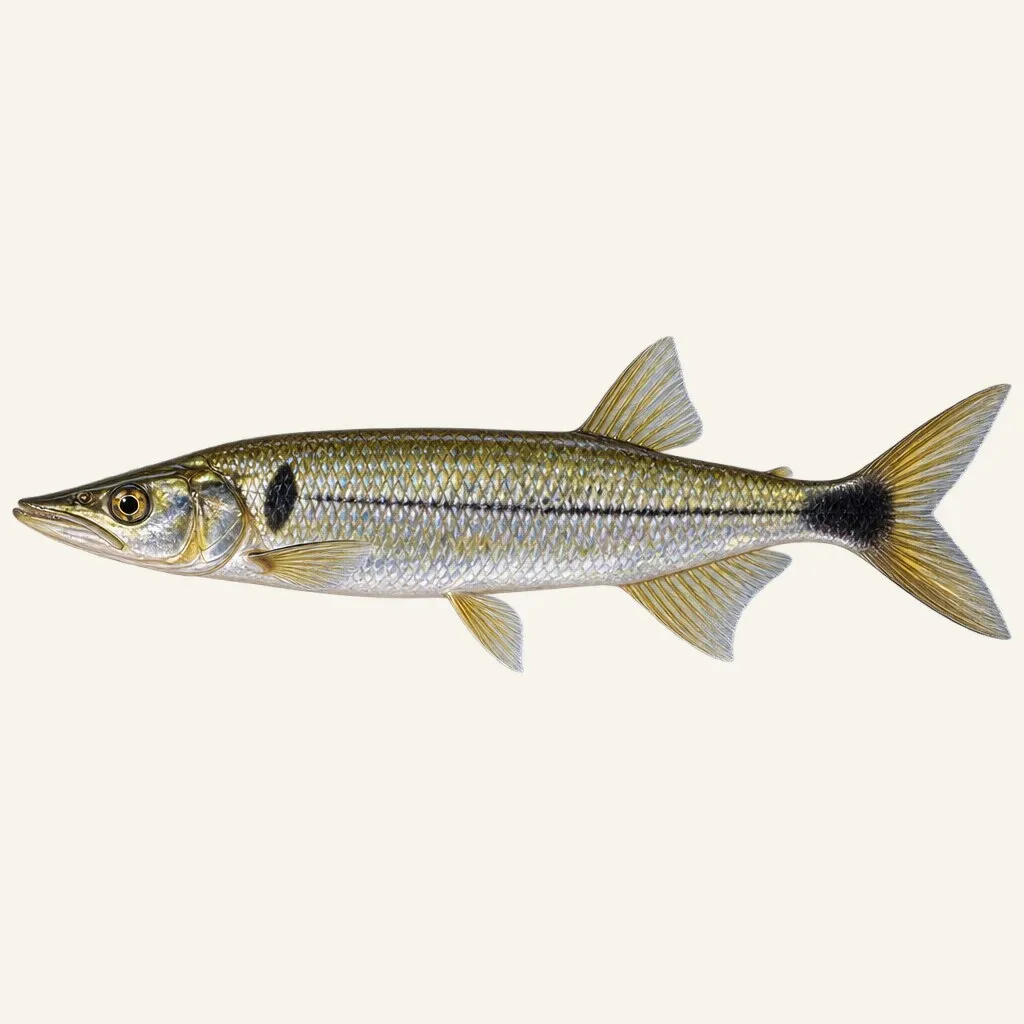
The pike characin is a slender, silver-bodied predator from Amazonian rivers, armed with sharp teeth and built for high-speed ambushes in clear, vegetation-lined waters. Its streamlined shape closely resembles a small pike despite belonging to the characin family.
Calendar
Its range
The range covers the Amazon and the Orinoco, plus the rivers of Guyana, Suriname and French Guiana — two continental basins and a coastal front that meets them only at its margins.
What the source stresses, though, is occupancy rather than limits. The species is described as ubiquitous, and as frequently found along the whole length of waters with moderate flow. A distribution that full points to an absence of requirements: no particular substrate, no depth, no narrow chemistry. Average current will do, and average current is everywhere.
Identifying it
The diagnosis gives this fish's two marks as fractions of the fish, not as colours — which is what makes them usable on a specimen that has faded, or on a photograph taken from three metres away.
The first sits on the shoulder, just behind the gill opening. It is oval or shaped like an inverted teardrop, and its height is never less than a quarter of the depth of the body. The second occupies the caudal peduncle, covering between a third and almost the whole of its depth, so the tail is barred with dark where it joins the body.
The fins fill out an open-water pattern. Two spines and nine soft rays in the dorsal; three to five spines and 21 to 27 rays in the anal, on an elongated body. Twenty-odd rays in the anal against nine in the dorsal means the unpaired surface is gathered low and well back — trim for a fish that swims fast in clear water rather than one that manoeuvres in cover.
Breeding
Spawning opens with the first rains. The calendar is the only thing published: no site, no substrate, no egg count, no incubation period has been recorded for this species.
What the date implies is solid enough on its own. Breeding on the rising water puts the young into a volume that is expanding, at the moment the plain fills and minute prey becomes abundant everywhere at once. A predator that starts life at a few millimetres needs that coincidence more than it needs a nest.
The water it needs
Moderate flow is the single condition named, and it excludes both extremes. Not the rapids, and not dead water.
The second half of that sentence is rarer than it looks. This fish is found along the entire length of such waters, from the upper courses down to the lowland reaches, where most river species divide the network into sections and hand over to a replacement as the gradient changes. This one hands over nothing. It accompanies the whole river.
Areas
- Open water in Amazonian rivers
- Surface upwelling areas
- Stream confluences
- Open lagoons and lakes
Techniques
- Small hard surface lures
- Fast small spoons
- Streamer fly fishing
- Small live bait in open water
Baits
- Small live fish
- Small bright spoons
- Colored streamers
- Slim soft plastic lures
What it eats
Exclusively fish. That is the word in the source, and nothing else appears on the list: no insect, no crustacean, no plant matter at all.
Set that against the size of the animal, which the rubric puts at around 20 cm. An obligate piscivore of that length is hunting fry and forage fish of the year, and nothing larger is available to it. The consequence for anyone fishing is blunt: the whole conventional repertoire of natural baits — worm, larva, grain — addresses a fish this is not.
How to catch it
The gape is the entire problem. A predator working at 20 cm can only take very small prey, so lure size is the one variable that moves the count. Too large and the offering leaves the range of what the animal can physically swallow. This is one of the few situations in which going down in size raises the number of takes with nothing else altered.
The teeth still matter. The rubric grounds its description of a formidable predator explicitly in two characters, the dentition and the body form, which is worth a trace that resists abrasion even on an animal that fits inside one hand.
The ubiquity then turns into an instrument. A species reported everywhere in water of moderate flow is almost never simply absent, so a blank on a reach that suits it says something about the reach rather than about the method being used. That is an unusual thing for a fish to offer, and it is worth more than any tackle advice on this page.
Regulations
Check the local regulations in force (legal size limits, closed seasons, bag limits).
For guidance only. Legal sizes, quotas and open seasons vary by location and season: always check the local regulations in force before fishing.
Other names
The six vernacular entries split cleanly in two, and the split is about where the describer's eye went.
English, French, German and Italian name the outline: pike characin, characin brochet, Hechtsalmler, carattino luccio. Brazilian Portuguese names the mouth instead — peixe-cachorro, the dog fish. One set of languages saw a silhouette in the water, the other looked inside a fish held in the hand, and both are describing the same animal. The Spanish entry declines to choose, giving the dog first and then the pike in brackets.
The scientific name belongs to the second camp. Acestrorhynchus joins an awl to a snout and falcatus is a sickle: two cutting implements attached to a fish of 20 cm, by describers who worked from the head down.
Sources: fishbase.se · api.gbif.org