Royal peacock bass
Cichla intermedia · Cichlidae
- Freshwater
- Predators
- Medium
- Size
55 cm
- Weight
3.0 kg
Where to fish
- River
Habitat icons: Flaticon
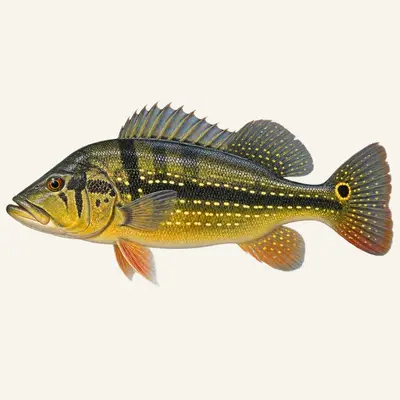
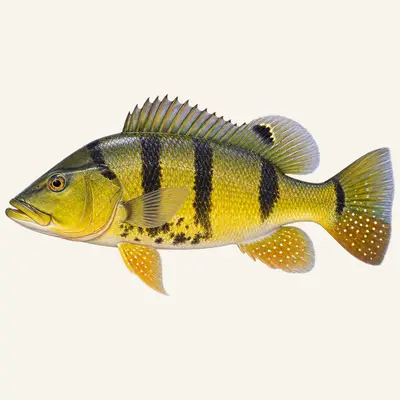
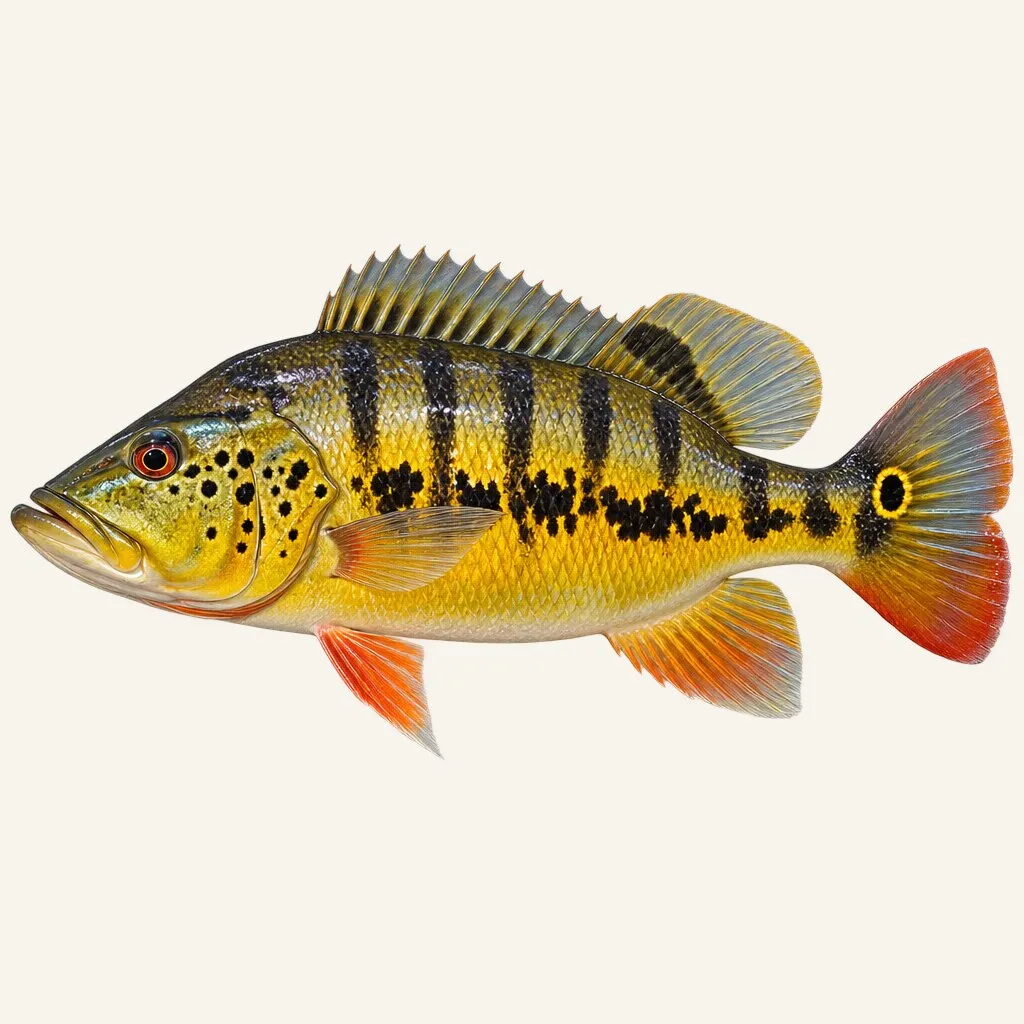
Robust cichlid with golden flanks marked with irregular dark blotches; typical tucunaré body shape with a large terminal mouth adapted for active hunting.
Calendar
Recorded in 1 country
GBIF occurrence records — native and introduced populations combined.
Its range
The range is a basin plus a corridor. Orinoco tributaries in Venezuela first. Then the Casiquiare, the channel that leaves the upper Orinoco and joins the Negro, the only permanent natural connection between the two great river systems of South America. Colombia is thought likely, with no record retained.
Plenty of fish have crossed by that corridor. The records for this species reach it and stop there, which makes it an Orinoco fish standing at an open door that nobody has yet seen it walk through.
Identifying it
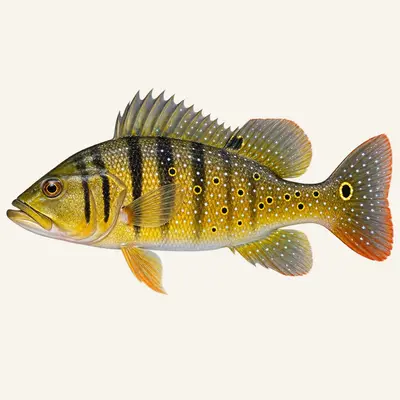
Six or seven narrow bars drop below the dorsal fin. Nothing else in the genus is marked that way — the others show three or five, and broad. The positions account for the count: the usual 1, 1a, 2, 2a and 3, plus one under the rear of the soft dorsal, plus occasionally another at the front of the caudal peduncle.
The juvenile band does not fade with age, it breaks up. In the young fish it is an unbroken dark stripe along the middle of the side; in the adult a line of irregular dark blotches occupies the same track.
The flank carries no pale spots, at any size. That is an absence, and it decides: most of the genus shows them, in rows or scattered.
Adults have several small black spots behind the eye socket and on the gill cover. The lateral line is almost always continuous and the E1 count runs 96 to 108.
Maturity begins at 28 cm.
The water it needs
Not a lagoon fish. It is taken hard against submerged rock or dead timber in the primary channel, either in swift current or on the edge of it.
Three conditions, and it is their combination that describes the lie: channel rather than the quiet side waters, hard structure rather than open bottom, moving water rather than dead water. Any one of the three on its own describes half the river.
Areas
- Rapids and rocky areas
- River confluences
- Shaded riverbanks
- Pools downstream of rocks
Techniques
- Cast and retrieve with minnow lures
- Bottom jigging
- Live bait fishing
- Surface lures
Baits
- Medium minnow lures
- Colored jigs
- Local live fish
- Spinner baits
- Soft plastic lures
How to catch it
It hunts by day. That is the only note on activity the file carries, and it is a plain one — the useful window is the one with light in it, without the dawn and dusk requirement that so many predators impose.
Everything else follows from where it holds. Fishing current against rock and timber demands terminal tackle that stays in the seam without jamming in it, and a lure that keeps its action at the speed the water imposes rather than the speed chosen for it. A lure that swims correctly on a slow retrieve in still water is not necessarily a lure that swims at all here.
The weight is mid-range for the genus, and it is delivered in current. That shifts the balance of the fight by a notch and puts the strain on the hook hold rather than on the line.
Regulations
Check the local regulations in force (legal size limits, closed seasons, bag limits).
For guidance only. Legal sizes, quotas and open seasons vary by location and season: always check the local regulations in force before fishing.
Other names
Royal peacock bass in English-language angling literature, pavón in Venezuela — a fitting name for a fish that is nearly confined to that country's rivers.
The epithet means intermediate. It is a comparative name with nothing left to compare it against in current usage, and of no help whatever on the water; the bar count is what names this fish.
Sources: fishbase.se · api.gbif.org