Speckled peacock bass
Cichla temensis · Cichlidae
- Freshwater
- Predators
- Medium
- Size
99 cm
- Weight
12 kg
- Water temp.
27–29 °C
Where to fish
- River
Habitat icons: Flaticon
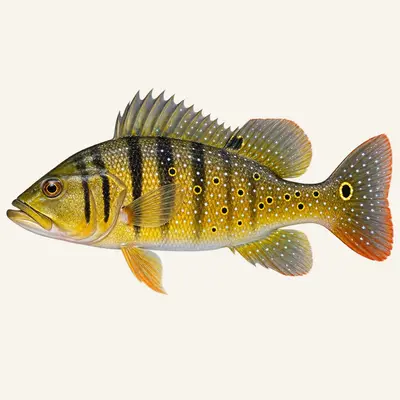
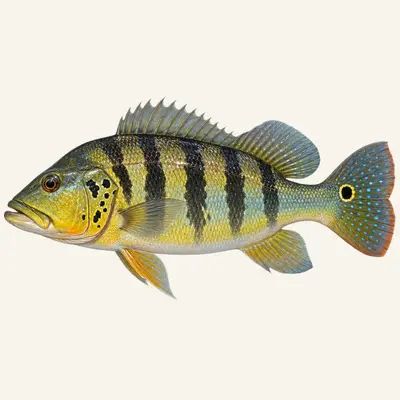
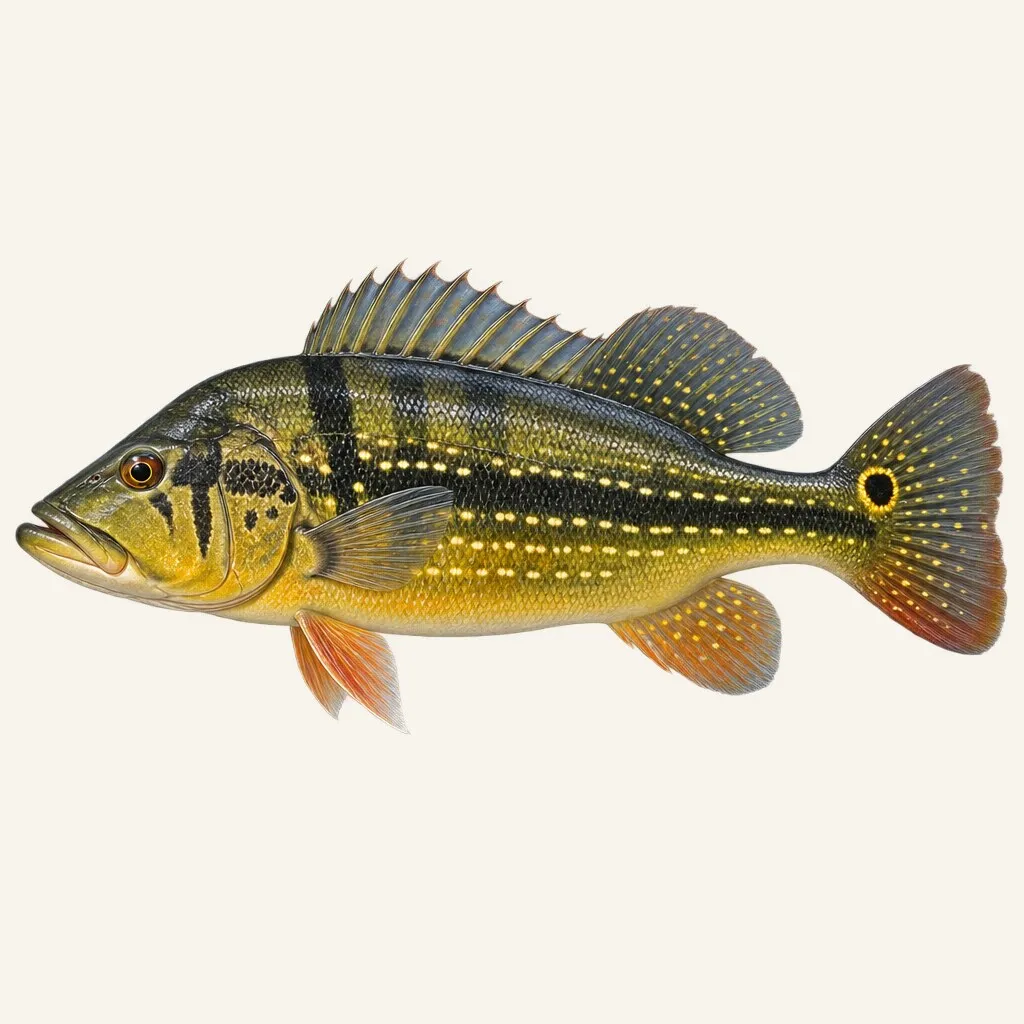
The speckled peacock bass is the largest member of the Cichla genus, capable of exceeding 80 cm and 10 kg in the dark, slow waters of the Amazon and Rio Negro. Its powerful body is marked with broad dark vertical bars and a distinctive ocellated spot at the base of the tail.
Calendar
Recorded in 6 countries
Brazil · Colombia · Guyana · Singapore · United States · Venezuela
GBIF occurrence records — native and introduced populations combined.
Its range
The Negro and Uatumã drainages in the Amazon basin, and Orinoco tributaries in Venezuela and Colombia.
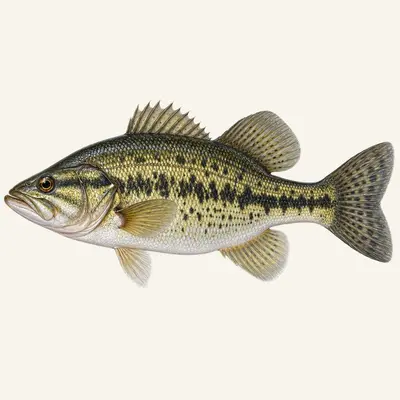
Attempts have been made to move it. Fish were released in Florida and Texas, and neither introduction is considered established — which sets this species apart from the congener that took hold in Florida and stayed.
Identifying it
Small scales on a large fish. The counted row carries 98 to 128 of them, usually more than 110, where the remainder of the genus stays under that figure. That one count decides most cases on its own.
The postorbital band — the dark stripe behind the eye — is present and entire. It can run irregular, but it never dissolves into scattered spots, which is what its congeners show when they show anything at all there. The lateral line is generally whole.
Colour brings it close to two relatives. Subadults and young adults share with them a dark midlateral band and four rows of pale marks along the side, the difference being shape: here those marks are slightly drawn out instead of round. The deciding characters are all things it lacks. No dark flank blotches with brightened margins. No eye-ringed marks on the upper body, at any size. No dark patch at the preopercle. And bars that stay straight and evenly wide instead of contracting into round patches.
The water it needs
A pH between 5.5 and 6.5, water at 27 to 29 °C: that is blackwater, acidic and thin, stained dark by dissolved plant matter, and the Rio Negro is its type example.
Read that way, the range makes more sense than it does on a map. What the species follows is a water chemistry rather than a drainage network, and the tributaries it occupies in the Orinoco basin behave chemically like the Negro. A pH window that narrow is a constraint, not a preference.
Adults hold in the deeper littoral of lagoons and along the sand and rock banks of the main channel. Depth is the part to keep: this fish sits off the shallow margins where several of its congeners are taken, and the two are not searched the same way.
Areas
- Flooded forests (igapó)
- Dead wood and submerged stumps
- Black river confluences
- Sandbars during dry season
Techniques
- Surface lure fishing (poppers/stickbaits)
- Swimbait cast and retrieve
- Jigging with colourful jigs
- Subsurface hard lures
Baits
- Poppers and surface lures
- Colourful swimbaits
- Live baitfish
- Soft plastic lures
- Colourful jigs
What it eats
Small fish, characids above all.
That fits the water. Blackwater is nutrient-poor, its fish community runs to small characids, and a predator living there eats what the river actually produces. The diet is not a specialisation so much as the only menu available.
How to catch it
This is the largest member of the genus, and the one that built the reputation of peacock bass fishing.
The lies are the sand or rock banks of the main channel and the deeper water of lagoons, which puts a premium on reading depth rather than on covering shoreline. A strictly fish-eating predator calls for lures that imitate fish, and the acid dark water of the Negro is the standard setting for that fishing.
First maturity arrives at 33.5 cm, within a range of 31 to 36. Against the length this fish goes on to reach, that is very early, and it has a consequence at the boat: every fish in the size class anglers travel for has spawned many times already. The sport fishery operates entirely above first maturity, which is not true of every fishery of this size.
Conservation
Two fisheries take this species — a commercial one and an organised sport fishery — and its early maturity gives it real turnover under both.
Its exposure is chemical instead. The pH window between 5.5 and 6.5 is a requirement, so anything that alters the chemistry of a blackwater basin acts on the habitat directly, without needing to touch the fish. Clearing, mining and impoundment all act on water chemistry, and a river that stops being blackwater stops being habitat, regardless of how much of it remains.
Regulations
Check the local regulations in force (legal size limits, closed seasons, bag limits).
For guidance only. Legal sizes, quotas and open seasons vary by location and season: always check the local regulations in force before fishing.
Other names
Speckled peacock bass in English, for those rows of pale marks. In Brazil it is tucunaré açu, the qualifier marking it as the big one, and in Venezuela pavón.
The Brazilian names separate the species with adjectives that English has never taken up, which is why a question about peacock bass, asked in English, comes back answered for several species at once.
Sources: fishbase.se · api.gbif.org