Redbreast tilapia
Coptodon rendalli · Cichlidae
- Freshwater
- Other
- Medium
- Size
45 cm
- Weight
2.5 kg
- Lifespan
7 years
- Water temp.
24–28 °C
- Depth
3–8 m
Where to fish
- Lake
- River
Habitat icons: Flaticon
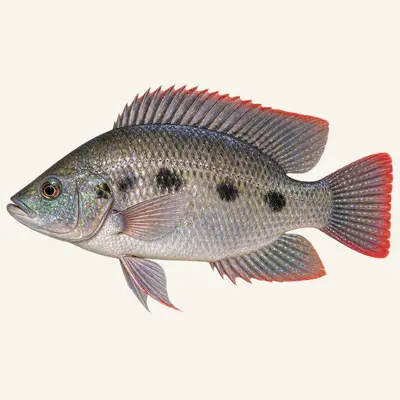
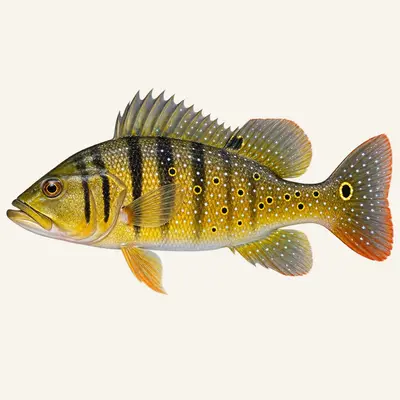
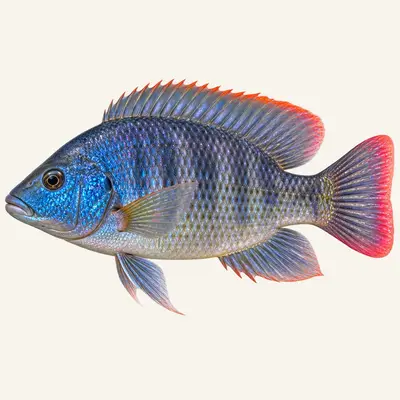
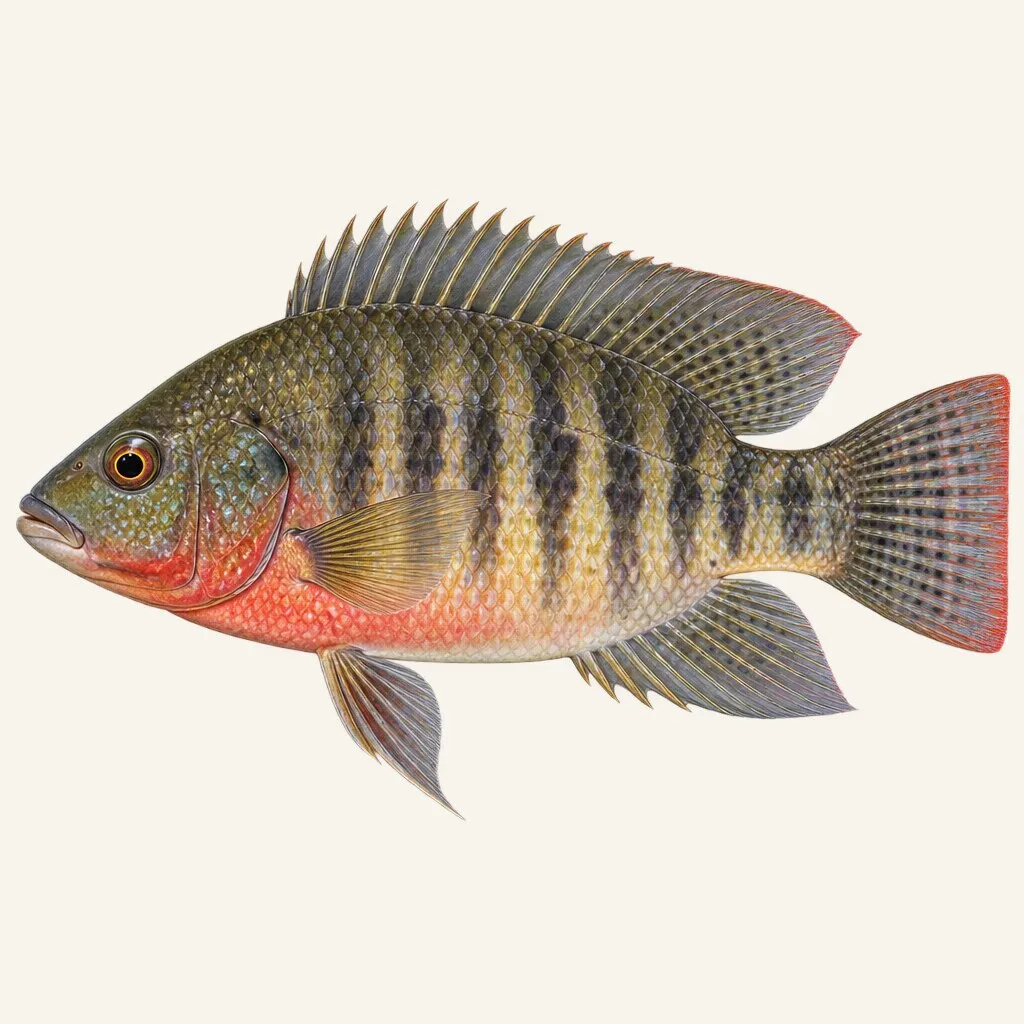
African cichlid with an oval, laterally compressed body, recognizable by its reddish chest and belly, with silvery flanks showing greenish reflections.
Calendar
Recorded in 21 countries
Angola · Argentina · Botswana · Brazil · Chad · Colombia · Eswatini · Kenya · Malawi · Mexico · Mozambique · Namibia · Puerto Rico · Rwanda · South Africa · Tanzania · Uganda · United States · Wallis & Futuna · Zambia · Zimbabwe
GBIF occurrence records — native and introduced populations combined.
Its range
Half of this range was chosen by people, and the source names the reason.
The native part runs from the middle Congo — the Kasai drainage, and the country between the Lomami and Kisangani — up to the upper Lualaba and the Bangweulu region. It takes in Lake Malawi, the Zambezi, the coastal belt from the Zambezi delta down to Natal, the Okavango, the Cunene, the Limpopo, the Malagarasi and Lake Tanganyika, along with the Cuanza and Catumbela in Angola.
It reached Lake Kivu by escaping from fish ponds, which is an introduction nobody decided on. Elsewhere it was introduced deliberately, and the stated purposes were weed control and aquaculture. Several countries report adverse ecological effects following its arrival.
Identifying it
The published diagnosis opens by admitting the problem: this species is very difficult to separate from Coptodon zillii. Then it gives what it has, and because it states the contrast itself the comparison is in the data rather than deduced from it.
This fish usually has the steeper head profile of the two, and the less prominent vertical bars. In East Africa its tail fin is often divided into a brownish upper part and a yellowish lower one, where the tail of C. zillii is uniform and spotted. Head profile and tail: that is the whole of the field separation the pair offers.
Taken on its own terms, it is a large deep-bodied fish with a steep forehead, a narrow head and a small mouth. The usual colouring is brownish with a white belly, though some individuals carry a bright red one. The sexes look alike, males simply running larger. Counts: 15 to 17 dorsal spines, 10 to 13 soft rays, three anal spines, nine or 10 anal rays, and 29 vertebrae.
Breeding
Some populations of this fish dig, and dig properly.
The basic pattern is substrate spawning. A pair forms, excavates a steep-sided circular pit in the mud, and both fish then guard the eggs and afterwards the young. The ground is chosen on a slope, near the marginal fringe of vegetation, and the nest itself is made in shallow water.
Then comes the variant. The species occasionally spawns in large cave-like structures, and in Lake Malawi it has been reported to excavate a network of tunnels at some sites. The difference between those two things is not one of degree. A pit is a depression a fish can defend by standing over it; a tunnel network is architecture, and it means the clutch can be put somewhere with a roof over it and a way in that only one animal at a time can use.
First maturity arrives at 17.7 cm, against a reported lifespan of seven years. A fish that starts breeding at that size and lives that long will build a good many of these nests, which is worth knowing before treating any one of them as expendable.
The water it needs
Adults want quiet, well-vegetated water: river littorals, backwaters, floodplains and swamps, at depths of three to eight metres. They form schools, and activity is mainly in daylight.
The envelope is the striking figure. The species holds between eight and 41 °C and across a wide span of salinities. Thirty-three degrees of thermal range is what allows one animal to occupy both the Congo and Natal — and it is also what makes it a candidate for any warm or temperate water anybody chooses to put it in.
Areas
- Vegetated margins
- Swampy areas
- Calm river banks
- Backwaters
Techniques
- Float fishing
- Feeder fishing
- Pole fishing
- Light float rig
Baits
- Algae
- Plant fragments
- Bread
- Sweet corn
- Vegetable pellets
What it eats
The juveniles feed on plankton. The adults eat the leaves and stems of submerged plants along with algae and vegetative detritus, and the rubric adds insects and crustaceans to the adult list.
So the grown fish takes a plant ration with an animal margin. That widens what will interest it without moving where it feeds: all of it, plant and animal alike, comes out of the weed.
How to catch it
A fish that eats leaves and stems is fished with plant baits, inside the vegetation rather than beside it, and not on a lure at any point. Float, pole and feeder tackle with plant groundbait covers the whole of it.
Schooling changes the arithmetic. A located shoal is a session and not a fish, which also means an unproductive margin is worth abandoning quickly instead of being worked patiently.
Daylight activity puts the effort in the middle of the day, which is unusual enough to be worth stating.
And the nest sits in shallow water with both parents on it. That makes a spawning pair conspicuous and combative, and it makes the removal of either of them expensive for what is in the pit.
Conservation
Within its own range the species is widespread and supports fisheries, and the interesting problem is what happens when it is moved.
The mechanism is neither competition nor predation. A large grazer released into a water body strips the submerged vegetation, and that vegetation was the spawning substrate and the cover the rest of the community depended on. The damage arrives indirectly and outlives the fish that caused it: an introduced predator eats a population, while an introduced grazer takes away the place the population lived in.
The uncomfortable part is that this was the intention. A fish put into a lake to clear weed cannot be faulted for clearing weed — the error was upstream of the fish, in treating the weed as the problem.
Regulations
Check the local regulations in force (legal size limits, closed seasons, bag limits).
For guidance only. Legal sizes, quotas and open seasons vary by location and season: always check the local regulations in force before fishing.
Other names
Redbreast tilapia is the English name, and redbelly tilapia belongs to Coptodon zillii. One word apart, for two fishes whose own diagnoses describe them as very difficult to tell apart: a catch reported under either name needs the head profile and the tail checked before the name carries any information.
Rendall's tilapia is the other English usage, after the man the epithet commemorates.
Like its congener, this species sat under Tilapia until the genus was divided, so a large part of the literature files it as Tilapia rendalli and will go on doing so.
Sources: fishbase.se · api.gbif.org