Pickhandle barracuda
Sphyraena jello · Sphyraenidae
- Saltwater
- Coastal
- Medium
- Size
120–150 cm
- Weight
8.5–12 kg
- Depth
20–200 m
Where to fish
- Reef
- Rocky shore
- Offshore
Habitat icons: Flaticon
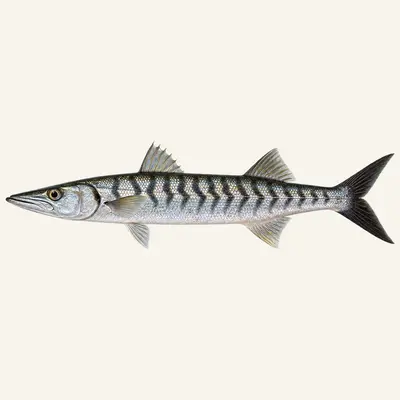
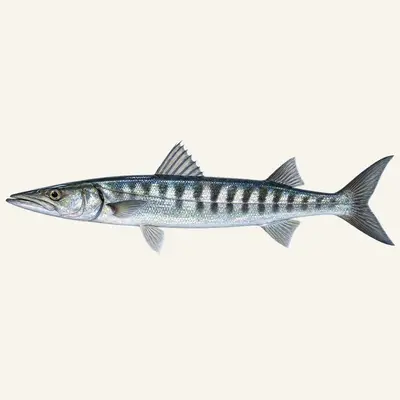
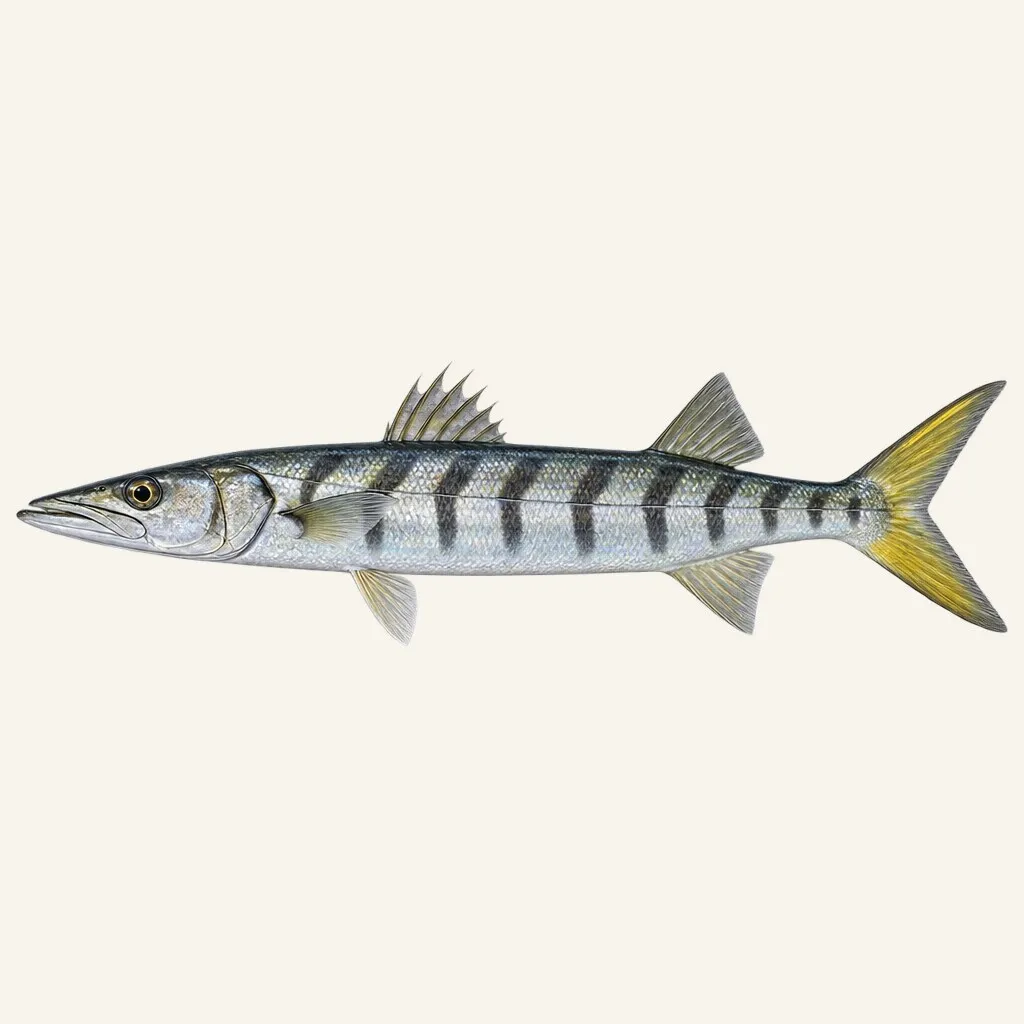
The jello barracuda is a robust tropical species with silver flanks marked by dark oblique bars, typical of Indo-Pacific Sphyraenidae. Its elongated body and fang-like teeth make it a formidable hunter of reef edges and shallow coastal waters.
Calendar
Recorded in 16 countries
Australia · China · Fiji · India · Indonesia · Japan · Kenya · Malaysia · Mozambique · New Caledonia · Papua New Guinea · Philippines · Singapore · South Africa · Taiwan · Thailand
GBIF occurrence records — native and introduced populations combined.
Its range
The known range runs from the Red Sea south to the south-eastern coast of South Africa and east to New Caledonia and Vanuatu, with a recent report from Tonga.
That list has to be read with reservations, and the source says so explicitly: the exact limits remain uncertain because the species has long been confused with two neighbours, the sawtooth barracuda and Sphyraena qenie. This is not a specialist's quibble. Any published map for one of the three probably incorporates records belonging to the other two, and a locality taken from an older atlas is worth little without re-examination of the specimen behind it.
Oceanodromous movement compounds the problem. The fish travels at sea, sometimes over long distances, so a recorded presence does not imply residence.
Identifying it
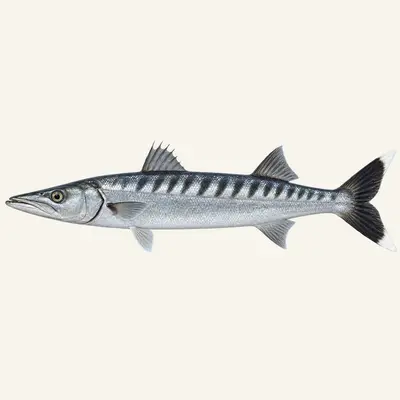
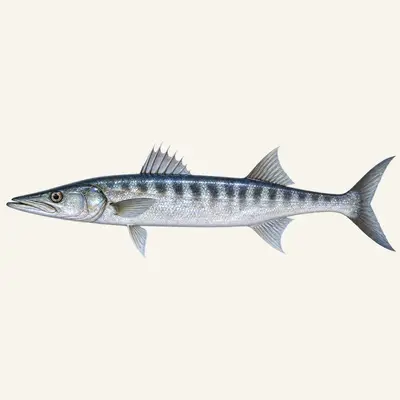
Each dark bar crosses the lateral line instead of halting at it, and each one bends on the way down. In the upper half of the body the bar leans well over; in the lower half it straightens until it is nearly vertical. That kink is the character to look for first, and it disposes of every barracuda whose stripes stop at the lateral line.
The caudal fin is largely yellowish. Within a genus where the tail is usually black or dark, the colour discriminates, and it survives on a freshly landed fish long enough to be used.
The body is oval in section rather than laterally compressed. The detail sounds thin and is obvious in the hand: the fish rolls under the fingers instead of presenting two flat sides.
Six dorsal spines, nine soft rays, two anal spines, seven to nine rays.
The water it needs
The species looks for current-swept reefs, whether outer reefs or exposed lagoon margins. The current is the condition, not the reef: it is what concentrates forage on a ridge or in a pass.
It also uses environments that appear to contradict those — bays, estuaries and turbid inner lagoons. Tolerance of brackish, sediment-laden water is real here, and it widens the search area considerably.
Depth begins at 20 m and reaches 200, with most of the activity above 60. The 20-metre floor is the notable end of that: this is not a fish of the shallow flat.
Areas
- Reef passes
- Coastal headlands and drop-offs
- Upwelling zones
- Shallow open waters
Techniques
- Fast surface lures
- Vertical jigging
- Coastal trolling
- Live-bait fishing
Baits
- Silver live fish
- Surface lures
- Chrome spoons
- Squid
What it eats
Fish make up the bulk of the diet, with squid taken as a secondary item.
The cephalopod share fits the ground the species occupies. Passes and exposed ridges are exactly where squid rise and drift with the flow, so the two items on the menu come from the same water rather than from different habits.
How to catch it
The current picks the spot. A swept reef edge, a pass draining a lagoon, a point where the water accelerates: that is where the fish holds, and the state of the tide governs the timing far more than the hour of the day does.
Adults are diurnal and live alone. The young, by contrast, gather in schools. The age split in behaviour means that a school of this species is a school of small fish — looking for a big one means leaving the school rather than following it.
The outline predicts the fight. A common length of 120 cm on a body that stays light for its measurement: this is a long, thin fish whose power is in acceleration and not in mass.
As for ciguatera, the existing mentions are unconfirmed for this species. The taxonomic confusion described above is probably part of the reason, since a case reported under this name may have involved one of the two neighbours. With nothing settled either way, the usual caution around large tropical reef predators applies, and the information is gathered locally.
Conservation
A species whose range cannot be drawn is a species whose stock cannot be measured. That is the central difficulty here: landings recorded under this name cover three different fish across part of the Indo-Pacific, and nothing allows them to be untangled after the fact.
The commercial fishery is not marginal for all that, and the fish is sold fresh, frozen or salted. The reference assessment, dated August 2023, is recent — but it applies to an entity whose boundaries are still under discussion.
Regulations
Check the local regulations in force (legal size limits, closed seasons, bag limits).
For guidance only. Legal sizes, quotas and open seasons vary by location and season: always check the local regulations in force before fishing.
Other names
Pickhandle barracuda in English, and the name describes the bent bars on the flank, compared to the handle of a pick. It is one of the few common names that preserves a genuinely useful identification character.
French has no established vernacular and falls back on the scientific epithet. Where the three confused species occur together, the local name is likely to cover all of them without distinction, which is how the records became entangled in the first place.
Sources: fishbase.se · api.gbif.org