Sawtooth barracuda
Sphyraena putnamae · Sphyraenidae
- Saltwater
- Coastal
- Medium
- Size
60–90 cm
- Weight
1.2 kg
- Depth
3–20 m
Where to fish
- Reef
- Rocky shore
- Offshore
Habitat icons: Flaticon
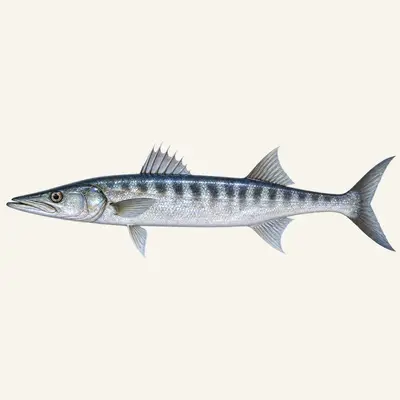
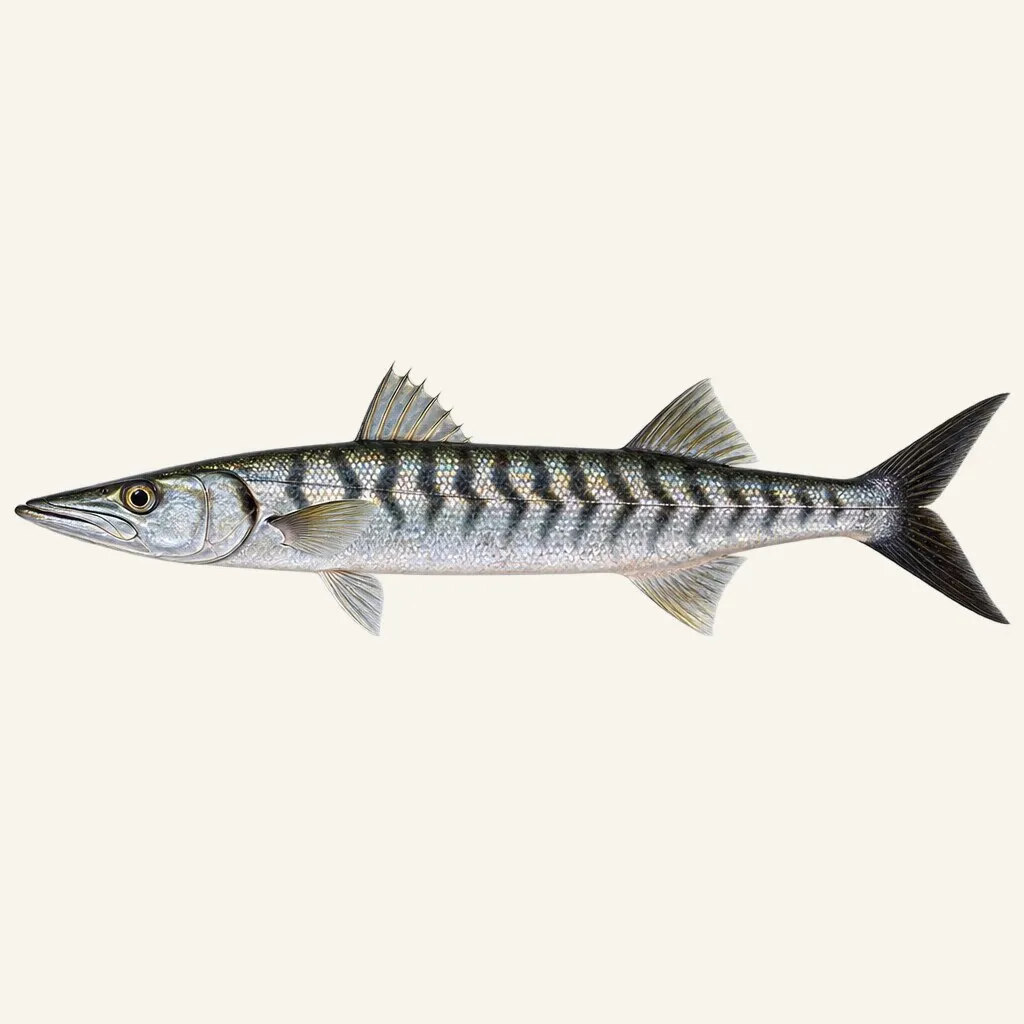
The sawtooth barracuda is distinguished by its finely serrated tooth rows and short pectoral fins, notable features among Indo-Pacific tropical Sphyraenidae. Its silver body with a slightly bluish back helps it blend into coastal pelagic waters.
Calendar
Recorded in 25 countries
Australia · Cayman Islands · Cuba · Egypt · Fiji · French Polynesia · Hong Kong SAR China · India · Indonesia · Japan · Malaysia · Malta · Mozambique · New Caledonia · Oman · Philippines · Singapore · South Africa · Spain · Sri Lanka · Taiwan · Tanzania · Thailand · United States · Wallis & Futuna
GBIF occurrence records — native and introduced populations combined.
Its range
From the Red Sea and East Africa to New Caledonia and Vanuatu, north as far as southern Japan, with records from Fiji and Tuvalu. The latitudinal bounds of 36° north and 31° south are those of properly tropical water.
Those bounds come with a caveat. The species shared its name for a long time with two neighbours from the same region, and older observations were not always assigned to the right one. The chevron pattern is what now allows a decision in the field — provided somebody looks at it before writing down a presence.
Identifying it
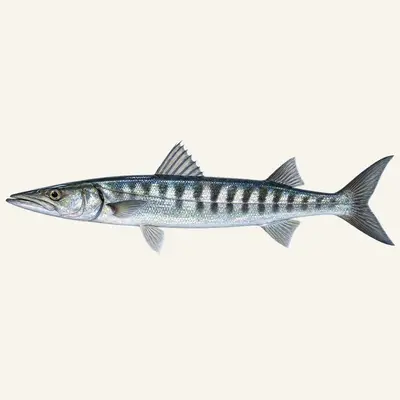
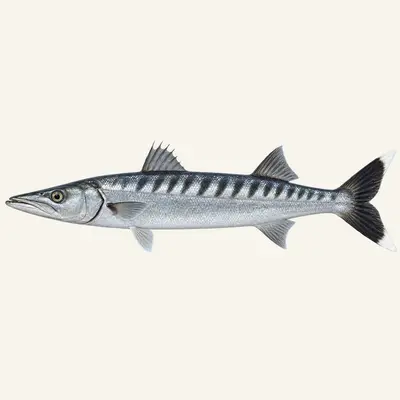
The flank markings are chevrons rather than bars. They come to a point, they pass over the lateral line without interruption, and they repeat in large numbers along the whole length of the body. No other barracuda in the same waters shows the V-pattern as plainly, and it can be read from a distance in clear water.
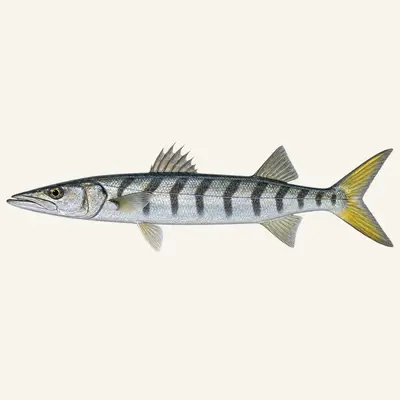
The caudal fin is almost entirely blackish — not yellow, not white-edged, dark from base to margin. Taken with the chevrons, it closes the identification.
The first gill arch bears no rakers. Rough platelets sit in their place, none of them carrying a true spine; the feature is shared with several members of the genus and so confirms the genus rather than the species.
Six dorsal spines, nine soft rays, two anal spines, seven to nine rays.
Size contributes as well. A common length of 60 cm makes this a small barracuda, so a fish of 120 cm seen over an Indo-Pacific reef is not this one.
The water it needs
The water has to be moving. The species occupies lagoons and outer reefs that the current works, and its presence is indexed on that circulation more than on the nature of the bottom. It tolerates bays and turbid inner lagoons as well, which are calm and loaded with sediment: the exact opposite conditions.
Depth is the most tightly bounded in the genus, from 3 to 20 m with no known exception. This is a shallow-water fish, reachable on a breath-hold dive or from a small boat, and it calls for no deep-water gear at all.
Areas
- Shallow coral reefs
- Passes and channels
- Coastal rocky areas
- Coastal pelagic waters
Techniques
- Fast cast and retrieve
- Light jigging
- Live-bait fishing
- Light coastal trolling
Baits
- Chrome spoons
- Small live fish
- Soft lures
- Sardines
How to catch it
The fish is active at night and it shows itself by day. Those two statements are not in conflict: the relatively large, dense schools met in full sun are resting groups, the hunting taking place once the light has gone. A school passed on an afternoon dive is therefore not a feeding school, and persisting with a lure on it rarely pays.
The practical lesson runs two ways. The daytime school is information — it marks a frequented sector and lets a session be planned for the right hour. And because everything happens above 20 m, working the same ground after dark needs no special means.
Position is chosen on the flow. A pass, a lagoon ridge, a point where the water speeds up will concentrate the species; calm, uniform bottom does not hold it, except in the turbid bays where it behaves differently.
The species is classed as harmless, which distinguishes it from several of the larger barracudas listed as traumatogenic. The dentition is still that of a predator and the unhooking is done with pliers, but nothing on record approaches the bites documented in the big species. Nor do the reference data associate any food poisoning with it, where several of its relatives carry that mention.
Conservation
The fish is sold fresh or processed into fish cakes, which makes it an ordinary food resource rather than a sport catch over much of its range.
The point to watch is the way it presents itself. A dense, motionless daytime gathering in 3 to 20 m of water, in a known pass, can be taken with a net or a spear gun without any technical difficulty whatsoever. The resource is local and so is the fishery, and that is the scale at which the state of the populations is actually decided.
Regulations
Check the local regulations in force (legal size limits, closed seasons, bag limits).
For guidance only. Legal sizes, quotas and open seasons vary by location and season: always check the local regulations in force before fishing.
Other names
Sawtooth barracuda in English, barracuda dente-de-serra in Brazilian Portuguese: both names describe the saw-toothed profile of the flank markings, not the teeth of the fish. The confusion is common enough to be worth clearing up, since no dental peculiarity is described for this species.
The scientific name, unlike them, describes nothing at all, and in the field it competes with the two species it was long confounded with. Where all three occur, a fish called a barracuda locally may be any of them, and the chevrons are the only thing that settles which.
Sources: fishbase.se · api.gbif.org