Great barracuda
Sphyraena barracuda · Sphyraenidae
- Saltwater
- Coastal
- Medium
- Size
140–200 cm
- Weight
17–50 kg
- Lifespan
18 years
- Depth
0–100 m
Where to fish
- Reef
- Rocky shore
- Offshore
Habitat icons: Flaticon
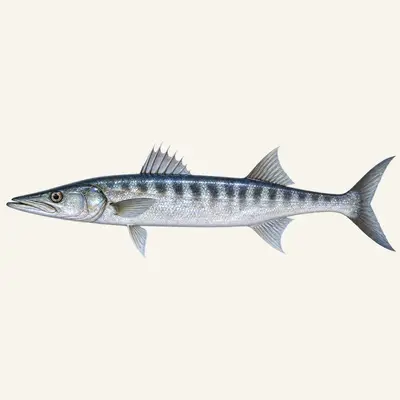
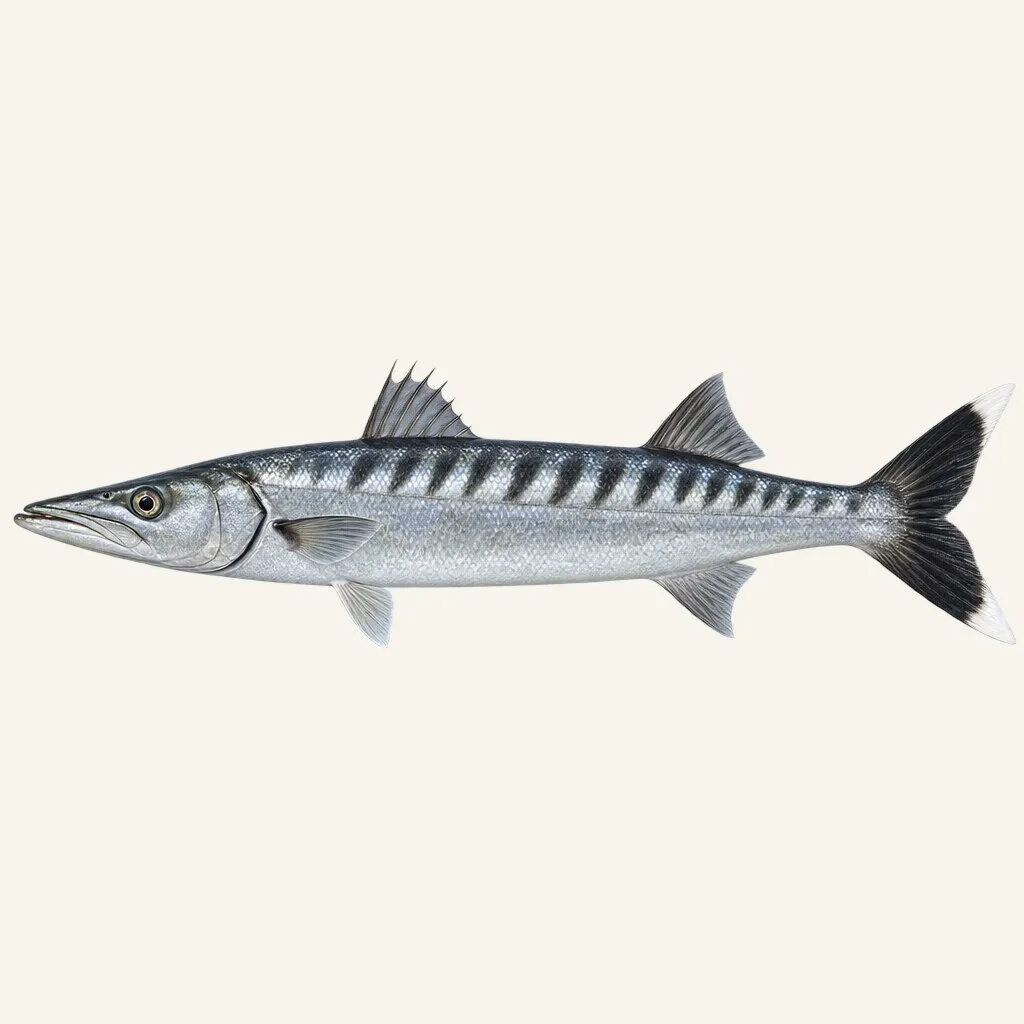
The great barracuda is a torpedo-shaped predator recognized by its prominent lower jaw armed with razor-sharp teeth and its silver body marked with irregular dark bars. This cosmopolitan species of tropical and subtropical seas can reach 1.8 metres and is feared for its explosive attack speed.
Calendar
Recorded in 59 countries
American Samoa · Anguilla · Aruba · Australia · Bahamas · Belize · Bermuda · Brazil · British Indian Ocean Territory · British Virgin Islands · Caribbean Netherlands · Cayman Islands · Colombia · Cuba · Curaçao · Dominican Republic · Egypt · Faroe Islands · Fiji · France · French Polynesia · French Southern Territories · Ghana · Guadeloupe · Honduras · Hong Kong SAR China · Indonesia · Jamaica · Japan · Madagascar · Malaysia · Maldives · Marshall Islands · Martinique · Mauritius · Mayotte · Mexico · Mozambique · New Caledonia · Northern Mariana Islands · Panama · Philippines · Puerto Rico · Réunion · Seychelles · Sint Maarten · St. Barthélemy · St. Martin · St. Vincent & Grenadines · Taiwan · Tanzania · Thailand · Trinidad & Tobago · Turks & Caicos Islands · U.S. Virgin Islands · United Arab Emirates · United Kingdom · United States · Venezuela
GBIF occurrence records — native and introduced populations combined.
Its range
The species occurs in all three tropical oceans, between about 42° north and 35° south. In the Indo-Pacific, from the Red Sea and East Africa to Hawaii, the Marquesas and the Tuamotus. In the western Atlantic, from Massachusetts and Bermuda through the Caribbean to Brazil. In the eastern Atlantic, from Mauritania and Senegal to the Gulf of Guinea, taking in St Paul's Rocks and São Tomé.
The northern limits are not fixed lines. A fish reported off Massachusetts got there on the warm current that runs up the American coast, and its presence at that latitude is seasonal rather than resident.
Identifying it
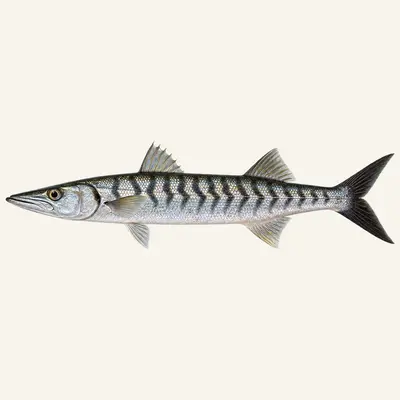
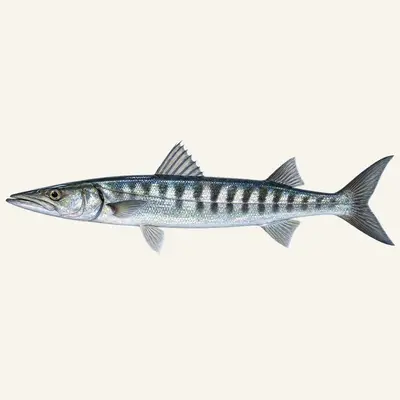
The dark oblique bars on the upper body stop at the lateral line. They do not cross it, and that is what separates this fish from several Indo-Pacific barracudas whose markings run all the way down the flank. On a fish in the water the lower half of the body therefore reads as plain silver under a barred back.
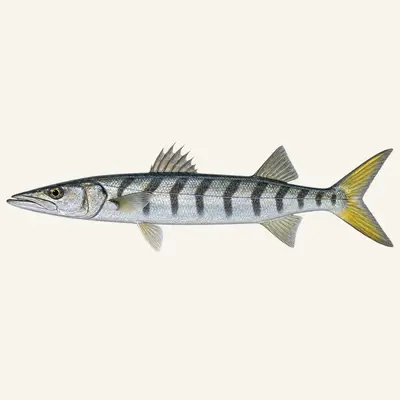
The tail supplies the second sign, and it changes with age. It is black with a white tip to each lobe; below about 50 cm total length it is clearly forked, and above that size the notch fills in and a pair of large lobes develops on the rear margin. Two fish of the same species do not have the same tail outline at different ages, which has caused a great deal of confusion over small ones. Juveniles also carry large irregular blotches instead of bars.
The body is extremely long — depth goes six to 8.2 times into standard length — and the eye is large. The teeth stand upright and touch one another, with no gap between them.
Inside the mouth there is a real anatomical oddity. The first gill arch bears no rakers at all; in their place both limbs are set with rough platelets that carry no distinct spine. It is a dependable character and it can be verified on a dead fish.
The first dorsal fin begins level with the rear base of the pelvics. Six dorsal spines, nine soft rays, two anal spines, eight rays.
Breeding
Average maturity is reached at 66 cm, but the recorded spread is very wide: 58 to 98.5 cm depending on the individual and the population.
That width has a blunt implication. An 80 cm fish may have spawned several times or never at all, so length is not a usable proxy for reproductive status in this species the way it is in many others. The maximum reported age is 18 years.
The water it needs
The fish keeps to the immediate neighbourhood of the surface. The depth range extends from zero to 100 m, but the ordinary band is 3 to 30.
The range of environments an adult will accept has no equivalent among its relatives: murky inner harbours at one end, the open sea at the other, and every intermediate state of reef in between. Few predators of this size tolerate both sediment-laden port water and blue offshore water.
The young are far more particular. They grow up among mangrove roots, in estuaries and on sheltered inner-reef ground, in shallow water.
Areas
- Coral reefs
- Offshore wrecks
- Passes and channels
- Coastal pelagic waters
Techniques
- Cast and retrieve with surface lures
- Fast jigging
- Coastal trolling
- Live-bait fishing
Baits
- Silver live fish
- Elongated soft lures
- Surface stickbaits
- Bright spoons
What it eats
It hunts fish, takes cephalopods, and occasionally shrimps.
Hunting is done by day and by sight, which accounts for the size of the eye. A surface predator that picks out prey at a distance in clear water needs neither scent nor ambush: it needs speed over a few metres, and a dentition that severs at the first attempt whatever it cannot swallow whole.
How to catch it
The adult is diurnal and solitary, which is convenient twice over: it is active during the hours anyone would fish, and an occupied spot is occupied by one fish that can be seen. Small aggregations do form in places.
Size governs the rest. A common length of 140 cm makes this a very large surface predator, and the biggest rod-caught fish on record came from the Bahamas.
The teeth dictate the terminal tackle and the unhooking alike. Upright contiguous teeth part monofilament without resistance, and handling on board calls for real caution — the species is classed as traumatogenic. Attacks on people are rare and usually amount to a single strike, fast and hard; serious, and rarely fatal.
The health question deserves stating precisely, because it is geographical before it is specific. Ciguatoxin is reported in this barracuda across most of its range, to the point where it is among the species most often named in Caribbean poisoning cases. In the eastern Atlantic, however, no case has been attributed to it. The same fish, the same species, two opposite verdicts depending on the ocean — which is the clearest available demonstration that where a fish came from decides the matter, and what it is does not.
Conservation
The nursery is the weak link. Juveniles depend on mangrove and sheltered estuary, habitats in retreat almost everywhere along tropical coasts, and a reef in good order counts for nothing if the mangrove next to it has gone.
Handling commits the angler as much as the fish. An animal of this size cannot be controlled bare-handed, and long pliers for the unhooking are as much a matter of the operator's safety as of care for a fish that is going back.
Regulations
Check the local regulations in force (legal size limits, closed seasons, bag limits).
For guidance only. Legal sizes, quotas and open seasons vary by location and season: always check the local regulations in force before fishing.
Other names
Great barracuda in English, picuda through much of the Spanish-speaking Caribbean.
The word barracuda itself passed from Antillean Spanish into every European language, and it now covers some thirty species spread across all the warm seas. In the French Antilles the local term bécune is applied to the whole genus, so it names no species in particular; English has the same problem in reverse, since a fish called simply a barracuda in the Indo-Pacific is as likely to be one of the smaller species as this one.
Sources: fishbase.se · api.gbif.org