Pacific barracuda
Sphyraena argentea · Sphyraenidae
- Saltwater
- Coastal
- Medium
- Size
145 cm
- Weight
12 kg
- Lifespan
12 years
- Depth
0–18 m
Where to fish
- Rocky shore
- Offshore
Habitat icons: Flaticon
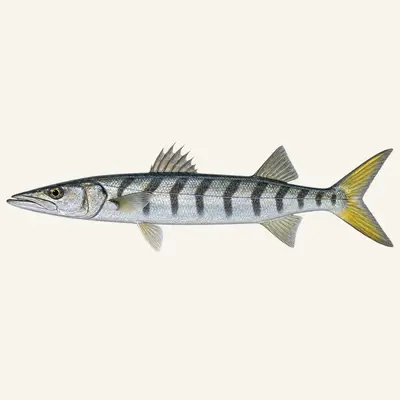
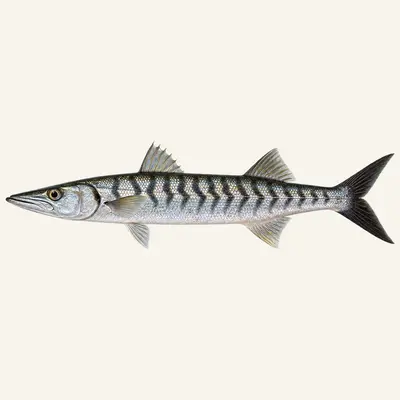
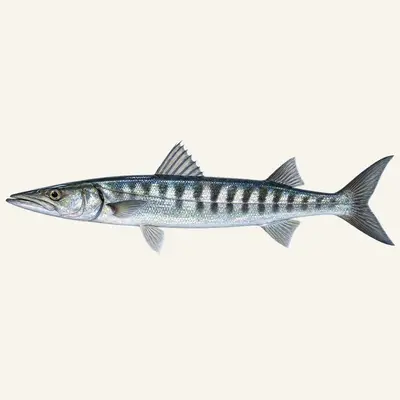
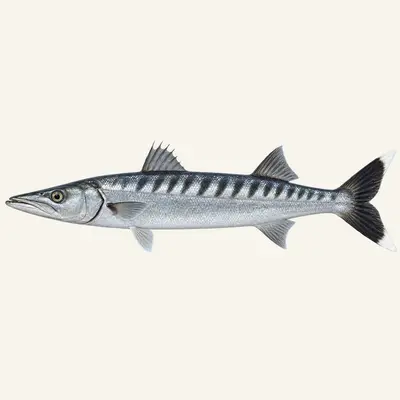
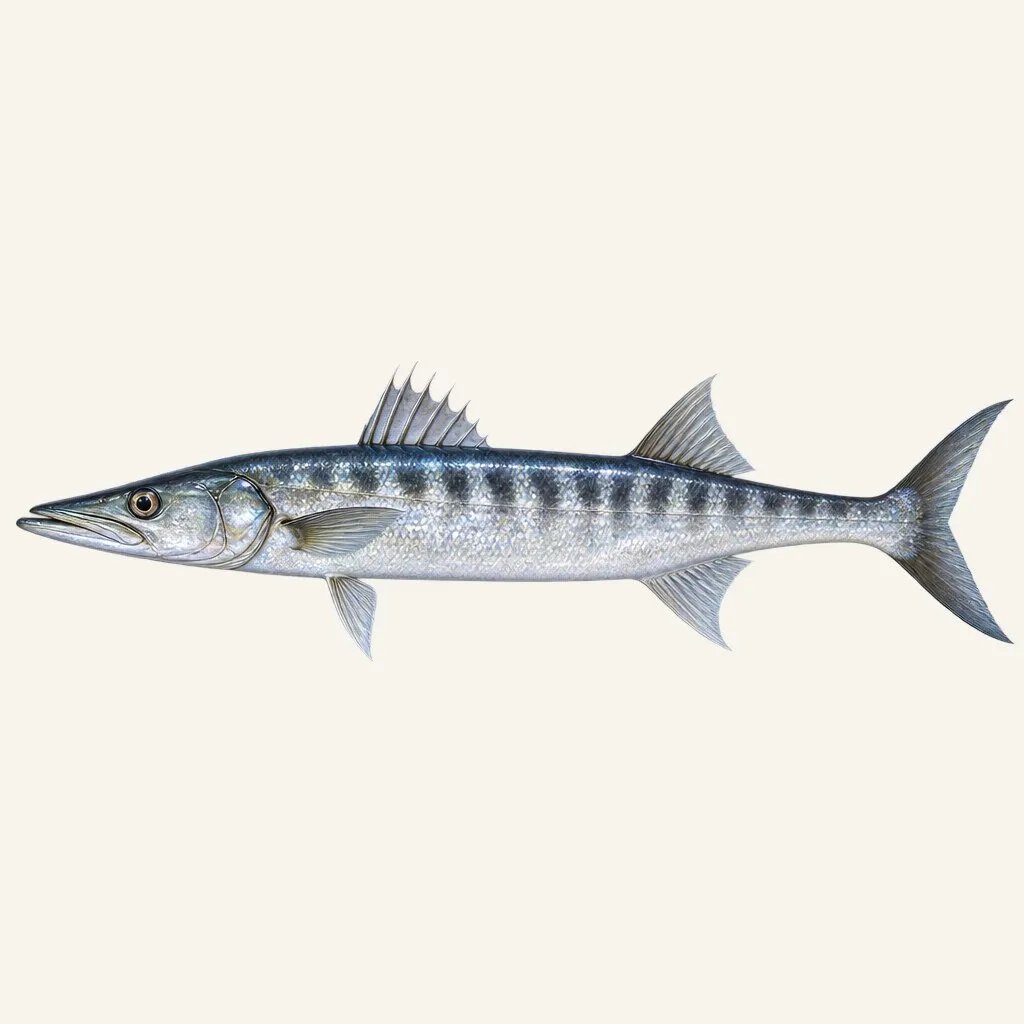
The Pacific barracuda is a slender species with bright silvery scales, a grey-blue back and a well-defined lateral line characteristic of Sphyraenidae. Endemic to the warm-temperate waters of the North American Pacific coast, it hunts in mid-depth coastal waters.
Calendar
Recorded in 2 countries
GBIF occurrence records — native and introduced populations combined.
Its range
The range extends from Alaska to Magdalena Bay in Baja California, along the eastern Pacific seaboard only. But the recorded range and the useful range are not the same thing: north of Point Conception, in California, the species stops being common.
That headland is not an arbitrary cut. It marks the major thermal break of the Californian coast, where the cold water driven up by upwelling gives way to a milder regime. A good part of the inshore fauna changes composition across it, and this barracuda is part of that change: the most northerly records are range limits, not fishing grounds.
It is also the only member of the genus here that lives in temperate water, between 24° and 58° north. Every other barracuda of comparable size belongs to the tropical or subtropical belts.
Identifying it
One anal spine. It is a small thing to announce, but it is binary, immediate, and it isolates this species from almost the whole genus, where there are two. Checking it on a fish in hand takes seconds and leaves nothing open to interpretation.
The colouring says almost nothing, and that is precisely what makes it informative. The back is bluish or brownish, the belly silvery, with no bar, no chevron and no blotch. Where the tropical barracudas carry markings, this one is plain.
The remaining counts are six dorsal spines, nine to ten soft rays, and eight to nine anal rays.
Breeding
Spawning is pelagic: the eggs are released into open water and drift with the coastal water masses rather than being attached to any support.
The reproductive calendar has to be read through the movement of the adults. They leave the Californian coast in autumn and head south, while part of the population may stay in front of the Mexican coast all year round.
The water it needs
The fish keeps close to shore or close to the surface, in a layer of water no deeper than 18 m. It is most often found in small groups.
The young enter bays. Those sheltered shallows are the nursery, and their condition governs recruitment far more directly than anything happening offshore.
Areas
- Coastal surface waters
- Around submerged structures
- Rocky inlets
- Coastal pelagic zones
Techniques
- Cast and retrieve with surface lures
- Fast jigging
- Coastal trolling
- Live-bait fishing
Baits
- Live anchovies
- Elongated silver lures
- Sea spoons
- Sardines
What it eats
The diet rests mainly on other fishes. This is a mid-water hunter working the schools of small pelagics that travel along the coast, and it does not diversify appreciably beyond them.
How to catch it
The calendar governs everything. The fish move south in autumn and return with the warm season, so presence on the Californian coast is seasonal while it may be permanent further south. The same mark is worth two different things depending on latitude and month.
The shallow water simplifies the rest. Eighteen metres at most and often much less, fish near the surface and in small groups: the search is conducted by eye, from the shore or a small boat, with no bottom gear involved.
The fish lives up to 12 years, and as throughout the genus, length flatters it — these are slender animals and the weight stays modest for the size.
The dentition calls for a precaution that is not theoretical. Long sharp teeth and an aggressive disposition make the fish potentially dangerous, though no attack has ever been reported. The risk, in other words, belongs to the moment of unhooking on board and not to swimming.
Conservation
The fact that matters is migratory. A population that spends the warm season off California and the winter off Mexico crosses a border, and is therefore worked by two successive fisheries, each of which sees only part of the year. Reading a local decline becomes awkward under those conditions: a fish that is absent may have been removed, or may simply be elsewhere.
To that is added the dependence of the young on coastal bays, the habitat most exposed to development along this seaboard.
The assessment used as a reference dates from May 2008, a long way back for a fish that lives 12 years and supports a commercial fishery.
Regulations
Check the local regulations in force (legal size limits, closed seasons, bag limits).
For guidance only. Legal sizes, quotas and open seasons vary by location and season: always check the local regulations in force before fishing.
Other names
Pacific barracuda or California barracuda in English, according to whether the ocean or the state where most of the fishing happens is being named. Both are in general use and neither is ambiguous, since no other barracuda occupies this coast in numbers.
The epithet argentea means silvery and refers to the absence of any flank pattern — a name that describes, for once, what the fish does not have.
Sources: fishbase.se · api.gbif.org