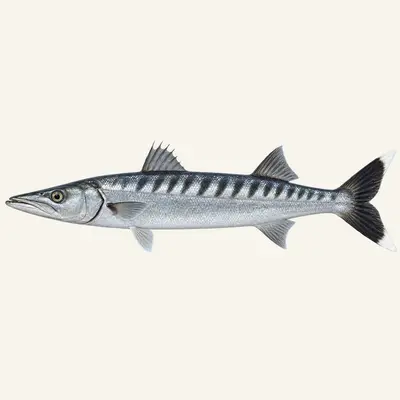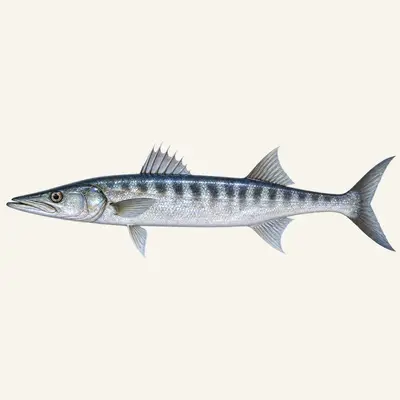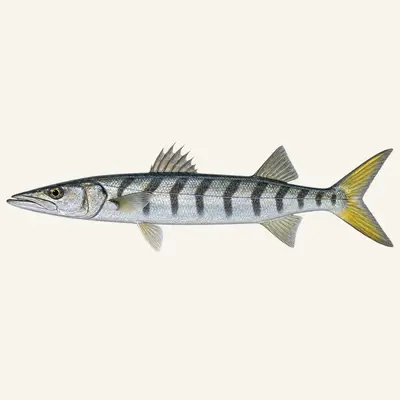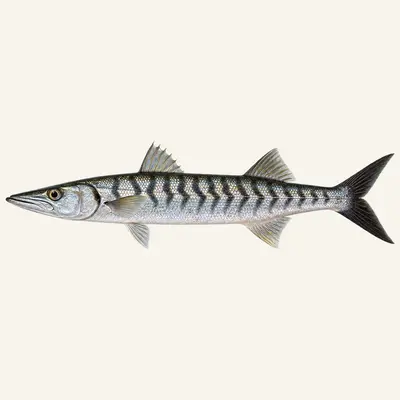
European barracuda
Sphyraena sphyraena · Sphyraenidae
- Saltwater
- Coastal
- Medium
- Size
60–165 cm
- Weight
1.2–3.6 kg
- Depth
0–100 m
Where to fish
- Rocky shore
Habitat icons: Flaticon
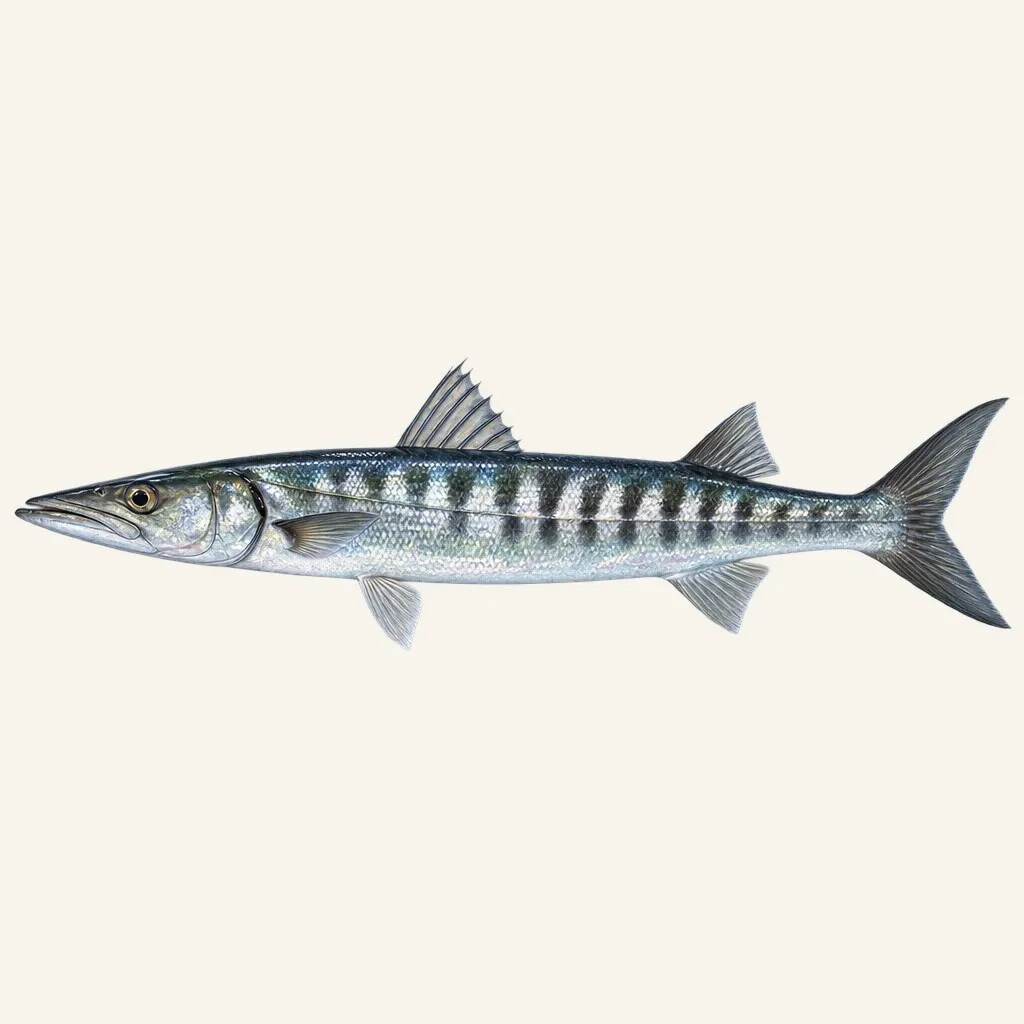
The European barracuda is a slender, silver-toned predator instantly recognisable by its powerful projecting jaw lined with sharp teeth and the torpedo-shaped body typical of the Sphyraenidae. It inhabits coastal temperate waters of the Mediterranean and East Atlantic, often in schools.
Calendar
Its range
The range is Atlantic and split in two. In the east it runs from the Bay of Biscay to Mossamedes in Angola and takes in the whole Mediterranean, the Black Sea, the Canaries and the Azores. In the west it is known only from Bermuda and Brazil.
That asymmetry is striking: a continuous occupation of the European and African seaboard, and two isolated points on the other side of the ocean. The latitudinal limits, 48° north and 18° south, place the species in warm-temperate and subtropical water, with the run up to Biscay as the northern edge of that tolerance.
Presence in the Black Sea is worth noting on its own. Few marine predators pass the Bosphorus and establish themselves beyond it, since the salinity there is markedly lower than in the Mediterranean.
Identifying it
No detailed morphology accompanies this species in the reference source: no ray counts, no flank pattern, no gill-arch character. The gap is better declared than filled, and it has a direct bearing on identification.
The genus itself is unmistakable — a very elongate body, two widely separated dorsal fins, a projecting lower jaw armed with long teeth. The difficulty lies one level down, at the species.
What remains solid is the ordinary size. Common length is 60 cm, where the large tropical barracudas are measured in metres and in tens of kilos. Anything caught in these waters that fights like a big fish is worth a second look on those grounds alone.
The water it needs
The species is neritic and pelagic. It lives in mid-water above the shelf, inshore and offshore alike, with no attachment to any particular bottom type.
Depth extends from the surface to 100 m, with most of the activity above 50.
Areas
- Rocky coastal headlands
- Marine seagrass beds
- Harbours and submerged wrecks
- Mixed sand and rock bottoms
Techniques
- Fast cast and retrieve
- Light jigging
- Coastal trolling
- Live-bait fishing
Baits
- Silver spoons
- Live fish
- Elongated soft lures
- Smelts or sardines
What it eats
Fish dominate the diet by a wide margin, with cephalopods and crustaceans appearing only as occasional items.
A narrow diet in a mid-water predator that exploits no substrate points at one resource in particular: the schools of small coastal pelagic fish moving along the shelf. Where those schools are is where this barracuda will be.
How to catch it
Maturity at 27.6 cm is the most useful figure available, and it is less than half the common length. Unlike the large tropical barracudas, whose spawning thresholds sit tens of centimetres higher, almost everything caught here is an adult fish.
The size figures need reading with care. The two published maxima, one of length and one of weight, plainly do not come from the same animal, and it is the common length of 60 cm that describes what is actually met with.
Fishing is done in the upper part of the water column, from the shore or on the drift. The species is classed as harmless and carries no toxicity note, which sets it clearly apart from its warm-water relatives; commercial exploitation is minor and the sport share dominant along the European seaboard.
Regulations
Check the local regulations in force (legal size limits, closed seasons, bag limits).
For guidance only. Legal sizes, quotas and open seasons vary by location and season: always check the local regulations in force before fishing.
Other names
European barracuda in the standard nomenclature, and Mediterranean barracuda in common use — which is where an English speaker runs into trouble. A second member of the genus, the yellowmouth barracuda, shares the same waters and grows larger, and both fish answer to that name on the quayside and in fishing reports. The name therefore identifies a sea rather than a species.
Local terms are older and more precise. Provençal and Languedocian spet, Spanish espetón and Italian barracuda mediterraneo have all been in use far longer than the Antillean loanword that eventually displaced them in print; the first two evoke a skewer, after the outline of the fish.
Sources: fishbase.se · api.gbif.org