Pink dentex
Dentex gibbosus · Sparidae
- Saltwater
- Coastal
- Medium
- Size
60–106 cm
- Weight
2.5–16 kg
- Depth
20–220 m
Where to fish
- Rocky shore
Habitat icons: Flaticon
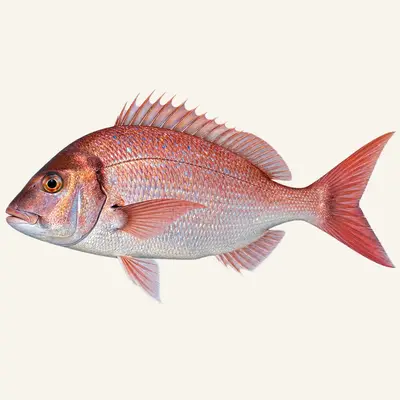
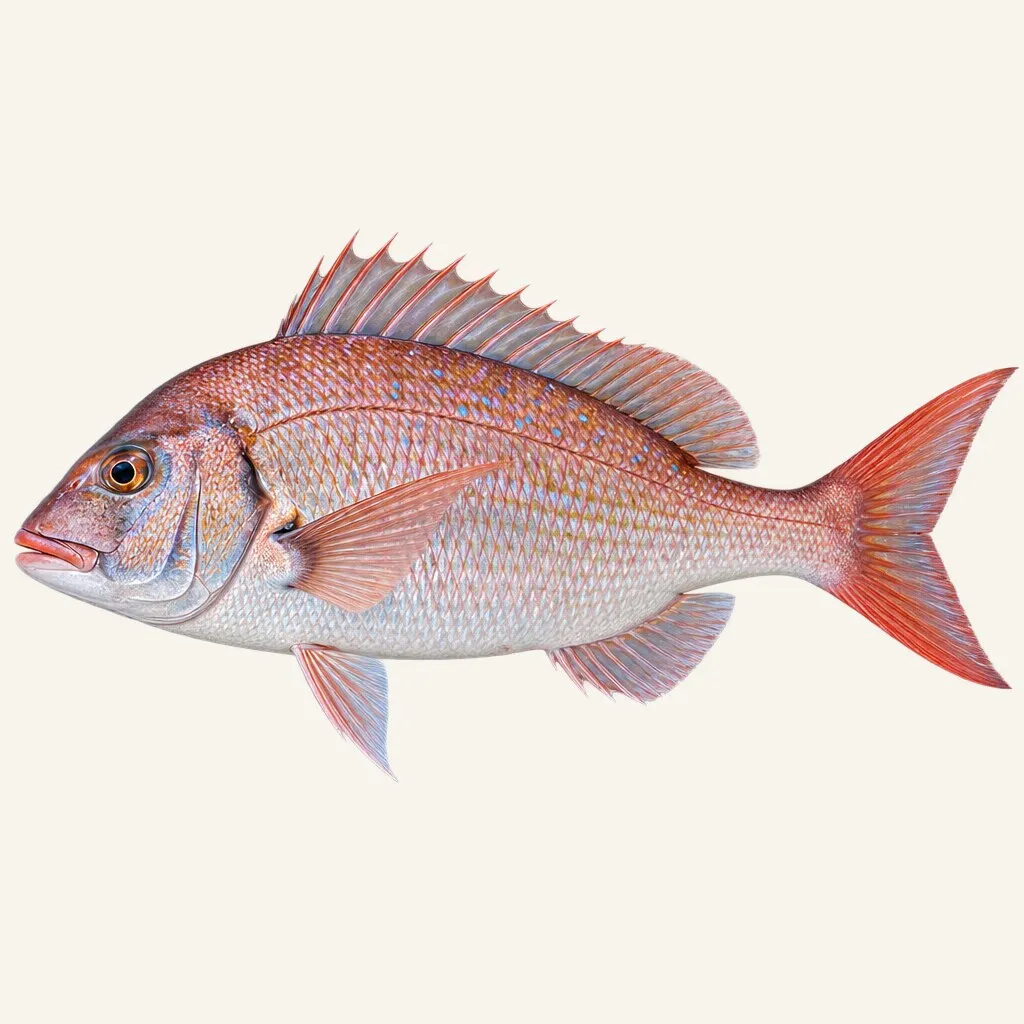
The pink dentex stands out for its stocky silvery-pink body and characteristically large eyes, proportionally bigger than those of the common dentex. A sparid of deep rocky bottoms and drop-offs in the Mediterranean and East Atlantic, it can exceed 10 kg.
Calendar
Recorded in 24 countries
Albania · Algeria · Angola · Benin · Cameroon · Congo - Brazzaville · Congo - Kinshasa · Côte d’Ivoire · Equatorial Guinea · Gabon · Ghana · Greece · Guinea · Guinea-Bissau · Israel · Italy · Liberia · Montenegro · Nigeria · Portugal · Senegal · Sierra Leone · Spain · Togo
GBIF occurrence records — native and introduced populations combined.
Its range
Portugal to Angola on the eastern Atlantic seaboard, plus the Mediterranean, the Canaries and the islands of São Tomé and Príncipe. Forty-six degrees north to seventeen south.
The southern half of that is the part worth reading. This species runs deep into the Gulf of Guinea and on past the equator, which is warm-water range that its better-known congener does not hold; the two overlap around Iberia and the western Mediterranean and then separate, one going north and one going south. Anything learned about this fish in Andalusia was learned at the cold edge of its distribution.
Identifying it
The epithet asserts a hump. Gibbosus means humped, several vernaculars repeat it — German Buckel-Zahnbrasse says so outright — and the raised forehead profile of a big old individual is the image the species travels under.
It cannot be checked against the reference. The FishBase account for this species carries no morphological section at all: no fin counts, no scale counts, no colour description, no note on the head profile. Whatever the name claims, the standard summary of the animal does not confirm it, and that is a fact about the documentation that anyone identifying this fish should be holding.
So the hump should not be used as a diagnosis on its own, and its absence should be used even less. If the profile develops with growth — which is what the name and general usage imply, and what the reference does not state — then a small individual will show nothing at all, and showing nothing means only that the fish is small.
What can be said positively is the sex arithmetic below, and it cuts in the same direction. Fifty centimetres is the hinge. Any character that only appears on fish above it is a character that appears mostly on females.
Breeding
Male first, female later, and the switch sits high. Up to about 50 cm, 50 to 70 per cent of individuals are male; above that length they transform into females. First maturity is given at around 34.7 cm.
Set that beside the rest of this family and the number is what stands out rather than the direction. Sex change in the sparids around it happens at 20 to 30 cm, sometimes lower — inside the size range of an ordinary fish. Here it happens above the length at which the species is worth targeting at all, which puts the whole transition inside the trophy end of the size distribution rather than at its middle.
The consequence is one line long. On these figures, the large individuals of this species are its egg producers, and the population's reproductive output is concentrated in exactly the fish that a deep-water session is trying to catch.
The water it needs
Rock and rubble on the shelf, and sand around rock, from 20 to 220 metres.
Age sorts the population by distance from shore. The young stay close in. The adults are offshore, out towards the continental slope, which is where the depth range gets its lower half.
That separation is the fishery. What can be reached from the coast or from a small boat working inshore ground is the juvenile stage of this species; the adults live where a fish has to be gone after deliberately, with weight, depth and a sounder. There is no single mark that produces both.
Areas
- Deep drop-offs
- Offshore rocky bottoms
- Deep wrecks
- Coralligenous zones
Techniques
- Deep jigging
- Sliding live bait
- Slow trolling
- Deep water dropshot
Baits
- Squid
- Live mackerel
- Sardine
- Deep shrimp
- Octopus
What it eats
The account for this species opens its diet with crustaceans, then fish, then cephalopods.
That ordering is worth taking at face value rather than smoothing over, because the congeneric account puts fish first and lists no crustaceans. Two related predators on overlapping ground, described from different prey. Neither list is an inventory and neither excludes what the other holds, but the emphasis differs and it is the emphasis that suggests a bait.
Crustacean first, then squid and fish. All three are things to be seized rather than broken.
How to catch it
Deep rock, offshore, in the lower half of a 20 to 220 metre band — a boat fishery, not a shore one, and the reason is where the adults live rather than any preference of theirs for depth as such.
Baits come off the diet in the order the reference gives them, and all of them suit an animal built to grip: crustacean, squid, fish, presented near hard bottom.
The decision that matters is not about method. Fifty centimetres is where this species changes sex, and the fish that a deep session is set up to catch are above it. A large individual on this ground is, on the published proportions, more likely to be a female than anything else in the water around it, and that is worth knowing before it goes in the box.
Regulations
Check the local regulations in force (legal size limits, closed seasons, bag limits).
For guidance only. Legal sizes, quotas and open seasons vary by location and season: always check the local regulations in force before fishing.
Other names
Pink dentex in English: six languages, four characters. Three of them name the head — German, French, and Brazilian Portuguese, which speaks of a high forehead. English took the colour, Spanish says sama de pluma, the plume, and Italian makes the animal a cuirassier, dentice corazziere.
The agreement of those three is weaker than it looks: they do not come from three separate observations but translate the same Latin epithet. A convergence of translation is no confirmation, and it has a practical cost: the names cannot be used to cross-check each other. An English speaker who reads "pink" and a German speaker who reads "hump" are looking for two different things on the same fish, and neither character is described in the reference account.
"Dentex" on its own is a genus of several species, so the adjective is doing all the identifying work — and "pink" is a colour shared with a good part of this family, which is a weak thing to hang an identification on. The binomial is the reliable form of the name here, which is not true of every fish on this list.
Sources: fishbase.se · api.gbif.org