Saddled seabream
Oblada melanura · Sparidae
- Saltwater
- Coastal
- Medium
- Size
20–37 cm
- Weight
0.1–0.5 kg
Where to fish
- Rocky shore
Habitat icons: Flaticon
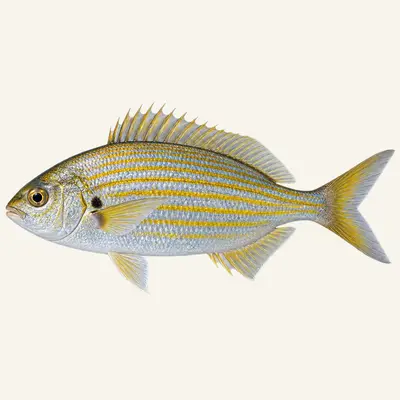
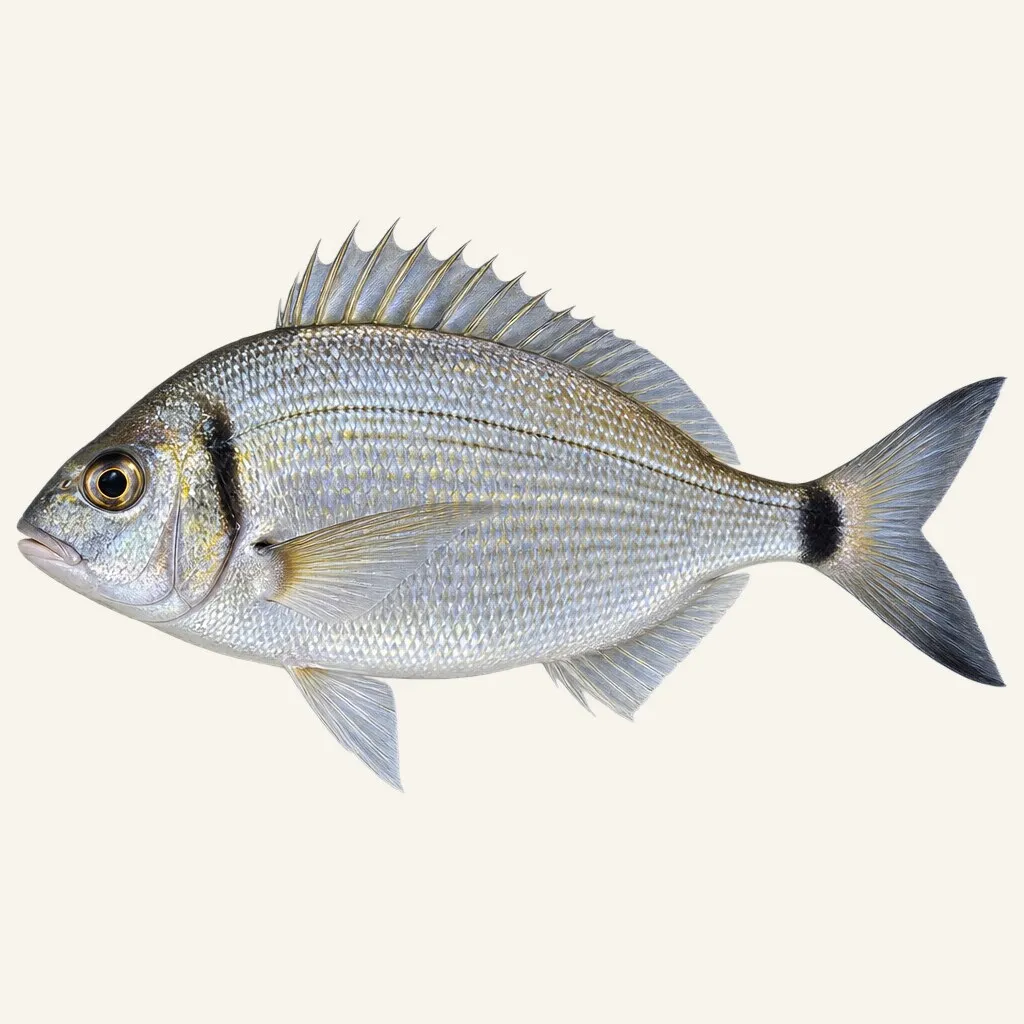
The saddled seabream is a slender sparid with a greyish-silver body, instantly recognizable by the distinctive black spot at the base of the tail, ringed in white. A gregarious coastal fish, it moves in dense shoals near rocks, posidonia meadows and jetties in the Mediterranean and East Atlantic.
Calendar
Its range
From Pico Island in the Azores east to the Bay of Biscay, through the Mediterranean, and from the Strait of Gibraltar south to Angola, with Madeira, Cape Verde and the Canaries. Forty-six degrees north to eighteen south, and 32°W to 36°E.
The western end of that is the part that needs explaining. Pico is mid-Atlantic, thousands of metres of ocean from the nearest continental shelf, and this is an adult that lives in the top thirty metres over rock. It did not swim there. What crosses an ocean basin in this species is the egg and larval stage, drifting, and the Azorean population is the result — which is also why the range takes in every Macaronesian archipelago and no part of the western Atlantic.
Identifying it
Melanura: black tail. The binomial names the mark and puts it in the right place, which is the base of the caudal fin rather than the fin itself. It is a discrete blotch sitting on the caudal peduncle, edged pale, and on a slim silver fish it is visible at a distance and from above.
That is the identification and there is very little else to it. The body is slender for a sparid rather than deep, the colour is silver-grey with nothing else on it, and the fish is small — first maturity at 18.8 cm, and the individual usually met is about 20.
Nothing here requires a count or a proportion. A small streamlined bream with a black spot where the tail joins the body, in shallow water on the Mediterranean or Atlantic rock, is this species.
Breeding
Mainly separate sexes, with some individuals protogynous hermaphrodites — female first, male afterwards. The account gives it as a tendency rather than as a rule, and there is no switch length published to hang anything on.
The figures that matter are the plain ones. First maturity comes at 18.8 cm, and the length usually encountered is 20. The ordinary fish caught from a Mediterranean rock has therefore already spawned, probably more than once, which is a better position than most small coastal species are in.
The water it needs
The depth range stops at 30 metres.
That is not a usual band with deeper water beyond it, in the way it is for most of this family; it is the recorded floor of the species. Everything this fish does — feeding, shoaling, spawning, wintering — happens in the top thirty metres of the sea. There is no deep ground it drops to in cold months and no offshore stage it moves out to as an adult.
The ground is rocky bottom and seagrass, Zostera and weed, and the fish aggregates over it. The environment classification is benthopelagic: over the bottom rather than on it.
A boat has no depth advantage on this species. Harbour walls, breakwaters, rock margins and shallow meadows put an angler in all of the water it occupies.
Areas
- Coastal rocks
- Harbour walls and jetties
- Shallow seagrass beds
- Mediterranean coves
Techniques
- Floating bread fishing
- Waggler fishing
- Pole fishing from shore
- Light ledger fishing
Baits
- White bread
- Ragworm
- Shrimp
- Mussel
- Cooked rice
What it eats
Omnivorous, with small invertebrates as the main item.
The important half of that is where the feeding happens rather than what is eaten. This is not a fish nosing through sediment for buried prey, and it is not a shell-crusher working attached items off hard ground; it is an animal holding position above the structure and taking what comes past it, in the water rather than on the floor.
Everything about the fishing follows from that one distinction, and the omnivory adds the second half: what comes past does not have to be an animal.
How to catch it
A shore fishery, from rock, mole and harbour wall, over shallow reef and weed.
Presentation is the whole thing. Because this species feeds in the water column rather than on the bottom, a bait sitting on the ground is out of position, and the difference between a good session and a blank is often nothing more than the depth a float is set to. Fish it in mid-water and let it drift.
The shoals are dense and they move, so a spot is either holding fish or it is not, and loose feed that stays suspended is what keeps them there once found. Small invertebrate baits match the diet; the omnivory means offerings of plant and cereal origin also work, and they hold a shoal cheaply.
The fish is small and the tackle should be. This is light float work on a fish of 20 centimetres, not a bottom rig.
Conservation
An important food fish across its range, taken commercially, and taken by a great many people from the shore.
The structural point is the 30-metre ceiling. The entire population of this species, at every stage of life, sits inside the depth band that recreational fishing reaches and inside the band where coastal development, mooring and turbidity are decided. It has no refuge in depth, which is the refuge most heavily fished marine species rely on, and its aggregating habit concentrates whatever effort is applied.
The removal that results is also the removal nobody counts. Shore catches of a small, abundant, locally eaten fish do not appear in landing statistics, and there is no series that would show a decline in one until it had already happened.
Regulations
Check the local regulations in force (legal size limits, closed seasons, bag limits).
For guidance only. Legal sizes, quotas and open seasons vary by location and season: always check the local regulations in force before fishing.
Other names
Saddled seabream in English, which describes a mark this fish does not have. A saddle, in fish naming, is a dark patch across the back; this one is a spot at the base of the tail, and the scientific name — melanura, black-tailed — gets it right where the English name does not.
Spanish oblada and French oblade solve the problem by not attempting a description: both simply adopt the genus name as the vernacular, which is unusual and, here, more accurate than the alternative.
Italian ignores the tail entirely and goes with occhiata, from the eye, which is large in this species. German Brandbrasse, surf bream, names the water instead.
Four languages, four different choices, and the two that describe a body part are describing different ones. When the identification has to be certain, the spot at the tail base is the character, whatever the name in use claims to be pointing at.
Sources: fishbase.se · api.gbif.org