Sharpsnout seabream
Diplodus puntazzo · Sparidae
- Saltwater
- Coastal
- Medium
- Size
30–60 cm
- Weight
0.4–1.7 kg
- Depth
0–150 m
Where to fish
- Rocky shore
Habitat icons: Flaticon
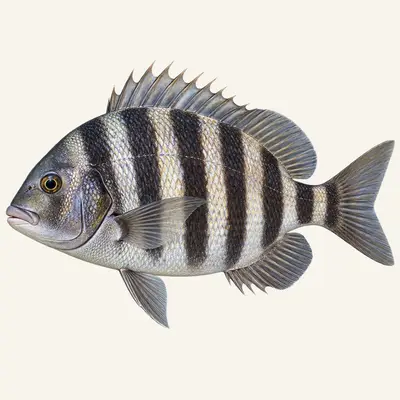
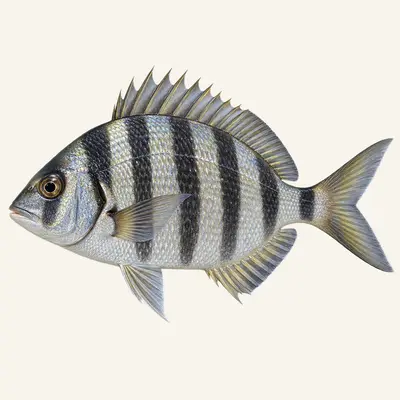
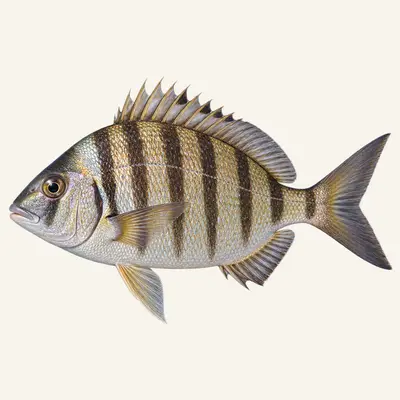
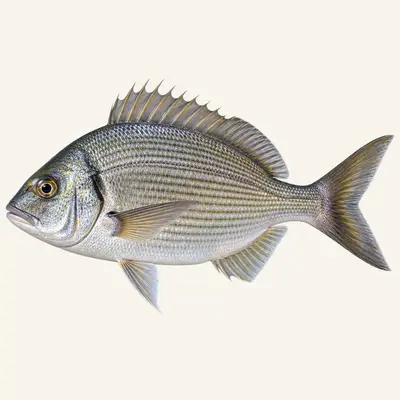
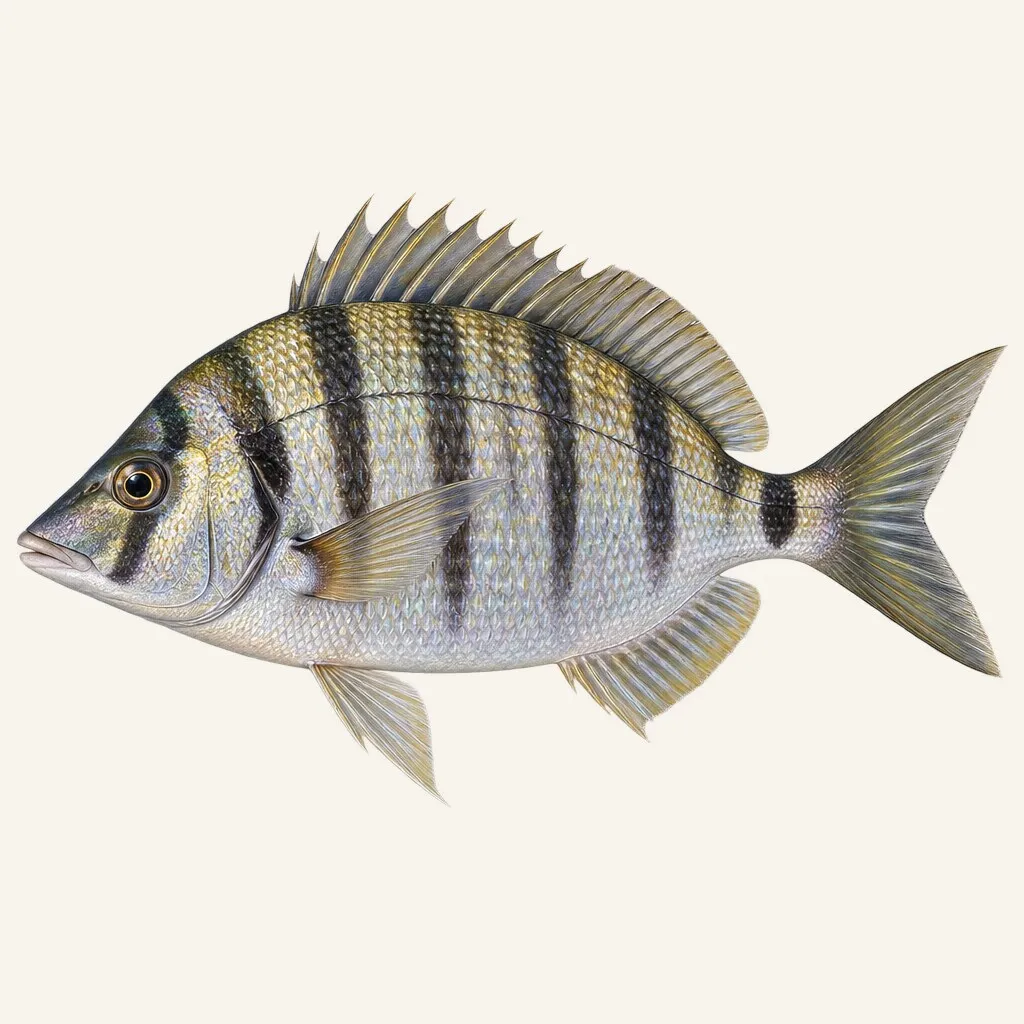
The sharpsnout sea bream is recognized by its elongated profile, prominent snout and fine vertical brown stripes on silvery flanks. A sparid of Mediterranean and Atlantic coastal waters, it is most active over rocky substrates and seagrass areas.
Calendar
Its range
Very common in the Mediterranean. In the Atlantic it runs from the Bay of Biscay, where it is rare, south to Sierra Leone, taking in the Strait of Gibraltar, the Canaries and Cape Verde; it is scarce in the Black Sea and it also occurs off South Africa.
The contrast between very common in one sea and rare in the other locates the real centre of gravity. This is a Mediterranean fish spilling into the Atlantic and not an Atlantic fish that entered the Mediterranean, and the density falls off with every degree of latitude north of the strait.
Identifying it
The snout is drawn out to a point and the profile of the head is almost straight, with no bulge at all over the eye. That is what names the fish in every language, and it is what separates it at first sight from relatives with a rounded forehead.
The flank carries dark vertical bars on silver, finer and more numerous than the white seabream's. On a fish out of the water it is the head shape to trust: the bars dull and the profile does not.
Breeding
Permanent hermaphroditism with protandric episodes — the fish functions as a male after first maturity and becomes female later on. Reproduction falls at the end of summer and through autumn.
Eggs measure 0.85 mm and larvae hatch at 1.7 mm, a smaller hatchling than the white seabream produces from an egg of the same size. The autumn timing is worth setting against that species' midwinter spawning: two fish sharing the same rocks and breeding a season apart.
The water it needs
A gregarious fish of coastal water, over rock or sand, down to 150 metres but only occasionally past 50.
The life history splits across two settings with nothing in common. Juveniles use brackish water and live in shoreline pools, sometimes in lagoons. Adults are often in the breaking waves. A rock pool and a surf line can be thirty metres apart and hold two stages of the same species that nobody would fish the same way.
Areas
- Rocky coastal bottoms
- Algae-covered rock areas
- Rocky headlands
- Detrital bottoms
Techniques
- Baited bottom fishing
- Float fishing
- Rock edge fishing
- Surf casting
Baits
- Sandworms
- Shrimp
- Sea urchins
- Mussels
- Crabs
What it eats
Seaweed, worms, molluscs and shrimp — and the order matters, because the algae come first.
Plant matter has a real place in the diet, and that single fact changes what can go on a hook. Where the rest of the genus answers to crustacean and shellfish before anything else, this one will take a bait of plant origin: bread and paste work on it, which is unusual among the sea breams that share its ground. It is regularly the first fish caught by somebody who reached the rocks with no marine bait at all.
The family does hold a stricter vegetarian, and it is not in this genus: the salema is described as almost exclusively herbivorous. The point here is not a record but a practical one — among the fish likely to be under the rod on a rocky shore, this is the one a piece of bread will reach.
How to catch it
Two pieces of information, and they work together. The adults hold the surf, so the fishing is done from the shore in very little water; and the partly vegetable diet opens up baits the other sea breams refuse.
Bread and paste produce more here than anywhere else in the genus, without ruling out crab, urchin or mussel. Working the rock edges and the algae-covered stone is what matches the diet, and it is where the fish is anyway.
Sociability changes the search. Finding one usually means finding a group, so a spot that produces produces repeatedly, and a spot that gives nothing in ten minutes is worth leaving.
Length is where it beats the other three, and on a body that stayed slim. The ordinary fish is 30 cm.
Regulations
Check the local regulations in force (legal size limits, closed seasons, bag limits).
For guidance only. Legal sizes, quotas and open seasons vary by location and season: always check the local regulations in force before fishing.
Other names
Sharpsnout seabream in English, sarago pizzuto in Italian, sargo picudo in Spanish, sar à museau pointu in French: for once every language noticed the same thing and said it the same way.
The oddity is that the scientific name did too. Puntazzo is not Latin. It is an Italian word for a large point, Latinised only in its ending, so the English name is not a translation of the binomial — both are renderings of the same Italian vernacular, and the binomial is the one that left the borrowing visible.
The convenience has a limit. Sharpness is a comparison, and it needs another Diplodus alongside for reference. On its own, on a slab, "sharpsnout" describes a head that anyone unfamiliar with the genus would call ordinary.
Sources: fishbase.se · api.gbif.org