Salema
Sarpa salpa · Sparidae
- Saltwater
- Coastal
- Medium
- Size
30–51 cm
- Weight
0.4 kg
- Depth
5–70 m
Where to fish
- Rocky shore
Habitat icons: Flaticon
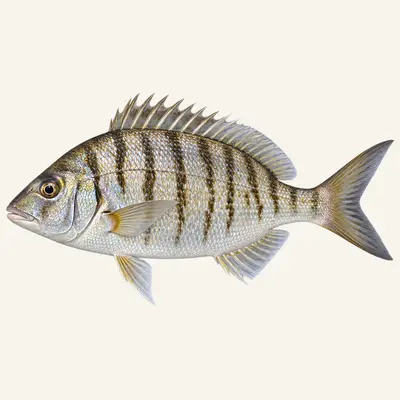
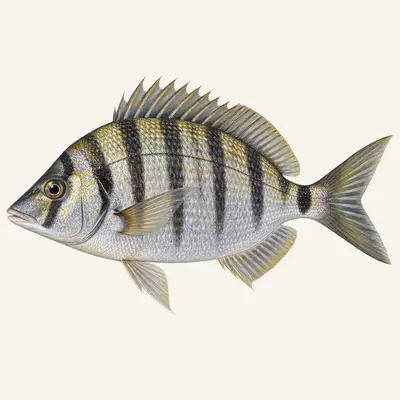
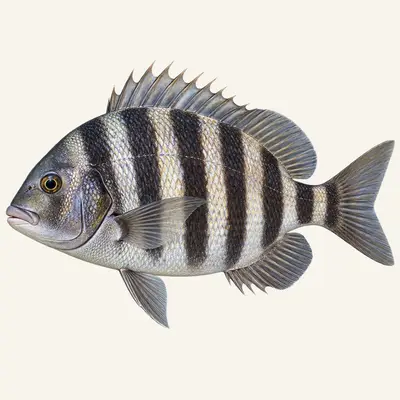
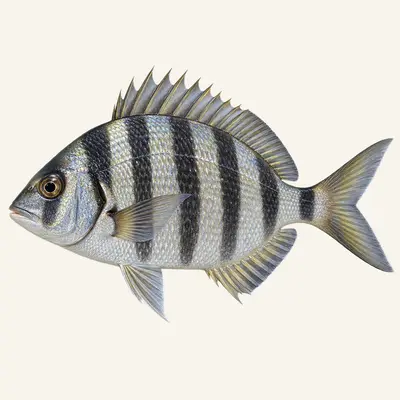
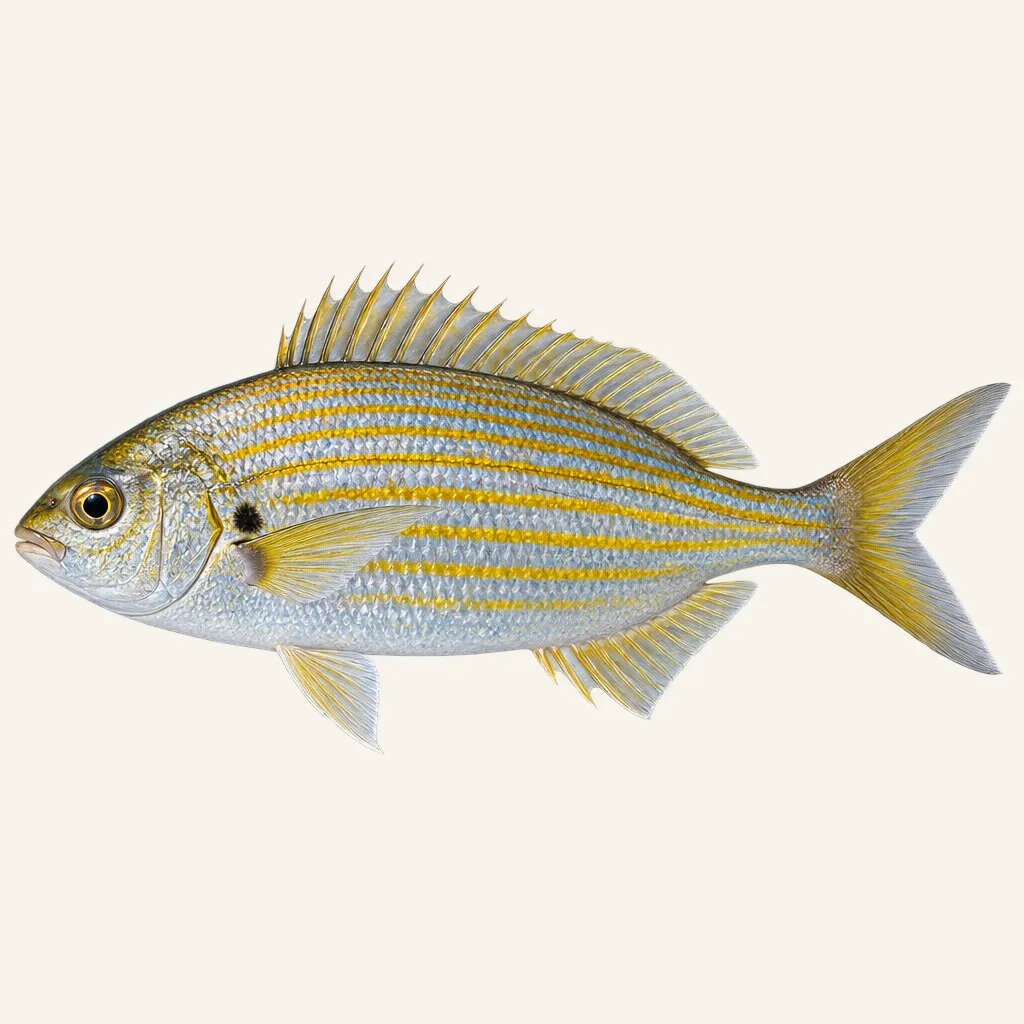
The salema porgy is a coastal sparid with an oval, silvery body marked by distinctive longitudinal golden stripes. It inhabits posidonia seagrass beds and shallow rocky areas across the Mediterranean and eastern Atlantic.
Calendar
Its range
The Bay of Biscay and the Strait of Gibraltar south to Sierra Leone, with Madeira, the Canaries and Cape Verde; then, separately, Congo to South Africa; and the Mediterranean. Forty-five degrees north to forty south.
The list steps over the Gulf of Guinea. Two subtropical blocks, north and south, and a tropical stretch between them that the species is not recorded through. For a fish that lives on an algal crop, that is a plausible shape: the shallow-water plant communities of the warm tropics are not the ones this animal grazes.
Identifying it
Ten golden lines run the length of the flank, parallel, evenly spaced, from behind the gill cover to the tail. They are the character, and unlike most sparid markings they are a count rather than an impression.
A black spot sits at the base of the pectoral fin. Note the position precisely — at the base, not above it — because that distinction separates species elsewhere in this family and is worth taking properly here.
The body is relatively slender. The fin counts are high at the soft end: 11 or 12 dorsal spines followed by 14 to 17 soft rays, three anal spines followed by 13 to 15. A long soft dorsal and a long anal fin on a slim body give this species a profile that reads differently from the deep-bodied breams sharing its ground, before any marking is looked at.
Breeding
The published accounts do not agree, and reporting the disagreement is better than choosing between its terms.
One section describes a protandrous hermaphrodite: male first, female later, monandric. Another gives the change at 25.0 cm total length and 3.75 years of age. A third records that conflicting descriptions of the reproductive style have been published, including the possibility of separate sexes.
The number that gives all this its edge is the common length: about 30 cm. If the change happens where it is reported to happen, the ordinary fish caught has already passed it. If the sexes are separate, it never had one to pass. Nothing about the animal in the hand distinguishes the two cases.
First maturity is given at 16.5 cm, which is early and which holds regardless of which description turns out to be correct.
The water it needs
Rocky substrates and sandy areas carrying algal growth, from 5 to 70 metres, marine and tolerant of brackish water. The species is oceanodromous and gregarious, and it forms schools of considerable size.
The depth figures should be read as a light range rather than a depth range. What the fish requires is a bottom growing enough weed to support a grazer, and how deep that bottom lies depends on how clear the water is. Turbid water compresses the band upward; clear water lets it run deeper. The same species will be at four metres on one coast and at forty on another without changing anything about itself.
Areas
- Posidonia meadows
- Algae-covered coastal rocks
- Shallow 1 to 10 metre bottoms
- Small harbours and coves
Techniques
- Floating bread fishing
- Pole fishing
- Seaweed bait fishing
- Light surface fishing
Baits
- Green seaweed
- White bread
- Cooked rice
- Sea grass
- Cooked corn
What it eats
The diet inverts over the animal's life, and that is the fact this whole page is built on.
Young fish are mainly carnivorous, taking crustaceans. Adults are almost exclusively herbivorous, feeding on seaweed. Not omnivorous with a plant preference — the account says almost exclusively, and it means the adult stops being a predator.
Three consequences follow, and they are not small ones.
Grazing sets the ground. Algae need light, so the fish is confined to bottom shallow enough to grow a crop worth eating; its recorded band is 5 to 70 metres and the productive end of that is the shallow end. It is over rock with algal growth, and over sand where weed has taken.
Grazing sets the season. A carnivore follows prey that moves; a grazer follows a standing crop that grows and dies back, so the fish concentrates where and when the weed is doing well.
And grazing sets what happens after the capture, which is the next section.
How to catch it
Shallow, lit, weedy ground: algal rock, seagrass, the margins of small harbours, in a few metres of water. The fish schools, and the schools are large, so this is a case of finding fish rather than of tempting one.
Loose feed does more work here than terminal tackle does. A grazing shoal that finds food in one place stays in it, and a fish taking small items off the bottom or off weed wants a small hook and a light line to a float. The adult diet is plant matter and the bait can be as well.
What to do with the fish afterwards deserves saying plainly, because it explains why the species is common on some coasts and ignored on others. The flesh is described as tasty when fresh but as softening easily, and as not much esteemed — and the reference also records the species as an occasional bait fish, which is a blunt statement about its standing. Both halves of that are handling facts rather than quality ones. A fish that must be eaten within hours does not travel to a market, and a fish that does not travel to a market never acquires a reputation, whatever it tastes like on the day.
Conservation
An abundant, commercially taken, shore-caught fish, and the thing worth thinking about is not the fishery.
A herbivore's numbers track its food, and its food is the standing algal crop of shallow rock and seagrass. That means the abundance of this species moves with the condition of the bottom — clarity, nutrient load, the state of the meadows — on a timescale and by a mechanism that has nothing to do with how many are caught. A decline here would be a symptom of the ground rather than of the fishing, and it would look exactly the same in a landing record.
The second point is more uncomfortable. Low esteem is currently the species' best protection: it is not much valued, it is sometimes used as bait, and effort goes elsewhere. Protection of that kind holds only as long as the market does, and markets for previously ignored fish have turned before.
Regulations
Check the local regulations in force (legal size limits, closed seasons, bag limits).
For guidance only. Legal sizes, quotas and open seasons vary by location and season: always check the local regulations in force before fishing.
Other names
One name, more or less, all the way round the northern Mediterranean. Italian salpa, Spanish and Portuguese salema, French saupe, and English salema borrowed from the Iberian form. All of them descend from the Latin salpa, which is also the specific epithet — so genus, species and half the vernaculars in the basin are the same word.
That uniformity is rare in this family and it is genuinely useful: a fish market from Alicante to Trieste will use a name an English speaker can recognise.
The two names that break ranks describe the stripes. German Goldstrieme, gold-stripe, and the English alternative "goldline", which is the more informative of the two English options and the less used.
The borrowing has a cost on the other side of the world. "Salema" is applied in the eastern Pacific to Xenistius californiensis, a grunt of the family Haemulidae — a striped fish of shallow Californian water and no relation. Where the two ranges cannot overlap the confusion stays theoretical, but it is enough to make a search on the bare word unreliable.
Sources: fishbase.se · api.gbif.org