White seabream
Diplodus sargus · Sparidae
- Saltwater
- Coastal
- Medium
- Size
22–45 cm
- Weight
0.1–1.9 kg
- Lifespan
10 years
- Depth
0–50 m
Where to fish
- Rocky shore
Habitat icons: Flaticon
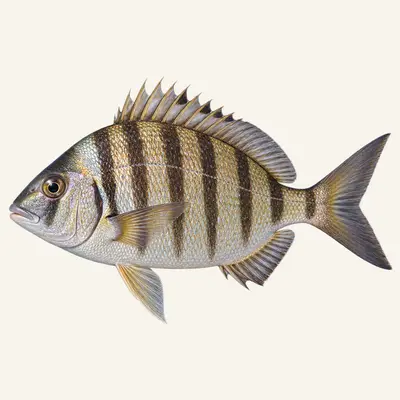
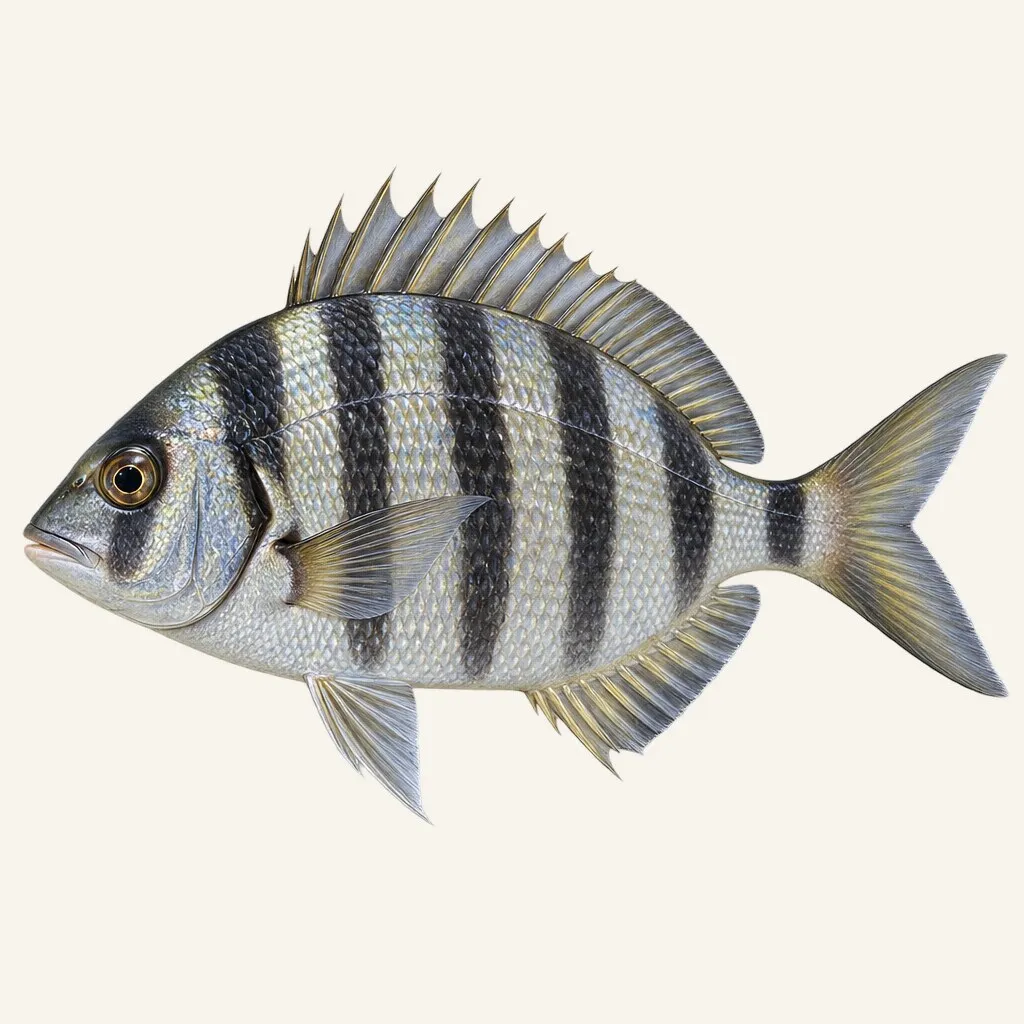
The white seabream is a coastal sparid with an oval, laterally compressed, silvery body bearing 7 to 10 dark vertical bars on the flanks and a characteristic black spot at the base of the tail; it typically reaches 25 to 45 cm. It lives among rocky bottoms, seagrass beds, and surf zones of the Mediterranean and north-east Atlantic.
Calendar
Its range
Brittany is the northern limit, and it is the northernmost of the group: this is the one sea bream here that a French Atlantic angler meets as a resident rather than as a curiosity. From there the range runs south to Gibraltar and Madeira, through the whole Mediterranean, into the south-western Black Sea, and on down the African coast to South Africa.
Brittany to the Cape is a wide temperature span for a fish tied to the shore, and what stays constant across it is not the water but the ground: rock, and the seagrass at its edge.
Identifying it
Count the bars. Five black vertical bands alternate with four grey ones down the flank, and no other sea bream of this coast shows that arrangement. It reads at a distance on a living fish, which is more than most sparid characters manage.
The snout is longer than the eye is wide. That is a measurable character rather than an impression, and it is the one to fall back on when the bars have dulled on a dead fish.
The dorsal fin carries 11 or 12 spines and 12 to 15 soft rays, the anal three spines and 11 to 14. The body is the deep, strongly compressed oval of the family.
Ten years is the oldest age on record. The fish met most often is about 22 cm.
Breeding
The sex of this species has been settled three times, and the sequence of conclusions is worth setting out as a sequence. It was first described as having separate sexes, or as protandrous. Then, in some areas, it was taken for a digynic hermaphrodite, with males and females both developing out of an intermediate juvenile stage. Protandry, with digyny possible alongside it, was confirmed afterwards.
In practice that means part of the population begins its sexual life male and turns female later, while part arrives at female without a male phase at all. Large fish are therefore more often females, but the tendency is statistical and cannot be applied to the animal in the hand. That is the difference between this fish and the gilt-head, where the order is fixed and admits of no exception worth planning around.
Maturity comes at two years, at about 17 cm. Spawning runs from January to March — midwinter, which is unusual in this group and unusual for a shore fish generally. Eggs are 0.8 to 0.9 mm and larvae hatch at 2.6 mm.
The water it needs
Coastal rocky reef and Posidonia oceanica beds, from the surface down to 50 metres. It tolerates brackish water as well, which widens the ground without altering the method.
The operative fact is the surf. This fish works the breaking zone actively, and mainly at first light. That places it in very little water, inside the waves, at a specific hour of the day, and no other line in its file is worth as much.
Areas
- Rocky coastal areas
- Marine seagrass beds
- Headlands and capes
- Mixed sand-rock bottoms
Techniques
- Baited bottom fishing
- Float fishing
- Surf casting
- Lure fishing
Baits
- Crabs
- Shrimp
- Sandworms
- Sea urchins
- Mussels
What it eats
Shellfish and other bottom invertebrates, picked out of the sediment.
The verb is the point. This is not random grubbing — the fish selects an item and detaches it. Cutting incisors at the front take a prey off its hold and the molars behind them break it up afterwards, which is why sea urchins and mussels appear on the bait list and why a soft-mouthed fish could do nothing with either.
How to catch it
Dawn, and the wave. Something that works the surf zone at first light is fished from the shore in very little water, at an hour when the sea has not yet got up and the light is still low. It is one window, and it is short.
The dentition sets the tackle. Crab, prawn, urchin and mussel, on a hook that will survive molars built to open a shell — a fine-wire pattern comes back deformed. Against that, the bite is discreet for a fish that pulls as hard as this one does.
Spawning from January to March puts the heaviest feeding outside those months, which is useful for laying out a season. Spring to autumn is the productive stretch; the winter belongs to the reproduction rather than to the angler.
Conservation
Two dependencies press on this species, and only one of them shows up in the catch.
The first is the seagrass. Posidonia meadows are in retreat across the Mediterranean under anchoring, inshore trawling and turbidity, and a sea bream without a meadow loses its cover and part of its larder in the same stroke. None of that appears in landings until the fish have stopped being there.
The second is the sex sequence. Selective removal of the largest individuals takes females, and the spawning goes with them — the ordinary consequence of protandry, softened here by digyny but not cancelled by it.
Regulations
Check the local regulations in force (legal size limits, closed seasons, bag limits).
For guidance only. Legal sizes, quotas and open seasons vary by location and season: always check the local regulations in force before fishing.
Other names
White seabream is the English name, and the trouble starts one level up, at the family. The Sparidae are sea breams on the eastern side of the Atlantic and porgies on the western, and the two vocabularies barely meet: an American angler who knows scup, red porgy and pinfish has no word at all for a Mediterranean Diplodus, and a British angler reading an American account of a porgy has to work out which fish is meant. Neither term narrows anything on its own, because both cover a whole family.
Spanish and Portuguese sargo, Italian sarago maggiore and French sar commun all do better, by treating Diplodus as a group with a word of its own and then qualifying it. English has no such word, which is why every fish in this genus ends up as some adjective plus "seabream".
Sources: fishbase.se · api.gbif.org