Sheepshead
Archosargus probatocephalus · Sparidae
- Saltwater
- Coastal
- Medium
- Size
35–91 cm
- Weight
0.8–9.6 kg
Where to fish
- Estuary
- Reef
- Rocky shore
Habitat icons: Flaticon
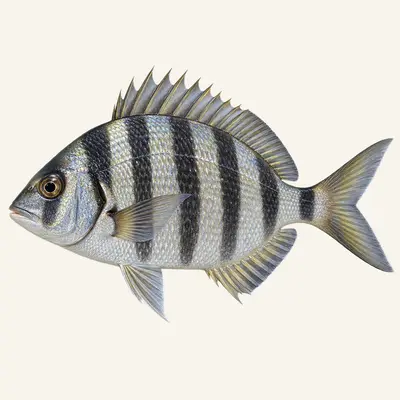
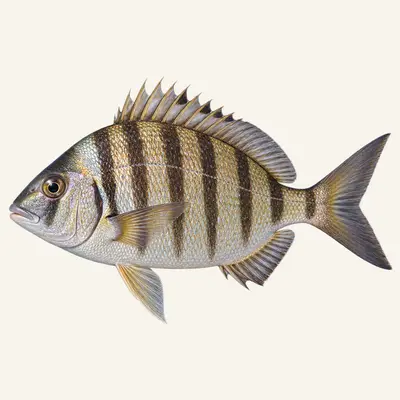
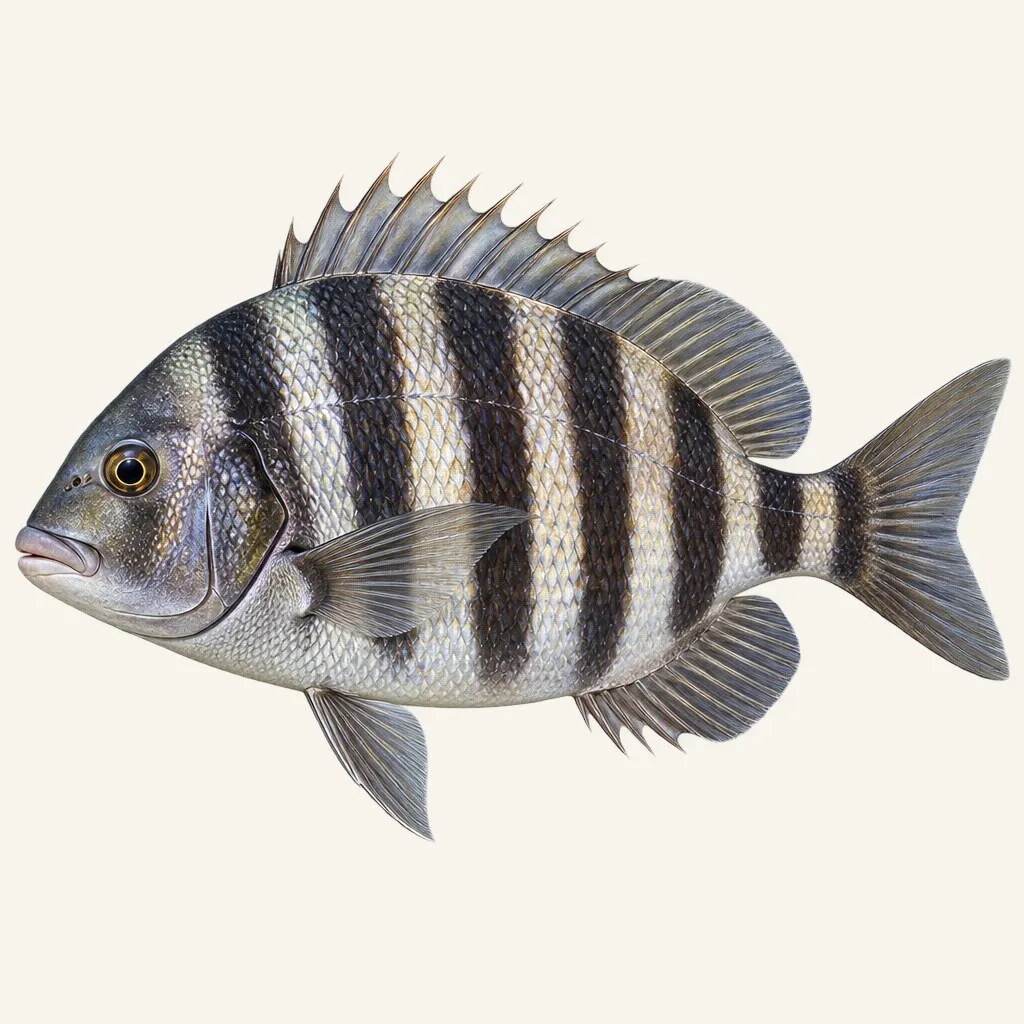
A stocky inshore fish with vertical black bars and famously human-like teeth, renowned for crushing crustaceans and shellfish.
Calendar
Recorded in 4 countries
Brazil · Mexico · Puerto Rico · United States
GBIF occurrence records — native and introduced populations combined.
Its range
Nova Scotia and the northern Gulf of Mexico south to Brazil — and absent from Bermuda, the Bahamas, the West Indies and Grenada.
Those absences carry more information than the presences do. The islands they name sit squarely inside the latitude band the species occupies, so temperature is not what is excluding it. What they lack is the ground: this is an animal of bays, estuaries and brackish water, and an oceanic island has no river mouth, no estuarine gradient and no extensive soft-bottomed bay behind it.
The range is therefore the shape of a continental coastline rather than of a climate. It reaches 49°N and 6°S along the mainland margin, and stops at the water's edge of every island group in between.
Identifying it
Probatocephalus is Greek for sheep's head, and it is the mouth that earned it. The teeth are described, in the account rendered beside this text, as famously human-like: broad and flat where a fish is expected to carry cones, and immediately familiar on a grazing mammal. No published diagnosis in the reference consulted here sets out their arrangement, so the shape of the battery is a matter of what the fish does with it rather than of a count.
What the diet does establish is that the mouth performs two operations, not one. This species feeds mainly on molluscs and crustaceans, which must first be detached from whatever they are fixed to and then broken open. A fish that lives on barnacles and mussels needs an edge at the front and a crushing surface behind, and the reputation the teeth have earned is exactly that of a mouth doing both.
The other field character is the barring: broad dark vertical bands on a deep silver body. Bars are common in this family and they are not, on their own, an identification. The teeth are, and they are visible on any fish held with its mouth open.
The water it needs
Bays and estuaries. The species enters brackish water freely and sometimes goes into fresh — which is an unusual amount of salinity tolerance for a family whose members are mostly tied to the sea.
Then the line that organises the entire fishery: it is commonly found around pilings, and it is caught by anglers from jetties and rocky shores. It is classed as reef-associated, and it has been recorded from 15 metres.
A piling is not cover for this fish. It is food. A vertical surface standing in warm brackish water grows barnacles, mussels, small crabs and encrusting life within a season, and what it presents is a wall of attached, armoured prey — precisely the diet above, held at a height where a fish can work it. The same is true of a bridge support, a dock, a jetty face, a wreck and a rock groyne.
Structure, for most fish, is where they hide. Here it is where they eat, and that changes where a bait belongs.
Areas
- Dock and pier pilings
- Jetties and breakwaters
- Wrecks and artificial reefs
- Estuaries and coastal channels
- Bridges and submerged structure
Techniques
- Bottom fishing near structure
- Float (bobber) fishing
- Light tackle / jighead finesse
- Sight fishing along pilings and jetties
Baits
- Fiddler crabs
- Live or fresh shrimp
- Mussels and clams
- Marine worms
- Barnacles scraped from pilings
What it eats
Molluscs and crustaceans, chiefly.
Both categories share a property that matters more than the taxonomy: the animal has to be removed from a surface before it can be eaten. Barnacles are cemented on. Mussels are byssally attached. Small crabs hold on. A fish making its living this way is not a suction feeder and not a chaser; it bites things off.
That is the mechanical fact behind everything anglers say about this species being difficult to hook. A mouth that removes a barnacle from a piling handles a bait the same way — it takes hold of a piece and detaches it — and there is no moment when the whole offering is drawn back into the mouth.
How to catch it
Fish the structure, not the water near it. Pilings, dock and bridge supports, jetty faces, breakwaters, wrecks and artificial reef: the bait wants to be against the surface, presented vertically, because that is where the food is growing.
Baits should be hard and attached-looking. Crustaceans and shellfish are the whole of the diet on record, and offerings that mimic what is scraped off a piling are what this fish is set up to deal with.
The bite is the problem and the dentition is why. A fish that detaches its food takes a bait in pieces, and the sensation transmitted up the line is small, brief and easily mistaken for the tackle touching the structure. Contact has to be direct — short line, tight to the piling, minimum slack — because there is very little signal to lose.
One further point belongs to the release decision rather than to the method. The reference gives no length at first maturity for this species and no reproductive data at all. There is therefore no published size below which a fish is known not to have bred, and no size above which it is known to have done so. Anyone using a size threshold to decide what goes back is using a rule that came from somewhere other than the biology of the animal.
Conservation
The pressure on this species is where it is fished rather than how much.
An animal that concentrates on pilings, bridges, jetties and wrecks is an animal whose accessible population sits on a countable number of marks. Those marks are fixed, they are public, they are reachable on foot in many places, and they hold fish reliably enough that they are worked continuously. A shore fishery on structure is not diffuse in the way a shore fishery over open beach is; it is a small number of places taking a large share of the effort.
The second exposure is the ground itself. Bays and estuaries are the habitat, and estuaries are where coastal water quality, freshwater flow and shoreline construction are all decided. Nothing about that appears in a catch figure until the fish have stopped using a system.
The third is the documentation. Fisheries for this species are commercial and recreational and long-established, and the standard reference carries no maturity size, no spawning season, no fecundity — the parameters a stock assessment is built from. Local science exists in places; a reader looking the species up will not find it in the general account.
Regulations
Minimum size and bag limits vary by state (e.g. Florida); follow local regulations.
For guidance only. Legal sizes, quotas and open seasons vary by location and season: always check the local regulations in force before fishing.
Other names
Sheepshead in the United States, where the fish is common and well known, and the name is a straight rendering of the epithet.
The trouble is that the word does not stay put. Around the Great Lakes and through the Mississippi basin, "sheepshead" is the ordinary name for the freshwater drum, Aplodinotus grunniens, a Sciaenid living entirely in fresh water. On the Pacific coast, the California sheephead, Semicossyphus pulcher, is a wrasse. Three fish, three families, one word — and unlike most fish-name collisions this one operates inside a single country, so context does not resolve it. An American saying "sheepshead" has to be asked which coast they learned it on.
"Convict fish" turns up as a nickname for the barring and it is unambiguous, which the official name is not.
Archosargus places the fish in the sea breams and porgies; probatocephalus gives it the mouth. Between them the binomial does what the vernacular cannot, which is to point at one animal.
Sources: fishbase.se · api.gbif.org