Sand steenbras
Lithognathus mormyrus · Sparidae
- Saltwater
- Coastal
- Medium
- Size
30–55 cm
- Weight
0.3 kg
- Lifespan
12 years
- Depth
0–150 m
Where to fish
- Estuary
- Beach
- Rocky shore
Habitat icons: Flaticon
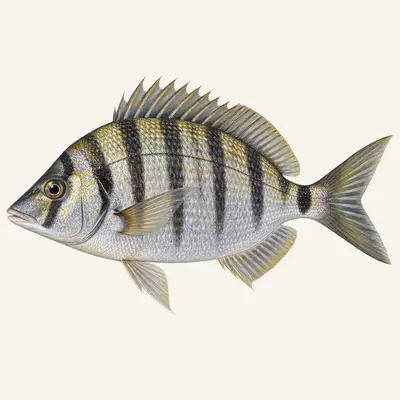
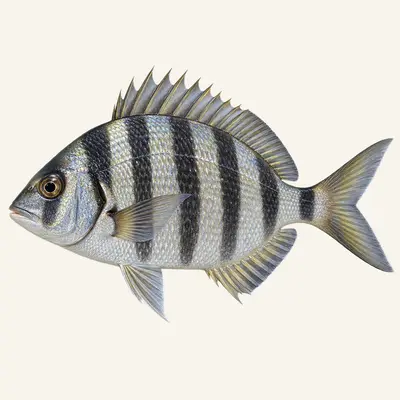
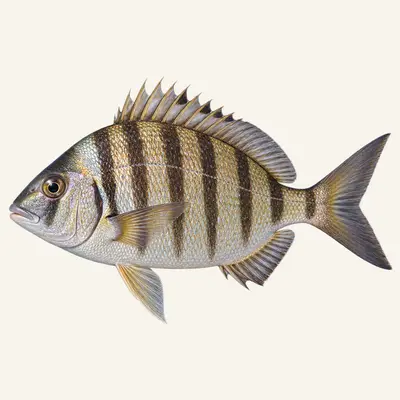
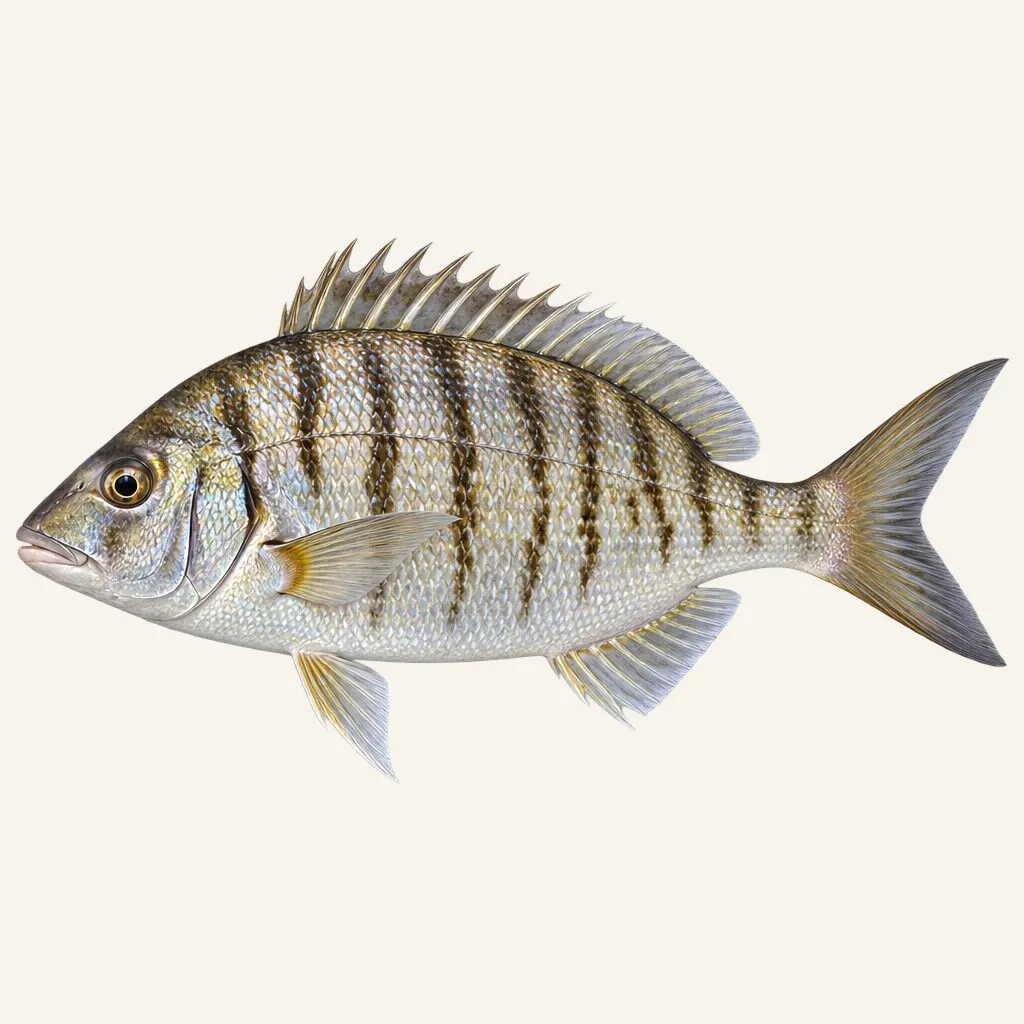
The striped seabream is a slender sparid with a silvery body crossed by about ten dark transverse bands reminiscent of marble, giving it its name. It frequents fine sandy beaches and surf zones in shallow water along Mediterranean and Atlantic coasts, rooting through the bottom for worms, molluscs and small crustaceans.
Calendar
Its range
The list has a hole in it, and the hole is the interesting part.
The species holds the Bay of Biscay, the Strait of Gibraltar, the Mediterranean, the Black Sea, Madeira, the Canaries and Cape Verde, and continues south along the African seaboard as far as the Cape of Good Hope. It is also present in the western Indian Ocean, in southern Mozambique, and in the Red Sea. And it is recorded as absent from tropical east Africa.
Two temperate and subtropical blocks, one at each end of a continent, with the warm middle left out. That shape belongs to a fish whose limit is heat rather than cold, and it is why the species is met by English speakers at the southern end of its range more often than anywhere else — a point the English name preserves.
Identifying it
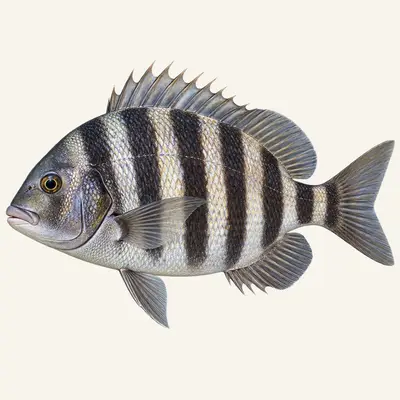
Bars across a silver flank, running top to bottom, repeated the length of the body. Every language that has a word for this fish names that pattern, and it is what settles the identification in the surf, in a bucket or through a metre of clear water over sand.
The pattern is also all the colour anyone should rely on. Read it on a fish that has just come out, because it is at its strongest then and every hour afterwards costs it definition.
The counts do not fade: 11 dorsal spines with 12 or 13 soft rays, three anal spines with 10 or 11 soft rays. That anal fin, three spines and eleven rays on a slender body, is a fin worth glancing at when the bars have gone.
The genus name is Lithognathus, stone jaw. It is a name about feeding, and it is the right place to start reading this animal.
Breeding
The reference disagrees with itself here, and the disagreement is the honest answer.
One section calls the species a protandrous hermaphrodite: male first, female afterwards, monandric. Another records sex inversion occurring mainly between 24.1 and 35.2 cm total length and at about three and a half years of age. A third notes that conflicting descriptions of the reproductive style have been published, including the possibility that the sexes are simply separate. In the northern Adriatic the overall ratio of males to females was measured at 1 to 1.62.
Set the switch band against the ordinary size of the fish and the practical consequence appears. The common length of this species is about 30 cm. The transition, where it happens, runs from 24 to 35. The fish an angler usually has in hand is therefore inside the transition rather than on one side of it, and two individuals of identical length can be in different states.
That is the opposite situation from most of this family, where length gives sex reliably enough to plan around. Here it gives nothing. First maturity is reported at around 17.4 cm, which at least is early: most fish entering a catch have bred.
The water it needs
The shelf, over sand and mud, with seagrass beds and estuaries. The recorded depth range runs from the surface to 150 metres, and the usual band is 10 to 20.
Ten metres of water is a very small slice of a 150-metre envelope, and it is where this species actually is. That places it inside surf, inside estuary mouths, and inside the reach of anyone standing on a beach. It also means there is no deep water to which it retreats.
It is a marine fish that tolerates brackish water, gregarious, and it forms schools of real size. A bite over clean sand is rarely a single animal.
Areas
- Sandy beaches
- River mouths
- Surf zones
- Harbours and sheltered coves
Techniques
- Surf casting bottom fishing
- Coastal feeder
- Sliding rig fishing
- Kayak fishing
Baits
- Bloodworm
- Cockle
- Mussel
- Brown shrimp
- Lugworm
What it eats
Worms, molluscs and small crustaceans.
Look at what is not on that list: nothing fast, nothing large, nothing that lives on top of the ground. Polychaetes are in the sediment. Bivalves are in the sediment. The small crustaceans of a sandy shelf spend most of their time under it. This is a diet composed almost entirely of animals that have to be extracted from a bottom rather than chased across it.
That is the whole explanation for where the fish lives and how it moves. Everything it eats is beneath a surface it has to work through, which is why it holds sand and mud rather than rock, and why it is worked over open bottom that carries no structure at all.
How to catch it
Beach, surf and estuary mouth, in 10 to 20 metres or less. Ground with no features on it — clean sand, a gutter, the edge of a bar — is not second-best water for this species, it is the water.
Baits come straight off the diet and all of them are things dug up: marine worms first, then small bivalves and small crustaceans. The fish is looking for buried, soft-bodied items, and presentation on or in the sand is what matches that.
Because the schools are large, effort should go into finding the shoal rather than into working a spot after it has gone quiet. And because the whole depth range accessible to the species is also accessible from a beach, there is no seasonal escape to depth to plan around — twelve years of life, spent within wading distance of the shore.
Conservation
This is a minor commercial fishery, and the pressure on the species is not the interesting part of its situation. What is interesting is that its most basic biological parameter is not known with confidence.
A stock assessment reads a length frequency and infers structure from it. That inference requires knowing how length maps onto sex. For this species there are three published answers: protandry with a switch between 24 and 35 cm, protandry with the switch at a different point, and no sex change at all. The Adriatic ratio of 1 to 1.62 is consistent with the first and does not settle it.
So a length distribution for this fish can be read several ways, and each reading implies a different sex ratio in the water. That is not an academic gap. Whether a fishery taking 30 cm animals is taking mostly males, mostly females, or a fixed mixture depends on which of the three descriptions is right, and the answer may not even be the same in every population.
A twelve-year lifespan and maturity at 17 cm are the reassuring numbers. The unresolved one sits between them.
Regulations
Check the local regulations in force (legal size limits, closed seasons, bag limits).
For guidance only. Legal sizes, quotas and open seasons vary by location and season: always check the local regulations in force before fishing.
Other names
Two English names are in use and they come from opposite ends of the range. Striped seabream describes the fish. Sand steenbras is what it is called where English speakers meet it most, which is southern Africa: steenbras is Afrikaans, from Dutch, and it means stone bream.
That name and the scientific one say the same thing independently. Lithognathus is Greek for stone jaw; steenbras is Dutch for stone bream. Two naming traditions, centuries and a hemisphere apart, reached for the same rock.
The Afrikaans word is also the problem with the English one. Steenbras in South Africa covers a set of sparids rather than a species, and the largest of them is Lithognathus lithognathus, the white steenbras — a congener carrying the genus name twice over. "Sand" is not decoration on that name; it is the whole of the identification.
Elsewhere the vernaculars go back to the pattern. French marbré, marbled. Italian mormora and Spanish herrera. The epithet mormyrus is an old Greek fish name reused rather than a description.
Sources: fishbase.se · api.gbif.org