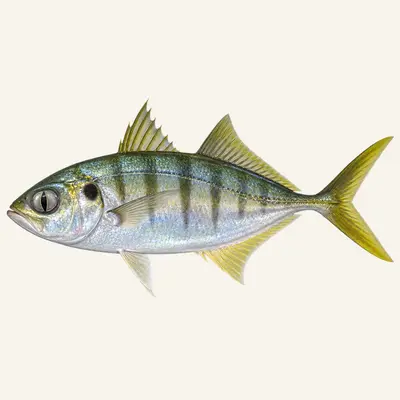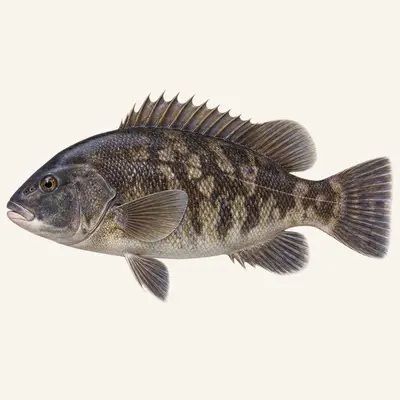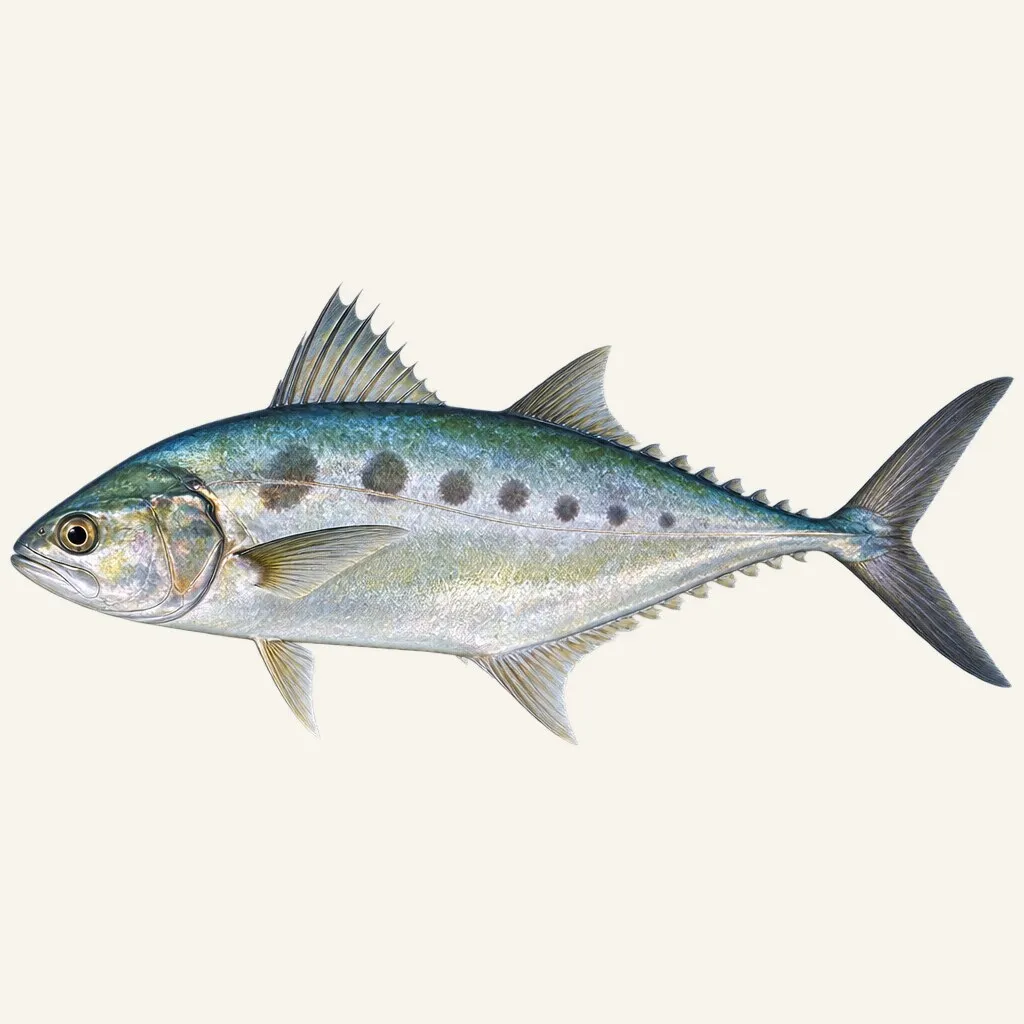
Talang queenfish
Scomberoides commersonnianus · Carangidae
- Saltwater
- Coastal
- Medium
- Size
90–120 cm
- Weight
5.6–16 kg
Where to fish
- Estuary
- Rocky shore
Habitat icons: Flaticon
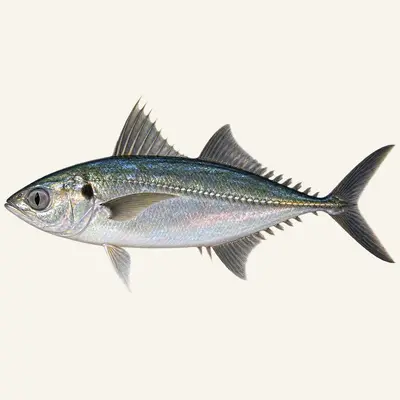
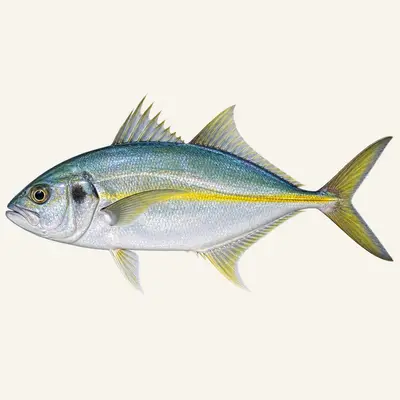
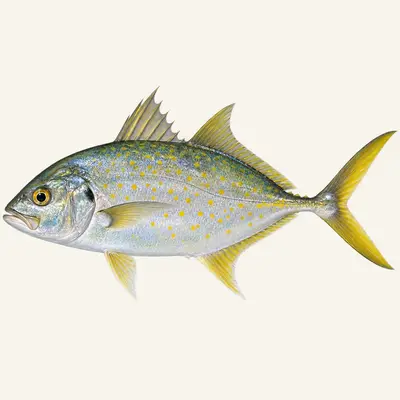
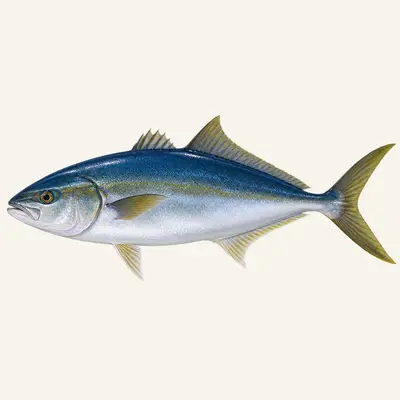
The talang queenfish is the largest member of the genus Scomberoides, inhabiting tropical coastal waters across Asia, Africa and Oceania. It is recognised by its elongated silver body, distinctive lateral spots and prominent lower jaw adapted for rapid surface prey capture.
Calendar
Recorded in 20 countries
Australia · Bangladesh · Cambodia · India · Indonesia · Malaysia · Mayotte · Mozambique · New Caledonia · Palau · Papua New Guinea · Réunion · Saudi Arabia · Singapore · Solomon Islands · South Africa · Sri Lanka · Taiwan · Thailand · United Arab Emirates
GBIF occurrence records — native and introduced populations combined.
Its range
The latitudinal spread is the striking figure: the recorded limits run from 35° north to 42° south. A warm-water animal reaching 42° south overshoots the tropics by a wide margin on that side of the equator and by considerably less on the other, so the range is not the symmetrical band around the equator that "tropical" usually implies.
Identifying it
Counting will not settle this fish. Both members of the genus in the catalogue carry seven or eight dorsal spines and three anal spines, and their soft-ray ranges lie almost on top of one another: 19 to 21 in the dorsal for either, 16 to 19 in the anal here against 17 to 19 in the doublespotted queenfish. Any key built on those numbers leaves a specimen undecided.
Body shape adds nothing, since it is the same word in both records — fusiform, compressed in section. What separates the two on the water is not the fin formula but the depth, the salinity and the way each of them groups.
The entry above adds a feature the fin counts do not: a prominent lower jaw, described there as an adaptation for taking prey quickly at the surface. Spanish reaches for the same region of the head, calling the fish pámpano dentón.
The water it needs
The ceiling is low. Fifty metres closes the recorded depth range, so everything happens inside the layer that light still reaches and depth stops being a variable worth searching through.
Adults work coastal water, often close to reefs and to offshore islands, and go up into estuaries from time to time. They move in small groups.
The record also files the species as amphidromous, and that word changes the standing of the estuary. An amphidromous fish crosses between salinities during its life for reasons that have nothing to do with breeding — the movement serves growth and feeding. The brackish records are therefore part of the cycle rather than strays out of place, and a fish met in a river mouth is where it is supposed to be.
Areas
- Coastal rocky flats
- Estuaries and river mouths
- Shallow tropical zones
- Passes and channels
Techniques
- Metal lure fishing
- Surface popper fishing
- Live bait fishing
- Coastal trolling
Baits
- Small live fish
- Shrimp
- Metal lures
- Poppers
What it eats
Fishes, cephalopods, small invertebrates and other open-water prey. The list favours nothing and excludes nothing: this is an opportunist working the upper layer and taking what that layer carries.
Cephalopods are the entry worth acting on, because they change what goes on the end of the line. A squid profile is not a fallback on this species. It is an imitation of something the fish actually eats, and it is the item on the list that the two other groups do not cover.
How to catch it
Maturity is the number that governs. It is reached at 63.5 cm against a common capture length of 90, and the gap between the two is comfortable. The fish ordinarily met has bred already; the one below that threshold has left nothing behind it.
The ground reduces to three items taken from the account — coast, reef, offshore island — plus the river mouths, and nothing below 50 m.
Small groups dictate how hard to work a spot. A take announces a few fish within reach rather than a school, so the sector is worth covering again without expecting a run of them.
Regulations
Check the local regulations in force (legal size limits, closed seasons, bag limits).
For guidance only. Legal sizes, quotas and open seasons vary by location and season: always check the local regulations in force before fishing.
Other names
The epithet honours Philibert Commerson, the naturalist who sailed with Bougainville and whose Indo-Pacific collections fed a substantial share of the descriptions published in the following century.
Queenfish is the name to handle with care in English, because it is doing at least two jobs at once. Within this family it covers several species of Scomberoides and needs a qualifier every time — talang here, doublespotted for the smaller congener that shares these coasts. Away from the family it has been attached to unrelated fishes on other seaboards, so the word on its own identifies a shape rather than an animal.
Other languages broke with it rather than borrow. Spanish named the teeth, German built Talang-Stachelmakrele on the same borrowed qualifier, and Brazilian Portuguese went to pampo-galhudo.
Sources: fishbase.se · api.gbif.org