Tautog
Tautoga onitis · Labridae
- Saltwater
- Coastal
- Medium
- Size
40–91 cm
- Weight
1.0–11 kg
- Lifespan
34 years
- Depth
1–75 m
Where to fish
- Reef
- Rocky shore
Habitat icons: Flaticon
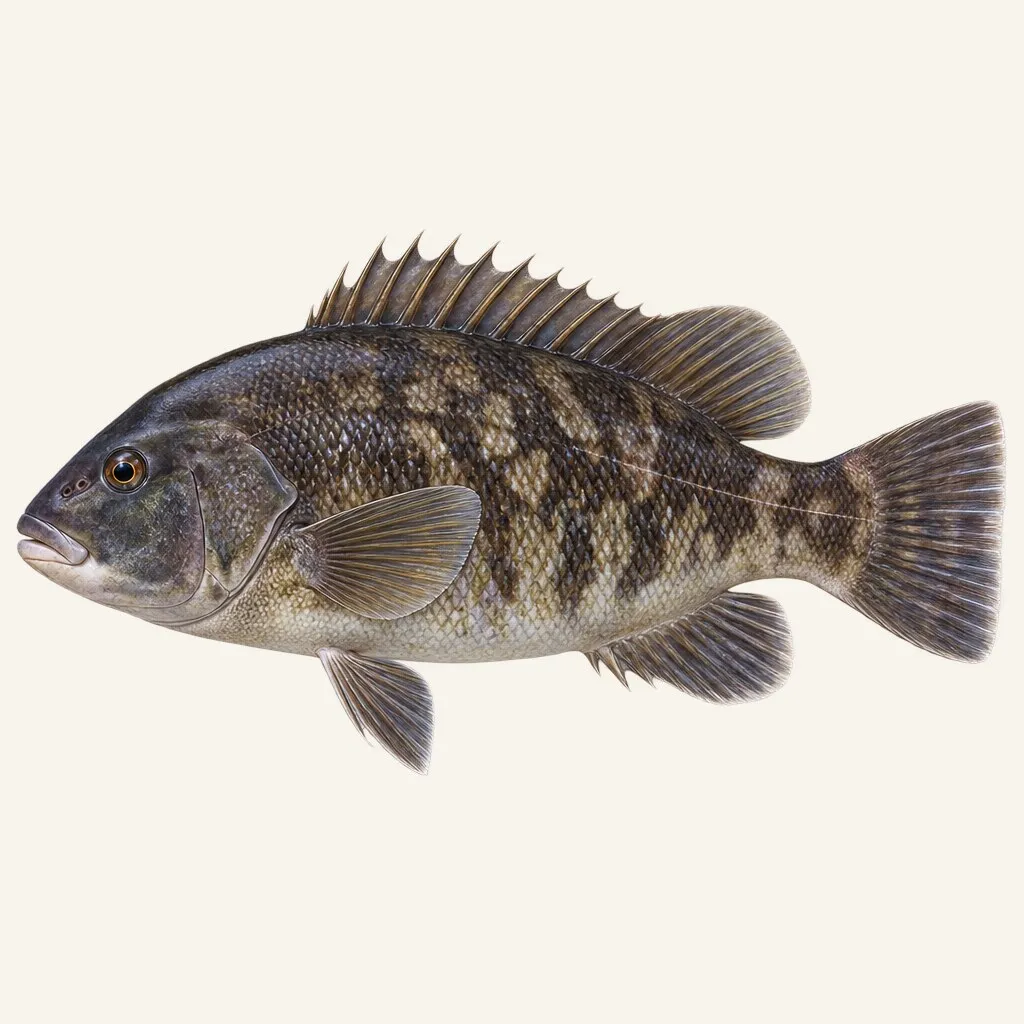
Stout Northwest Atlantic wrasse with a thick body and powerful jaws, prized for its firm flesh and dogged fight around structure.
Calendar
Recorded in 2 countries
GBIF occurrence records — native and introduced populations combined.
Identifying it
Sixteen or 17 spines in the dorsal fin, then only 10 soft rays: a long spiny fin over a short soft one, on a stout, laterally compressed body. Three anal spines and seven or eight rays complete the formula.
The useful part of the identification is a comparison the source makes itself. The cunner, Tautogolabrus adspersus, shares these coasts and runs further north, and four characters are given to separate the two: a steep, rounded profile to the top of the head, a stouter body, a scaled lower gill cover, and pelvic fins set further back. Head profile and gill cover are the two that can be checked with a wet fish in one hand.
Breeding
Pairing is between a female and a male that dominates by size, and it is preceded by a protracted courtship. Those males hold territories and defend them strongly. Spawning happens in pairs or in groups.
The record then adds a note that looks technical and is not: gonochorism is confirmed for this species. Sexes are separate and fixed, with no sex change at any point. That is a statement worth making only in a family where sex change is widespread, and the wrasses are that family — so the confirmation is doing real work. It means the biggest fish on a piece of structure is not necessarily a female, and that the size-dominant males are a category of fish that can be removed without any of them being replaced by a smaller individual changing sex.
Timing shifts with latitude. Spawning was recorded in June and July in Canadian waters and appears more protracted, from April to July, off Virginia. Maturity comes at 23.6 cm, within a range of 18 to 26.5.
The water it needs
Close inshore, on hard bottom, from 1 m down to 75, with occasional excursions into brackish water. The temperature preference is above 10 degrees, and that threshold governs the inshore season more than the calendar does.
The daily routine of the adult male is described precisely, and it is the most useful thing on the page. He is territorial and active by day, feeding; at night he rests in a crevice. Those patterns were worked out with ultrasonic telemetry in the southern part of the range, which is why they are given with that much confidence.
A fish that sleeps in a known fissure has a fixed address. It can be found again, and it can be emptied out — the fidelity cuts both ways, and the same detail that makes the fishing possible is what makes the local stock exhaustible.
Areas
- Northeastern U.S. Atlantic coast
- New England
- Chesapeake Bay
- New Jersey and Long Island
- Southern Nova Scotia
Techniques
- Bottom fishing on structure
- Bait fishing on a sinker rig
- Vertical jigging over wrecks
- Bait fishing from jetties
Baits
- Green crab
- Rock crab
- Mussel
- Hermit crab
- Clam pieces
What it eats
Mussels chiefly, then gastropods, other molluscs and crustaceans.
A diet of that kind requires two operations rather than one: detaching a bivalve from its anchorage, and breaking it open. The description this catalogue carries credits the fish with powerful jaws, and wrasses do their crushing behind the mouth, on pharyngeal plates, rather than with the teeth at the front. The published diagnosis here says nothing about the dentition either way, so what stands is the diet and the ground it is taken from: shellfish attached to rock, prised off and milled.
How to catch it
Hard bottom close to the shore — rock armour, wrecks, rocky drop-offs, the piles of bridges and jetties. Much of it is within reach from land, which is unusual for a fish of this size and quality.
The diet sets the bait, and it sets it narrowly. Crab and mussel work; a clam or a hermit crab works; nothing that imitates a small fish has any business here. The rig is a bottom rig fished tight to structure, and the price of fishing that ground is tackle left on it.
Activity is diurnal, which makes a session easy to plan and separates this species from the many bottom fish that have to be fished at night. Above all, the temperature preference sets the window: below 10 degrees the inshore ground stops producing, whatever the season is called.
Conservation · Vulnerable (IUCN) — This species is threatened with extinction. Always release it (no-kill), handle it with the utmost care and check local rules — fishing for it may be prohibited.
Conservation
Thirty-four years is the maximum reported age, against maturity at 24 cm. A stock built on that arithmetic takes decades to rebuild, because the large fish in it were recruited decades ago and nothing accelerates their replacement.
Territoriality makes it worse in a specific way. The males that dominate by size hold known fissures and are the ones the pairing depends on, and since the sexes are fixed, a removed male is not replaced by a sex-changing neighbour. Their addresses are also stable enough to be fished again and again.
The geography compounds both. The range runs from just east of Halifax to South Carolina and the fish is most abundant between Cape Cod and Delaware Bay — a narrow, densely populated stretch of coast where shore and small-boat fishing is heavy. The rules for it change by state and by year, and the fisheries authority for the coast being fished is where they come from.
Regulations
Subject to strict state-specific minimum sizes, bag limits and seasons (ASMFC); per local regulations.
For guidance only. Legal sizes, quotas and open seasons vary by location and season: always check the local regulations in force before fishing.
Other names
Tautog is a borrowing from an Algonquian language of southern New England, and it is one of very few fish names in English taken from a Native American source. All six languages in this catalogue use it, in one spelling or another: no European tradition had a word for a fish it never met, so the local name travelled intact.
Blackfish is the working name along the American east coast. It is not a safe one in writing — the word is applied to several unrelated animals elsewhere — so tautog is what should go in a notebook.
Sources: fishbase.se · api.gbif.org