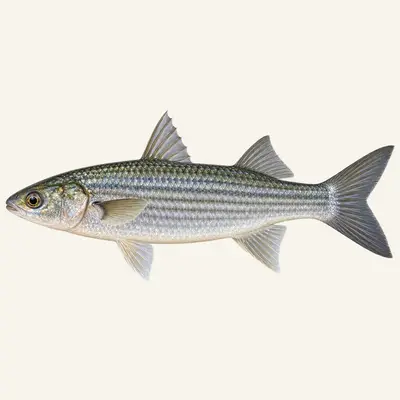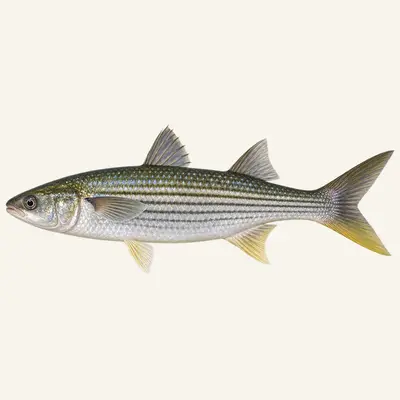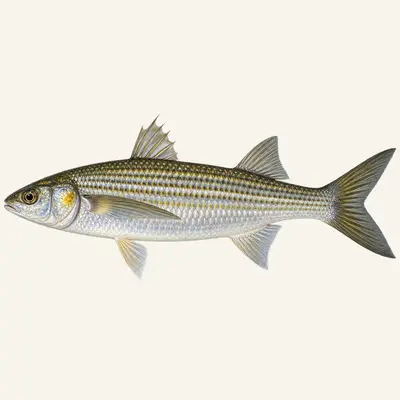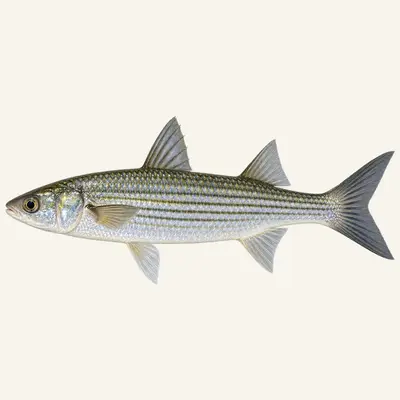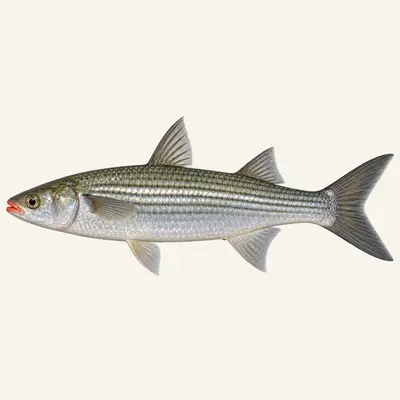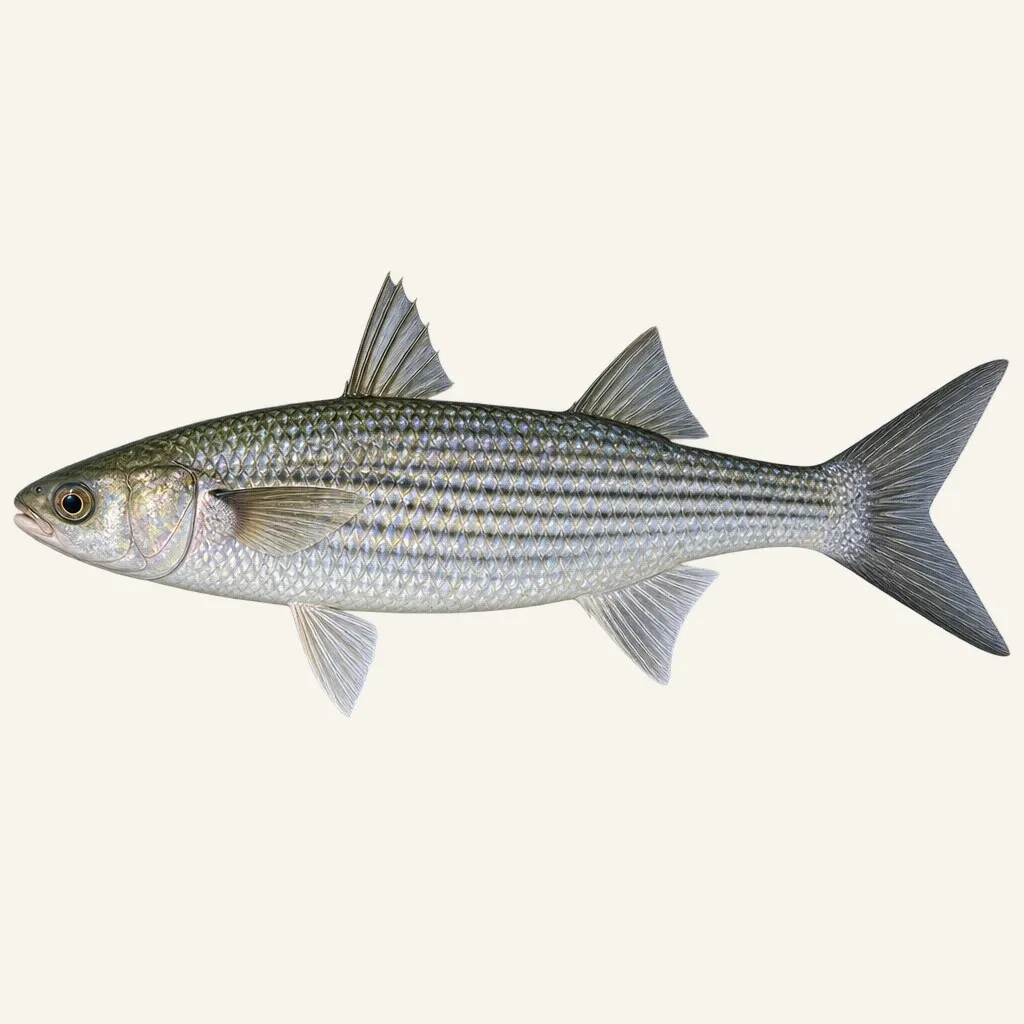
White mullet
Mugil curema · Mugilidae
- Saltwater
- Coastal
- Medium
- Size
30–91 cm
- Weight
0.3–0.7 kg
- Depth
0–300 m
Where to fish
- Estuary
Habitat icons: Flaticon
Muddy bottoms of lagoons and estuaries. Sometimes moves up into rivers.
Calendar
Recorded in 29 countries
Bahamas · Barbados · Belize · Benin · Bermuda · Brazil · Canada · Colombia · Costa Rica · Côte d’Ivoire · Cuba · Curaçao · Ecuador · El Salvador · French Guiana · Guadeloupe · Guatemala · Honduras · Martinique · Mexico · Nicaragua · Panama · Peru · Puerto Rico · Senegal · Trinidad & Tobago · U.S. Virgin Islands · United States · Venezuela
GBIF occurrence records — native and introduced populations combined.
Its range
Three seaboards across two oceans. In the western Atlantic the species runs from Nova Scotia to Argentina, becoming uncommon north of Cape Cod. In the eastern Atlantic it holds the coast from the outflow of the Senegal River south to Namibia. In the eastern Pacific it occupies the stretch from the Gulf of California to Chile.
Those populations do not produce the same fish, and the difference is large enough to matter. Eastern Atlantic specimens commonly run to about 25 cm; western Atlantic ones reach roughly three times the length their eastern counterparts manage at the top end. A size reference taken on one coast is worthless on the other, and the headline weight published for the species reflects only the smaller of the two formats.
Identifying it
The anal fin formula changes as the fish grows, and that single fact is the main hazard attached to this species. An adult shows three spines and nine soft rays, very rarely 10. A juvenile shows two spines and 10 rays. A key worked through without first noting the size of the specimen in hand will therefore arrive at the wrong genus, let alone the wrong species, and the error is built into the animal rather than into the observer.
The upper lip is the field character. It is thicker and deeper than in most of the Mugil mullets, and it carries two or three rows of teeth: those in the outer row are curved, single-pointed and set anywhere from moderately close to widely spaced, with a row of smaller ones sometimes present just behind. The lower lip has one row only, its teeth smaller than the outer uppers.
Against the flathead grey mullet, with which it shares the fatty eyelid over the pupil and the whole silhouette, three measurements decide. A vertical dropped from the hind end of the upper jaw falls halfway between the rear nostril and the front of the eye, which is further forward. The first dorsal begins at equal distance from the snout and from the tail base, rather than nearer the snout. And only 11 to 13 scale rows lie between the first dorsal origin and the pelvic origin.
Two features finish the description. The axillary process above the pectoral fin is strongly developed, running to 30 or even 37 per cent of the length of that fin. And the second dorsal and the anal are covered with scales over their whole extent, more or less densely — not over the forward part alone.
Head broad, interorbital space flat, body stout and round in section.
Breeding
Spawning runs from March through August. A female releases several million pelagic, non-adhesive eggs, and the notable thing about them is the size of the yolk supply each one carries. A large yolk buys time: a larva provisioned that way can drift for longer before it has to find its first meal, which suits a species whose eggs are shed into open water and left there.
Maturity is early, at around 20 cm — a little over half the length at which the flathead grey mullet begins to breed. Juvenile growth is described as moderate, reaching 30 to 40 cm in four years.
The water it needs
Sandy coasts and littoral pools, and equally the muddy floors of brackish lagoons and estuaries. Rivers are entered from time to time.
It is also found on coral reefs, which is worth registering as a positive fact about this mullet rather than as a contrast. A grazer that works hard substrate as well as sediment has a second set of surfaces available to it, and a film of algae grows on coral rock as readily as it settles on sand.
The recorded depth range reaches 300 m against an ordinary working band of nought to 20 — an extraordinary figure for a fish of this kind, and one that says more about the occasional stray than about where the species spends its time.
Juveniles swarm in coastal water and make their way into estuaries and coastal lagoons. Adults go about in schools.
Areas
- Mangroves and channels
- Sheltered bays
- River mouths
- Sandy coastal areas
Techniques
- Float fishing
- Light ledger fishing
- Cast net fishing
- Bread fishing
Baits
- Bread crumb
- Sea algae
- Chopped shrimp
- Sandworm
- Marine flavored paste
What it eats
Microscopic and filamentous algae, with the small juveniles of planktonic organisms taken as well.
The word filamentous is the informative one. An animal cropping strands rather than swallowing sediment is working a surface it can see and grip, which puts the emphasis on the rasping edge of the mouth and explains the curved outer teeth of the thickened upper lip. Diet and dentition describe the same action from two directions.
How to catch it
An inshore fish of modest format, living where the surf breaks over sand and in the pools it leaves behind. A common length of 30 cm calls for fine diameters and short-shanked hooks; nothing about the tackle needs to allow for a large fish.
A school located is worked on the spot rather than searched past, since the adults are gregarious and the juveniles occupy the same coastal sectors in numbers. Salinity guides the search more usefully than depth does, from the full-strength water of open beaches to the freshened mud of a lagoon.
The eastern and western Atlantic formats also change what a session is for. On the African side, an ordinary fish of 25 cm is a bait or a pan fish. On the American side, the same species reaches a length that changes the answer.
Regulations
Check the local regulations in force (legal size limits, closed seasons, bag limits).
For guidance only. Legal sizes, quotas and open seasons vary by location and season: always check the local regulations in force before fishing.
Other names
White mullet in English, and silver mullet is in use for the same fish. Both names describe a colour that half the group shares, so neither is much help in the hand.
Spanish-speaking American fisheries say lebranche and lisa blanca; French mulet blanc. Lebranche is worth noting as a trap in its own right, since it is applied elsewhere to other mullets on the same coasts.
The epithet curema is not Latin. It was taken directly from a vernacular name used in tropical America and carried into the nomenclature unchanged, which makes it one of the few mullet names in the system that came from the fishermen rather than from the describers.
Sources: fishbase.se · api.gbif.org