Comber
Serranus cabrilla · Serranidae
- Saltwater
- Coastal
- Medium
- Size
25–40 cm
- Weight
0.1 kg
- Depth
5–500 m
Where to fish
- Rocky shore
Habitat icons: Flaticon
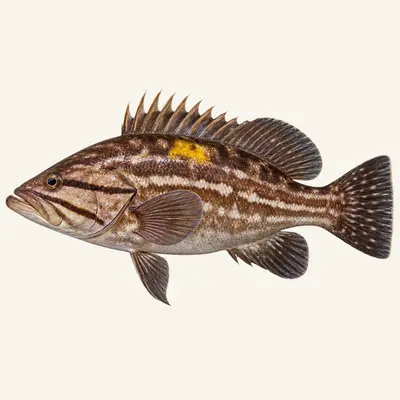
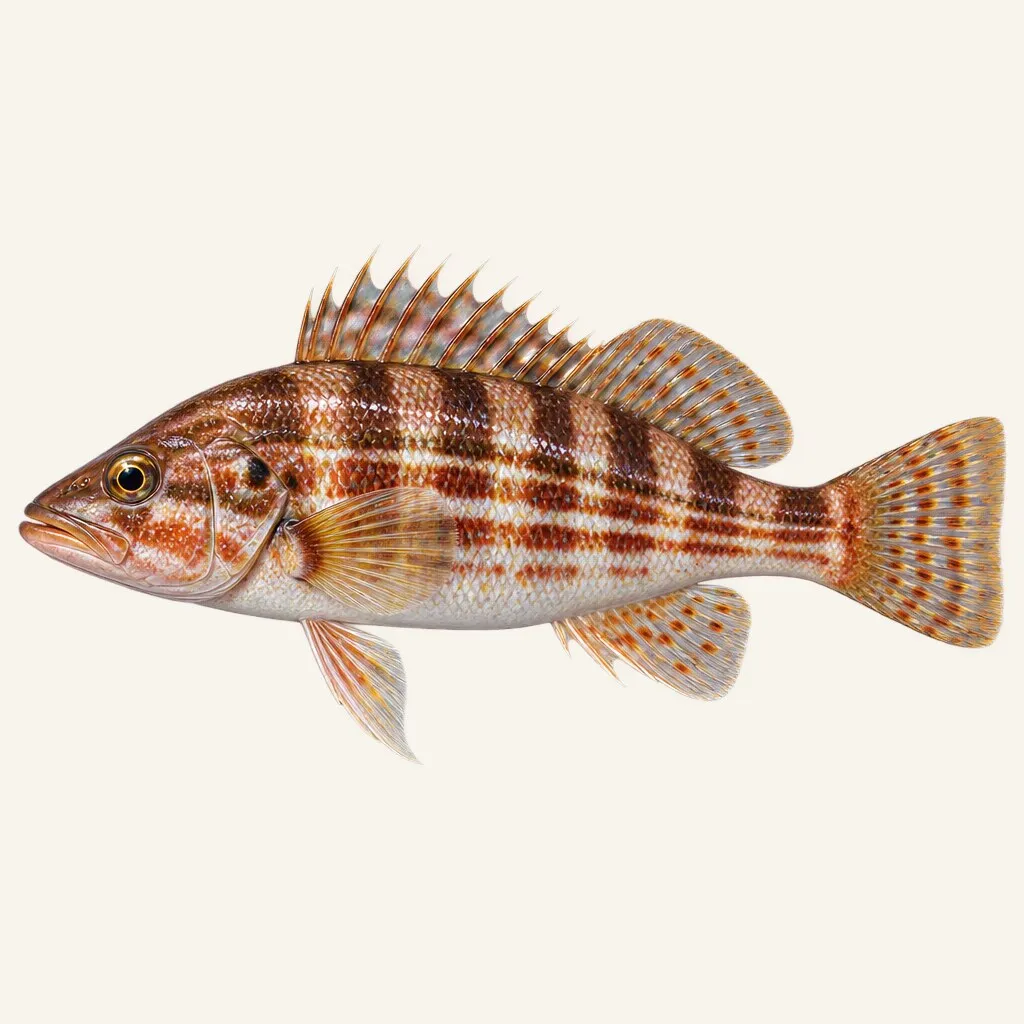
The comber is a small Mediterranean and Atlantic coastal serranid with an elongated body decorated by orange-rust longitudinal stripes alternating with bluish streaks. A simultaneous hermaphrodite like its relatives, it frequents mixed sandy-rocky bottoms down to 500 metres.
Calendar
Recorded in 23 countries
Algeria · Cameroon · Congo - Brazzaville · Côte d’Ivoire · Croatia · Equatorial Guinea · France · Gabon · Ghana · Greece · Guinea · Guinea-Bissau · Israel · Italy · Liberia · Montenegro · Nigeria · Portugal · Senegal · Sierra Leone · South Africa · Spain · Türkiye
GBIF occurrence records — native and introduced populations combined.
Its range
The range is remarkable for a fish of this size. It runs from the English Channel southward down the whole eastern Atlantic seaboard, round the Cape of Good Hope and on to Natal in South Africa, and it takes in the Azores, Madeira and the Canaries along the way. Add the Mediterranean and the western Black Sea. A presence in the Red Sea is recorded as possible rather than established.
That is 57 degrees of northern latitude to 35 of southern, in an animal of 25 cm — and the depth range is what makes it possible. A species that can live anywhere between 5 and 500 m has, at every latitude it reaches, some depth at which the water is the temperature it needs. It does not have to follow an isotherm along a coast; it can follow it downwards. Small demersal fish with narrow depth tolerances do not span 90 degrees of latitude, and this one does.
The upper thermal limit on record is 26 degrees, which is consistent with the same reading: in the warmest parts of the range the fish is not at the surface.
Identifying it
Depth is the most reliable character this fish has, and it is a strange thing to say about identification. The recorded band runs from 5 m all the way to 500, where its shallow congener the painted comber stops at 150. Any comber brought up from the upper slope is therefore this species by elimination, and no examination is required to say so.
In the hand, the counts are available here in a way they are not for its relative: 10 dorsal spines with 13 to 15 soft rays, and an anal fin of three spines and seven or eight rays. That anal ray count is low, and it is the sort of figure worth taking on a specimen that cannot be placed by anything else. The body is fusiform, and an ordinary fish measures around 25 cm.
Breeding
Fertility arrives at about 13.7 cm, roughly half the length of an ordinary fish and earlier than in the painted comber.
The genus is characterised by simultaneous hermaphroditism, one individual carrying working ovarian and testicular tissue at once. The record consulted here states that for its shallow-water congener rather than for this species, so it is set down as the genus's arrangement and not as a demonstrated fact about this fish.
If it holds, this is the species where it pays best. Individuals scattered from the shelf down to 500 m over sand, mud and rock meet each other far less often than fish crowded onto a shallow reef do, and the whole value of carrying both sets of gonads lies in making any encounter a usable one. The arrangement matters most exactly where the population is thinnest.
The water it needs
Shelf and upper slope, over rock, over Posidonia beds, over sand and over mud. Four substrate types, and no preference stated among them.
That indifference is worth stating plainly, because it removes substrate from the list of things to look for. Bare sand and open mud are on the list alongside rock, which is what a species occupying the slope has to accept: there is not much rock down there, and a fish that required it could not use the depth range this one has.
Areas
- Coastal rocky bottoms
- Seagrass beds
- Sandy bottoms
- Small drop-offs
Techniques
- Bottom fishing
- Cast and retrieve with soft lure
- Handline fishing
- Vertical fishing
Baits
- Marine worms
- Shrimp
- Small squid
- Soft lures
What it eats
Adults take fishes, cephalopods and crustaceans.
The cephalopods are the entry worth stopping on, because the published diet of the shallow-water painted comber records only fish and crustaceans. Squid and small octopus are the kind of prey the deeper part of this range supplies, and a diet that names them fits an animal working ground well below the shelf.
How to catch it
There are effectively two fisheries here, in one species, and they have nothing in common.
On the shelf it is an incidental capture: a small predator on rock, seagrass and sand that takes a bait meant for something else, in the first tens of metres. From a boat over the upper slope it becomes a deliberate target on baited rigs, and at those depths a comber is very often what is on the hooks when they come up. Small hooks, and strips of fish or squid, cover both cases.
Maturity at under 14 cm settles the arithmetic on a capture: virtually every fish of catchable size has bred.
The species also feeds a commercial aquarium trade, which is a demand for small live fish rather than for food-sized dead ones — a different market, buying a different part of the population.
Regulations
Check the local regulations in force (legal size limits, closed seasons, bag limits).
For guidance only. Legal sizes, quotas and open seasons vary by location and season: always check the local regulations in force before fishing.
Other names
Comber, plain and unqualified, is this fish in English. The related painted comber carries the modifier, which means the shorter name is the more specific of the two — the reverse of the usual arrangement, and a frequent source of error in catch reports where the adjective has been dropped as redundant.
Spanish cabrilla is the source of the scientific epithet: a vernacular name lifted into the nomenclature unchanged, as happened to a number of southern European fish described early.
That word has since travelled and become a problem. In Mexico and along the Pacific coast of the Americas cabrilla is applied to entirely unrelated fish — the sand basses of the genus Paralabrax, and various groupers — so a Spanish-language record using it says almost nothing on its own about which animal was caught. French serran commun, Italian perchia.
Sources: fishbase.se · api.gbif.org